

Technology Insurance & Professional Liability Coverage
A software bug can stop a client’s sales. A failed system setup can delay a launch. Poor IT advice can lead to lost revenue. When a client says a technology product or service caused financial harm, a standard business liability policy may not address the claim.
Technology Insurance & Professional Liability Coverage helps technology businesses manage risks tied to their products, services, advice, systems, and client work. One important part of that protection is technology errors and omissions insurance, often called technology E&O or Tech E&O.
Coverage differs by insurer and policy. Definitions, exclusions, limits, endorsements, contracts, and the facts of a claim can all affect whether insurance responds. Travelers notes that actual coverage depends on policy terms, claim circumstances, and applicable law.
What Is Technology Insurance?
Technology insurance is a broad term for business insurance designed around risks faced by software companies, IT firms, cloud providers, hardware businesses, consultants, and other technology companies.
It may include technology professional liability insurance, cyber insurance, general liability, commercial property, workers compensation, directors and officers insurance, and other business coverage.
Technology insurance is therefore better viewed as a group of policies selected for a company’s risks rather than one policy that covers everything.
What Is Technology Professional Liability?
Technology professional liability covers certain claims involving mistakes or alleged failures in technology products or professional services.
It is commonly called technology errors and omissions insurance. The Insurance Information Institute explains that professional liability can address claims involving negligence, misrepresentation, and inaccurate professional advice that may fall outside general liability coverage. IT consultants and software developers are among the professions that may consider it.
For a technology business, a claim might begin with a software defect, failed implementation, missed deadline, system outage, or advice that allegedly caused a client financial loss.
Is Technology E&O the Same as Professional Liability?
Technology E&O is generally a form of professional liability written for technology related work.
The Hartford also describes technology professional liability insurance as Technology E&O insurance. Still, the policy wording matters more than the label.
Some insurers combine E&O with cyber, privacy, network security, or media coverage. Two policies with similar names can therefore provide different protection.
Who Needs Insurance for Technology Work?
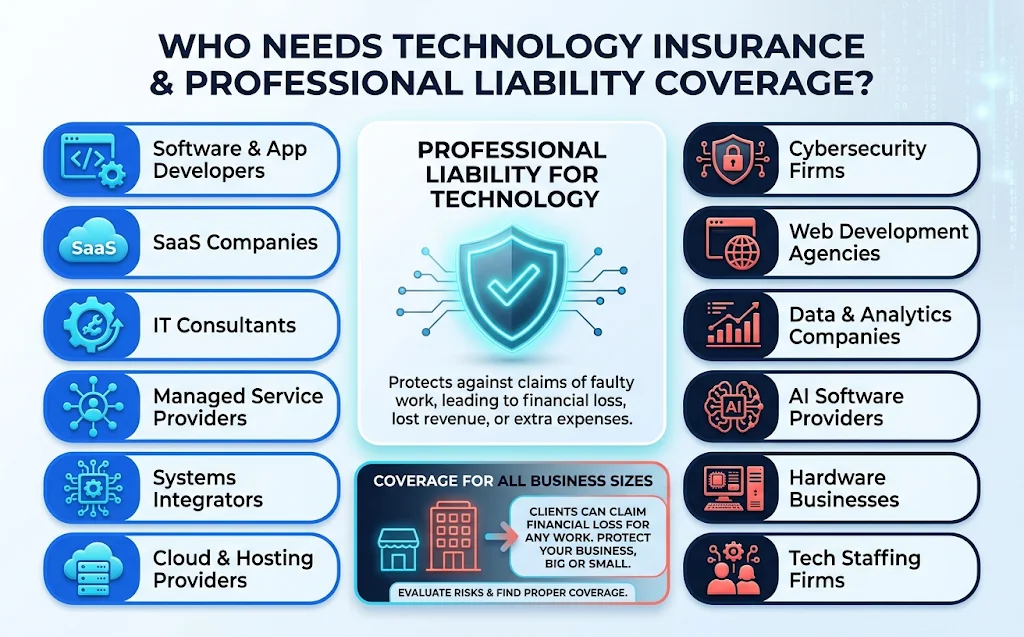
A business should consider professional liability when clients rely on its technology, services, or advice and a mistake could cause financial loss.
Businesses that may have this exposure include:
- Software and application developers
- SaaS companies
- IT consultants
- Managed service providers
- Systems integrators
- Cloud and hosting providers
- Cybersecurity firms
- Web development agencies
- Data and analytics companies
- AI software providers
- Hardware businesses
- Technology staffing firms
A small technology company can face the same type of allegation as a larger provider. The possible financial loss may differ, but clients can still claim that faulty work caused lost revenue or added expenses.
What Does Technology Professional Liability Cover?
Technology professional liability insurance may respond when a client claims that a covered technology product, service, error, omission, or professional failure caused financial harm.
Software Errors and Product Failures
A client might claim that software contained faulty code, produced incorrect results, corrupted data, or failed to perform as promised.
The Hartford gives examples involving software glitches, failed equipment, unsuccessful data backup, and other technology failures that cause client losses.
Failed Technology Services
An IT provider might be accused of installing the wrong system, configuring software incorrectly, or failing to complete agreed work.
Insureon lists errors, delayed services, undelivered IT services, breach of contract allegations, and certain cyber related claims among exposures that may arise for technology firms.
Missed Deadlines
A delayed software release or implementation can become a liability issue if a customer claims that the delay caused lost sales or other financial harm.
Contract claims need careful review because a policy may not insure every promise made in an agreement.
Negligent Advice
Technology consultants can face claims when clients allege that recommendations, security work, system design, or other professional advice caused loss.
Defense Costs and Damages
Depending on the policy, covered costs may include attorney fees, court expenses, settlements, and judgments.
Some policies count defense expenses within the liability limit. If so, legal costs can reduce the amount remaining for a settlement or judgment.
What Technology E&O May Not Cover
Understanding exclusions is essential when comparing policies.
Bodily Injury and Property Damage
These claims are commonly associated with general liability rather than technology E&O.
Employee Injuries
Work related employee injuries are generally handled through workers compensation.
A technology insurance company may offer workers compensation alongside other business policies, but it is separate from technology professional liability coverage.
Intentional or Dishonest Conduct
Professional liability generally does not protect deliberate fraud or intentional wrongdoing. The Insurance Information Institute also identifies intentional and dishonest acts as typical limitations.
Some Contract Obligations
A client agreement may promise uptime, refunds, warranties, delivery dates, indemnification, or performance levels beyond what an insurer agreed to cover.
Companies should compare customer contracts with the policy definition of professional services and its contractual liability terms.
Some Intellectual Property Claims
Patent, copyright, trademark, trade secret, and media claims can receive different treatment across policies.
Some forms include limited protection while others exclude these claims. Do not assume technology liability insurance automatically includes every intellectual property dispute.
Tech E&O vs Cyber Insurance
Tech E&O and cyber insurance can overlap, but their main purposes differ.
Technology E&O focuses mainly on claims that a technology product, service, or professional failure caused a client financial loss.
Cyber insurance may address data breaches, ransomware, network attacks, incident response, data recovery, privacy claims, and certain business interruption losses.
Some insurers combine the two because one event can create both professional liability and cyber exposures.
| Scenario | Tech E&O | Cyber Insurance |
| Software error causes client loss | Often relevant | Sometimes |
| Negligent IT advice causes loss | Often relevant | Usually not primary |
| Data breach | May overlap | Often relevant |
| Ransomware attack | Usually not primary | Often relevant |
| SaaS outage causes client loss | Often relevant | Depends on cause |
Actual coverage depends on the policy and facts of the claim.
Tech E&O vs General Liability Insurance
Technology E&O and general liability address different types of claims.
Tech E&O is designed around professional mistakes and technology services that allegedly cause financial harm. General liability usually focuses on bodily injury, physical property damage, and certain personal or advertising injury claims.
For example, if faulty software causes a customer to lose revenue, Tech E&O may be the relevant policy. If a visitor slips and is injured at a software company’s office, general liability is more likely to be relevant.
A technology business may need both because one does not replace the other.
How Claims Made Technology E&O Works
Technology businesses should understand how claims made coverage works before buying a policy.
The Insurance Information Institute identifies claims made and occurrence as two major professional liability policy forms. Most professional liability policies are written on a claims made basis.
With claims made coverage, the timing of the claim and the policy terms matter. A business may also need continuous coverage for earlier work to remain protected.
Check the Retroactive Date
A retroactive date sets a boundary for earlier services.
A claim filed today might involve work completed years ago. If that work occurred before the applicable retroactive date, the policy may not respond.
Avoid Coverage Gaps
Businesses changing insurers should check how the new policy treats prior work.
They should also ask about prior acts coverage and any extended reporting period available after a claims made policy ends.
Policy Terms Worth Reading Closely
The liability limit is only one part of a technology E&O policy.
Professional Services Definition
The policy should accurately describe what the company does.
A SaaS business might develop software, host data, integrate APIs, provide implementation support, and offer consulting. A narrow definition could leave some activities outside the intended coverage.
Defense Costs
Check whether defense expenses reduce the policy limit.
A $1 million limit does not always mean the full $1 million remains available for damages if legal expenses are paid from the same limit.
Contractual Liability
Compare policy terms with customer agreements, statements of work, service level agreements, and indemnification clauses.
A contract can create obligations broader than the insurer agreed to cover.
Contractors and Vendors
Technology businesses often depend on independent developers, cloud platforms, security vendors, or subcontractors.
Check how the policy treats work performed by others on the company’s behalf.
Technology Risks That Need Extra Review
Technology risks continue to change as companies use AI tools, cloud infrastructure, APIs, outside vendors, and open source software.
AI products can produce incorrect output. APIs can fail. Cloud services can become unavailable. Open source components can raise licensing disputes. A third party outage can also prevent a company from meeting a client obligation.
These situations do not automatically fall within technology errors and omissions coverage. The policy and client contract must be reviewed.
Startups receiving technology grants and industry support programs should also check funding and project agreements for required insurance limits, indemnification clauses, or certificates of insurance before starting funded work.
How Much Does Technology E&O Insurance Cost?
There is no fixed market price for technology professional liability insurance.
Insureon currently reports an average cost of about $67 per month for its technology customers purchasing professional liability coverage. The Hartford publishes an average minimum monthly premium of $146 for its technology E&O product.
Those figures are not universal quotes. They come from different insurers, policy structures, customer groups, and underwriting methods.
Premiums can vary based on:
- Annual revenue
- Services provided
- Business size
- Client industries
- Contract values
- Claims history
- Coverage limits
- Deductible or retention
- Cyber exposure
- Security controls
Businesses should compare actual quotes rather than using an online average as an expected price.
How Much Coverage Should a Tech Company Buy?
There is no liability limit that suits every technology company.
A business should consider its client contracts, largest projects, possible client financial losses, legal defense exposure, revenue, industry, and existing insurance.
Enterprise customers may also require a specific E&O limit before signing a contract.
A small software consultant serving local businesses can have very different exposure from a cloud company supporting hospitals or financial institutions.
Common Technology E&O Buying Mistakes
Choosing a Policy Only by Price
A low premium has little value if the policy does not cover the professional services the company actually performs.
Assuming General Liability Is Enough
General liability and professional liability address different risks. Technology companies providing software or professional services should not assume a standard general liability policy covers errors in their work.
Ignoring Cyber Exposure
The same event can create both cyber and professional liability claims.
A security flaw in software, for example, could lead to a data breach and also prompt a customer to allege negligent technology services.
Forgetting Past Work
Companies changing claims made policies should review retroactive dates, prior acts coverage, and reporting requirements before canceling existing coverage.
How to Reduce Professional Liability Risk
Insurance works best alongside sensible business controls.
Use clear scopes of work. Define deliverables and client responsibilities. Record approvals and project changes. Test software before release. Review service level commitments. Keep incident records. Assess outside vendors. Train staff. Use qualified legal counsel when contracts create large financial obligations.
These practices cannot prevent every claim, but they can reduce avoidable disputes and create better records when disagreements occur.
Frequently Asked Questions
What does technology professional liability cover?
It may cover eligible claims alleging that technology products, services, errors, omissions, or professional advice caused financial harm. Depending on the policy, covered expenses may include legal defense, settlements, and judgments.
What does technology insurance cover?
Technology insurance can include professional liability, cyber insurance, general liability, property insurance, workers compensation, management liability, and other policies. The right combination depends on the company’s operations and risks.
Is technology E&O the same as professional liability?
Technology E&O is generally a type of professional liability insurance designed for technology products and services. Policy definitions and exclusions can differ between insurers.
What does professional liability coverage include?
Professional liability may address covered claims involving negligence, mistakes, omissions, misrepresentation, or inaccurate professional advice. The exact scope depends on the policy.
What is not covered under professional liability insurance?
Common limitations may include intentional wrongdoing, employee injury, bodily injury, physical property damage, employment disputes, and some contractual or intellectual property claims. Exclusions differ by policy.
Do I really need professional liability insurance?
A technology business should consider it when clients depend on its professional work and a mistake could cause financial loss. Some client contracts also require evidence of E&O coverage before work begins.
Conclusion
Technology Insurance & Professional Liability Coverage can help a technology company manage claims arising from professional mistakes, failed services, software problems, and other covered exposures. It does not replace cyber, general liability, workers compensation, or every other business policy.
Before buying coverage, review what the company sells, what its contracts promise, how a client might suffer financial loss, and how existing policies work together.
Pay close attention to professional services definitions, exclusions, defense costs, limits, retroactive dates, prior acts coverage, and contractual obligations. Policy wording matters more than the product name alone.


