

Investment Banking Technology & Financial Market Innovation
Investment banking once depended heavily on phone calls, spreadsheets, manual research, separate databases, and long approval chains. Those tools still exist, but banks now use technology across deal making, capital raising, trading, risk management, compliance, and settlement.
Investment Banking Technology & Financial Market Innovation now includes artificial intelligence, data platforms, cloud computing, APIs, electronic trading, automation, cybersecurity, distributed ledger technology, and tokenized assets.
McKinsey identifies AI, digital assets, nonbank competition, and changes in financing markets as important forces affecting corporate and investment banking. J.P. Morgan’s 2026 electronic trading survey, based on 955 institutional traders across 59 locations, also shows how technology is affecting institutional markets.
The real issue is not whether banks will use more technology. It is where technology improves results, where human judgment still matters, and how firms control the risks created by faster and more automated financial systems.
What Is Investment Banking Technology?
Investment banking technology is the software, data, infrastructure, and digital tools used to support investment banking and capital market activities.
It helps bankers research companies, manage client relationships, value businesses, review documents, prepare transactions, execute trades, monitor risk, meet compliance rules, and process transactions after execution.
A bank may use a customer relationship management system for deal sourcing, market data for valuation, AI for document search, trading software for execution, and automated systems for settlement.
Technology Is Not the Same as Technology Banking
These two terms describe different subjects.
| Term | What It Means | Examples |
| Investment banking technology | Technology used by banks and capital market firms | AI, trading systems, APIs, data platforms |
| Technology investment banking | Banking services for technology companies | M&A advice, IPOs, debt and equity raising |
A technology investment banker may advise a software company on an acquisition. Investment banking technology refers to the systems that banker and the wider institution use to complete financial work.
Why Banks Are Investing in Better Technology
Investment banks process large amounts of financial, legal, market, and client information.
A deal team may need company filings, comparable company data, transaction records, market prices, legal documents, research, and internal client history at the same time. A trading desk may need current prices and liquidity information within seconds.
Many banks also operate systems built at different times for different business units. Moving information between them may require manual checks and repeated reconciliation.
Technology can make data easier to access while keeping controls around who can view, change, or use it.
McKinsey’s recent corporate and investment banking research argues that banks need to move AI beyond isolated experiments and into business processes where results can be measured.
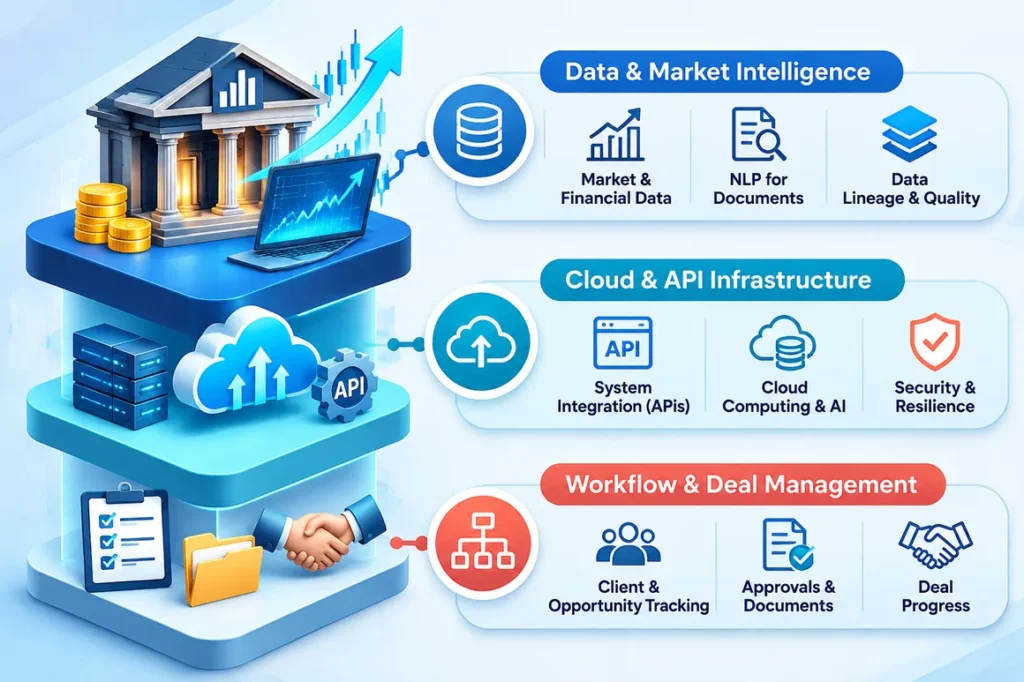
The Modern Investment Banking Technology Stack
It is easier to understand the technology stack as several connected layers.
Data and Market Intelligence
Banks use company financials, market prices, transaction histories, credit information, economic data, research, news, and internal client records.
Alternative data can add other signals, such as payment activity, supply chain information, web activity, or legally obtained external data.
Natural language processing can help search filings, earnings calls, research reports, and large document collections.
Banks also need data lineage, which simply means knowing where data came from, how it changed, and which system currently owns it. Poor data can weaken every tool built on top of it.
Cloud and API Infrastructure
Older bank systems often store information separately.
An API, or application programming interface, is a controlled way for software systems to exchange information. APIs can reduce manual copying between systems and help connect older infrastructure with newer applications.
Cloud services provide computing capacity, storage, development tools, and AI infrastructure. Many banks use cloud systems alongside existing internal technology rather than moving everything to one platform.
That flexibility comes with security, resilience, vendor, and concentration risks.
Workflow and Deal Management Systems
Bankers need tools that track clients, opportunities, approvals, documents, and deal progress.
Connected workflows can reduce repeated data entry and make responsibilities clearer.
Technology works best when it removes repetitive work without hiding important decisions from the people responsible for them.
How AI Is Changing Investment Banking
Financial firms have used machine learning for years in fraud detection, surveillance, trading, and risk analysis.
Generative AI adds the ability to work with natural language, summarize documents, search large knowledge bases, draft content, and help users interact with financial data.
The Financial Stability Board also warns that financial institutions must manage model risk, data quality, cybersecurity, and dependence on outside technology providers.
Research and Information Retrieval
Bankers spend significant time finding information.
AI assisted search can help locate internal research, company documents, industry information, transaction records, and approved knowledge.
The benefit is speed. The risk is trusting a generated answer without checking the underlying source.
For important financial work, the original evidence still matters more than the summary.
Deal Sourcing and Client Coverage
Technology can organize company information, ownership data, transaction history, industry events, and client interactions.
AI can help screen large groups of companies and identify patterns that deserve further research.
It cannot decide on its own which company should be approached or how a client relationship should be managed. Senior bankers still rely on timing, industry knowledge, trust, and judgment.
Valuation and Financial Modeling
AI can assist with data collection, formula checks, scenario preparation, and research used in valuation.
It can also let users query some financial information in plain English.
Valuation still depends on assumptions about growth, margins, risk, comparable companies, market conditions, and deal structure. Those assumptions require human review.
Pitchbooks and Documents
Generative AI can help prepare first drafts, summarize source material, organize notes, and find information for presentations.
Client materials may contain confidential information and material financial claims. Banks therefore need controls around approved models, access rights, recordkeeping, and review.
Due Diligence
M&A and capital raising processes can involve large collections of contracts, financial records, legal documents, and operating information.
Document tools can classify files, extract clauses, compare versions, and flag items for review.
The software can narrow the search. Bankers, lawyers, accountants, and company management still need to decide what the findings mean.
From AI Assistants to AI Agents
An AI assistant responds to a user’s request.
An AI agent can perform several connected tasks, such as gathering approved information, running defined analysis, updating a workflow, and preparing an output for review.
McKinsey identifies agent based AI as one area that could affect corporate and investment banking. Banks using such systems need permissions, monitoring, limits, audit records, and clear human responsibility.
BNY provides a current institutional example. The bank says it has more than 125 AI enabled solutions in production as well as its own enterprise AI platform.
Automation Across the Deal Lifecycle
Technology can support almost every stage of a transaction.
| Banking Activity | Technology Use | Main Benefit | Key Control |
| Deal sourcing | Data screening and CRM | Faster research | Data quality |
| Valuation | Analytics and AI assistance | Less manual work | Assumption review |
| Due diligence | Document analysis | Faster review | Human verification |
| M&A execution | Workflow tools | Better coordination | Approval controls |
| Equity raising | Data and syndication tools | Faster information flow | Disclosure review |
| Debt raising | Pricing and market data | Better market visibility | Risk review |
| Compliance | Monitoring and automation | Faster checks | Governance |
| Reporting | Automated data flows | Fewer manual steps | Data reconciliation |
Technology also supports different workflows in equity and debt capital markets. ECM, or equity capital markets, tools support IPOs, follow on share offerings, investor demand, pricing, and syndication. DCM, or debt capital markets, tools support bond issuance, credit analysis, pricing, order books, and debt syndication.
The best automation targets repeated tasks with clear rules.
Negotiation, client trust, unusual deal structures, and major financial judgments remain much harder to automate safely.
Electronic Trading Is Changing Market Structure
Financial market innovation extends beyond advisory work.
Trading has become more electronic across equities, foreign exchange, fixed income, and other institutional markets.
J.P. Morgan’s 2026 survey found that respondents expected about 60 percent of trading activity to go through electronic channels in 2026 and about 70 percent in 2027.
Electronic systems can improve access to prices, execution analysis, speed, and the ability to process many smaller trades.
Algorithms can help determine when and where orders are executed. Execution platforms connect traders with markets and provide tools for order handling and analysis.
Human traders still matter.
Large, complex, illiquid, or unusual trades may require judgment that cannot be reduced to a standard algorithm. J.P. Morgan’s 2026 research notes that voice trading remains useful for larger or harder to source transactions.
Data Is Becoming Part of the Product
Banks once treated data mainly as a record of past activity.
Today it supports pricing, risk analysis, client coverage, research, execution, and product design.
Modern systems may use APIs, shared data services, cloud infrastructure, real time processing, and access controls rather than requiring every business unit to maintain separate copies of the same information.
This also matters to investors studying Technology Investing, Portfolio Management & Planning. A company that spends heavily on technology does not automatically create more value. Investors need to examine what that spending produces.
The same rule applies to banks.
A new system creates little value if employees do not use it, the data cannot be trusted, or workers still need manual processes around it.
Tokenization Is Moving Toward Market Infrastructure
Tokenization means recording a financial claim or asset on a programmable digital platform.
It can apply to securities, funds, deposits, bonds, and other financial assets.
Its potential comes from linking ownership records with rules for transferring an asset. This could reduce some separate messaging, reconciliation, and settlement steps.
The Bank for International Settlements has studied tokenized central bank money, commercial bank deposits, government securities, and other assets as parts of possible future financial infrastructure.
The U.S. market is also testing more practical applications.
DTCC announced in May 2026 that more than 50 financial industry firms were working with it on a DTC tokenization service. The group includes banks, asset managers, custodians, brokers, trading firms, and technology providers.
Tokenization does not automatically replace today’s infrastructure.
Questions remain around legal rights, custody, liquidity, privacy, interoperability, standards, regulation, and operational risk.
Interoperability means the ability of different systems or networks to work together and exchange information correctly.
Settlement Technology Has Become More Important
A trade is not finished when a buyer and seller agree on a price.
Securities must still be confirmed, matched, cleared where necessary, and settled.
The United States moved most broker dealer securities transactions from T plus 2 settlement to T plus 1 on May 28, 2024.
Shorter settlement leaves less time to find and fix errors.
That increases the importance of accurate settlement instructions, automated matching, clean reference data, and straight through processing, which means moving a transaction through processing steps with little or no manual reentry.
DTCC says its post trade tools are being used to support T plus 1 obligations. Its CTM platform also processed more than 30 million cash securities transactions across EMEA markets in 2025.
Settlement technology receives less public attention than AI, but it directly affects market efficiency and operational risk.
Cybersecurity and Resilience Remain Core Requirements
Connecting more systems can improve efficiency while creating more points where failures matter.
Banks must protect client information, trading systems, models, credentials, communications, and financial market infrastructure.
AI creates additional concerns.
The Financial Stability Board identifies cyber risk, model risk, poor data quality, third party dependence, and provider concentration among the vulnerabilities linked to AI adoption.
Banks therefore need rules for:
- Who can access sensitive information
- Which models can be used
- What actions automated systems may take
- When human approval is required
- How decisions are logged
- How systems are tested
- What happens if a provider or model fails
The aim is not maximum automation. It is controlled automation that remains accountable.
How Banks Should Measure Technology Value
Technology budgets do not create value on their own.
Banks should connect technology projects with operating results.
| Technology Change | Operating Measure | Business Result |
| Document automation | Review time | Faster deal work |
| Better data integration | Fewer reconciliations | Lower processing cost |
| Electronic execution | Execution speed | Better workflow efficiency |
| AI search | Research time | More banker capacity |
| Compliance automation | Review time | Better control efficiency |
| Cloud infrastructure | Deployment speed and uptime | Faster system delivery |
Useful measures include time saved, error rates, automation rates, processing cost, system availability, deal cycle time, adoption, and compliance exceptions.
Banks should then ask whether those improvements affect revenue, risk, client retention, return on capital, or operating cost.
Related analysis of Alternative Technology Investments & Market Trends can extend this question beyond banks by examining where investment is moving across AI infrastructure, financial software, digital assets, and other technology themes.
Risks of Financial Market Innovation
New technology can solve one problem while creating another.
Model Errors
AI systems can produce incorrect answers or use weak inputs.
A confident answer is not proof that it is correct.
Confidentiality
Investment banks hold market sensitive and client confidential information. Moving that information into an unapproved system can create legal, regulatory, and security problems.
Technology Concentration
Many financial firms rely on a relatively small group of cloud, data, model, and infrastructure providers.
A major outage at one provider could affect many firms at once.
Market Behavior
If many automated systems react to similar information in similar ways, they may increase correlation or stress during unusual market conditions.
Legacy Integration
A modern user interface does not remove the problems inside an old back end system.
Banks often need to modernize technology while keeping critical services running.
Regulation and Accountability
A bank remains responsible for regulated activity even when software performs part of the work.
Automation still requires clear ownership.
A Practical Technology Opportunity Matrix
| Technology | Current Maturity | Main Use | Main Risk |
| Cloud computing | High | Infrastructure and data | Provider concentration |
| APIs | High | System connectivity | Security and access |
| Workflow automation | High | Repeated processes | Poor process design |
| Machine learning | High in selected uses | Risk and analytics | Model risk |
| Generative AI | Scaling | Research and knowledge work | Accuracy and confidentiality |
| AI agents | Early to scaling | Connected workflows | Control and accountability |
| Electronic trading | High in many markets | Execution | Operational and market risk |
| Tokenization | Emerging | Asset infrastructure | Standards and interoperability |
| DLT | Emerging | Shared records and settlement | Integration and governance |
The right tool depends on the problem being solved.
Banks should not adopt technology simply because competitors are discussing it.
Reading Financial Technology News Carefully
Financial technology search results include regulators, major banks, research firms, specialist publishers, and small websites.
Source quality therefore matters.
A search for ftasiatrading technology news by fintechasia may return articles about AI, blockchain, trading systems, cybersecurity, or payments. Claims from smaller publishers should be checked against regulators, exchanges, banks, or market infrastructure providers before they are used for financial decisions.
The same caution applies to ftasiafinance technology. The phrase appears in general finance and technology content, but it is not a recognized financial market standard or regulated technology category.
What to Watch in Investment Banking Through 2026
Several developments deserve close attention.
Banks are moving generative AI and agent based systems from experiments into controlled business processes.
Institutional trading continues to become more electronic. J.P. Morgan’s survey also identifies generative AI, machine learning, natural language processing, and API integration among technologies expected to affect trading.
Digital asset infrastructure is becoming more connected with established financial institutions. Tokenized assets were also a major digital asset opportunity identified by respondents in J.P. Morgan’s 2026 trading survey.
Post trade automation matters more as settlement cycles shorten.
Technology governance is becoming just as important as technical ability. Banks need to know what a system can do, what information it uses, and who is responsible for its actions.
These changes also matter to Technology Investment Funds: Mutual Funds, Private Equity & Venture Capital, where investors need to separate durable financial technology businesses from temporary market themes.
Frequently Asked Questions
What is investment banking technology?
Investment banking technology includes software, data, AI systems, trading platforms, cloud infrastructure, workflow tools, and risk systems used for deal making, capital raising, trading, compliance, and post trade processing.
What are current technology trends in investment banking?
Major 2026 trends include generative AI, agent based systems, workflow automation, electronic trading, cloud and API modernization, improved data infrastructure, tokenization, cybersecurity, and automated post trade processing.
Will AI replace IB analysts?
AI is more likely to change analyst work than remove the role. It can reduce time spent on research, document review, information retrieval, and first drafts. Analysts still need accounting knowledge, financial judgment, communication skills, and transaction knowledge.
How does tokenization affect capital markets?
Tokenization can place financial claims on programmable platforms and may connect ownership, transfer rules, and settlement more directly. Wider use still depends on legal clarity, custody, interoperability, liquidity, regulation, and reliable infrastructure.
What are the emerging trends in banks for 2026?
Major trends include AI adoption, agent based workflows, cloud modernization, cyber resilience, tokenization, digital assets, API connectivity, automation, and stronger technology governance.
Other Investment Banking Questions
Is there a future in investment banking?
Yes. Companies will still need advice on mergers, acquisitions, financing, restructuring, and capital raising. Technology is changing how the work is completed, especially repetitive research and document tasks.
What skills are needed for investment banking?
Important skills include accounting, corporate finance, valuation, financial modeling, Excel, presentation skills, business writing, attention to detail, and communication. Data literacy and responsible use of AI are becoming more useful.
Does Piper Sandler have a good reputation?
Piper Sandler is an established U.S. investment bank with a significant middle market presence. Reputation can differ by sector, office, team, and whether the question concerns employment, deal experience, or client service.
What is the big 4 for investment banking?
There is no official investment banking group called the Big Four. Big Four usually refers to Deloitte, PwC, EY, and KPMG. Large investment banks are more commonly described as bulge bracket banks.
What bank do most billionaires use?
There is no reliable public evidence that most billionaires use one bank. Very wealthy clients often divide assets and services across private banks, investment firms, custodians, family offices, and asset managers.
What college does J.P. Morgan hire from the most?
J.P. Morgan does not publish an official ranking naming one university from which it hires the most investment bankers. The firm recruits through universities, internships, analyst programs, apprenticeships, and other routes.
Conclusion
Investment Banking Technology & Financial Market Innovation is changing both bank workflows and the infrastructure beneath financial markets.
AI can reduce time spent on research and documents. Better data systems can cut repeated work. Electronic trading can improve execution. Tokenization may change how some assets and settlement processes are organized. Automation can make post trade processing faster.
None of these tools removes the need for financial judgment, controls, or accountable people.
Long term value will depend on whether banks connect technology with a clear business problem, reliable data, measurable results, and strong governance. In finance, faster systems matter only when the information and controls behind them can also be trusted.


