
Health Informatics vs Health Information Technology
Health informatics and health information technology both help healthcare organizations work with patient information, but they serve different purposes. Health informatics focuses on using data to improve care, support decisions, and solve healthcare problems. Health information technology (HIT) focuses on the digital systems used to record, store, protect, and share that information.
The two fields often overlap. Understanding their differences can help students and healthcare professionals choose suitable skills, degrees, and careers.
What Is Health Informatics?
Health informatics combines healthcare knowledge, information science, and technology to help people use health information effectively.
The American Medical Informatics Association (AMIA) describes informatics as the science of using data, information, and knowledge to improve human health and healthcare services.
Informatics professionals study how information moves through healthcare organizations. They identify problems, examine data, and help care teams make better decisions.
What Do Health Informatics Professionals Do?
Their responsibilities may include:
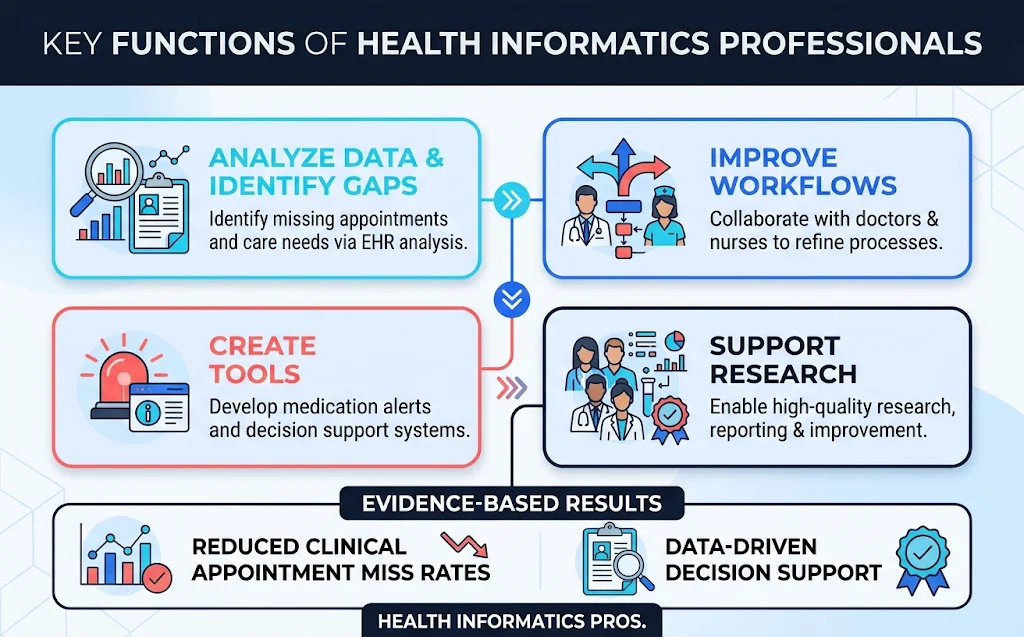
- Analyzing electronic health record (EHR) data to identify gaps in care.
- Working with nurses and doctors to improve clinical workflows.
- Helping develop medication alerts and clinical decision support tools.
- Evaluating how well healthcare software meets patient and staff needs.
- Supporting research, public health reporting, and quality improvement.
For example, an informatics analyst might notice that some patients are missing follow up appointments. The analyst can study scheduling records and help the hospital improve its reminder process.
What Is Health Information Technology?
Health information technology includes the hardware, software, and connected systems that healthcare organizations use to handle electronic health information.
According to the U.S. Assistant Secretary for Technology Policy and Office of the National Coordinator for Health IT (ASTP/ONC), health IT supports the electronic creation, maintenance, access, and exchange of health information.
Health IT professionals help hospitals, clinics, and other providers operate their digital systems safely and reliably.
What Do Health IT Professionals Do?
Common duties include:
- Installing, configuring, and maintaining EHR software.
- Managing user accounts and access permissions.
- Troubleshooting system errors and connection problems.
- Supporting databases and information exchange.
- Maintaining backups, software updates, and security controls.
Examples of health information technology include patient portals, electronic prescribing systems, laboratory information systems, and telehealth platforms.
Key Differences Between Health Informatics and Health IT
The main difference between health informatics and health information technology is how each field approaches healthcare information.
Health IT provides and supports digital tools. Health informatics studies how those tools and the information they contain can support healthcare decisions.
| Feature | Health Informatics | Health IT |
| Main focus | Effective use of health information | Digital systems and infrastructure |
| Primary goal | Improve decisions and care processes | Support reliable information systems |
| Typical work | Data analysis, workflow design, system evaluation | Configuration, maintenance, technical support |
| Common skills | Clinical knowledge, analytics, communication | Networking, databases, software, security |
| Common tools | Analytics dashboards, EHR data, decision support | EHR platforms, servers, networks, databases |
| Typical roles | Clinical informatics analyst, informatics specialist | Health IT specialist, systems administrator |
| Main outcome | Better information use and workflows | Reliable and secure access to information |
These are typical differences, not strict job boundaries. An informatics specialist may help design software, while an IT analyst may study clinical workflows.
The difference between health informatics and health information technology becomes clearer when both teams work on the same healthcare system.
How Health IT and Health Informatics Work Together
Health information technology vs health informatics is not always a choice between two separate departments. Healthcare organizations often need professionals from both fields to complete the same project.
Consider a hospital introducing a new EHR system.
The health IT team configures the software, connects laboratory systems, sets access permissions, and checks that patient records can be retrieved.
The informatics team works with clinicians to decide which information should appear on their screens. It may also review medication alerts and study whether the system makes daily tasks easier.
After launch, both teams investigate problems. IT specialists address technical faults. Informatics specialists examine whether the workflow supports safe and efficient care.
This shared work shows why healthcare organizations need both technical and clinical knowledge.
Health Informatics vs Health Information Management
Health information management (HIM) is a third field that readers often confuse with informatics and HIT.
The American Health Information Management Association (AHIMA) explains that health information includes medical histories, diagnoses, procedures, test results, and treatment outcomes.
HIM professionals help maintain the quality, accuracy, accessibility, and protection of health records.
| Field | Main Responsibility |
| Health informatics | Improve how health information is used |
| Health IT | Support technology that handles health information |
| Health information management | Maintain accurate, complete, and secure health records |
HIM professionals may oversee medical coding, record quality, release of information, and documentation practices.
The fields share responsibilities, particularly in data quality, privacy, and EHR operations.
Health Informatics Technology: Tools and Applications
The technology used in health informatics depends on the task. Some professionals analyze patient information, while others help design clinical software or improve information sharing.
Important technologies include:
Electronic health records: Systems that give authorized healthcare professionals access to patient histories, prescriptions, and test results.
Clinical decision support: Tools that provide reminders, alerts, or relevant information during care.
Data analytics: Software used to study patterns in patient care, service quality, or public health.
Interoperability standards: Standards such as HL7 Fast Healthcare Interoperability Resources (FHIR), which help different healthcare systems exchange information.
Healthcare software platforms: Products from vendors such as Epic and Oracle Health, which organizations may use to support clinical records and workflows.
These systems provide useful examples of health information technology, especially when comparing their technical features with clinical uses.
Education, Degrees, and Skills
There is no single degree that qualifies someone for every informatics or health IT job. Employers set requirements based on each position.
Degree and Certification Options
Health informatics programs often cover healthcare systems, statistics, data analysis, medical terminology, and information science.
Health IT programs may focus more on networking, databases, software support, cybersecurity, and electronic records.
An associate degree may prepare students for certain technical or records positions. A bachelor’s degree can support entry into some analyst roles, while advanced informatics positions may prefer a master’s degree or relevant clinical experience.
Professional credentials include the Certified Associate in Healthcare Information and Management Systems (CAHIMS) from HIMSS. This credential assesses foundational healthcare information and technology knowledge.
Students should compare program accreditation, curriculum, tuition, and employer requirements before enrolling.
Skills Employers May Look For
| Informatics Skills | Health IT Skills |
| Clinical workflow analysis | Software troubleshooting |
| Data interpretation | Database administration |
| Healthcare terminology | Network fundamentals |
| Quality improvement | Information security |
| Communication with clinicians | System configuration |
SQL, Excel, data visualization, and familiarity with EHRs can also be helpful, depending on the role.
Careers, Salaries, and Job Outlook
Health informatics and health IT professionals work in hospitals, physician practices, insurance organizations, public health agencies, and healthcare software companies.
Their responsibilities sometimes overlap, so job descriptions are more useful than titles alone when comparing career options.
Career Roles and Responsibilities Compared
| Career Role | Typical Responsibilities | Useful Skills |
| Clinical informatics analyst | Reviews clinical workflows, examines EHR data, and helps improve documentation | Clinical knowledge, data analysis, communication |
| Nursing informatics specialist | Works with nursing teams to improve documentation and technology use | Nursing experience, EHR knowledge, workflow design |
| Healthcare data analyst | Studies healthcare data and prepares reports to support decisions | SQL, statistics, Excel, data visualization |
| EHR support specialist | Helps users solve EHR problems and supports software updates | Troubleshooting, EHR configuration, customer support |
| Healthcare systems analyst | Reviews system requirements, investigates problems, and supports technical improvements | Systems analysis, databases, project coordination |
| Health IT technician | Maintains equipment, user accounts, and technical access | Hardware, networking, security basics |
The first three roles commonly involve informatics or healthcare analytics. The other three often focus more on technical systems.
These descriptions show common duties rather than fixed requirements. A nursing informatics position may require an active nursing license, while an EHR support role may prioritize technical experience and software training.
U.S. Salary and Employment Data
The U.S. Bureau of Labor Statistics (BLS) does not report one universal salary for all health informatics or health IT workers. Instead, it tracks specific occupations.
| U.S. Occupation | Median Annual Pay, May 2025 | Projected Growth, 2025 to 2035 |
| Health information technologists and medical registrars | $68,020 | 16% |
| Medical records specialists | $51,140 | 8% |
Sources: BLS Health Information Technologists and Medical Registrars and BLS Medical Records Specialists.
These occupations have different responsibilities. Their wages should not be presented as direct averages for health informatics, health IT, or HIM.
The BLS also estimates approximately 3,000 annual openings for health information technologists and medical registrars during the 2025 to 2035 projection period.
Pay varies with job duties, experience, location, and qualifications. Readers should compare specific occupations rather than assume one entire field pays more.
Which Field Should You Choose?
Your interests offer a useful starting point.
Choose a health informatics pathway if you enjoy studying data, understanding patient care, working with clinical teams, and improving how information supports decisions.
Consider health IT if you prefer configuring software, solving technical problems, supporting networks, or maintaining secure computer systems.
If accurate records, medical coding, privacy, and documentation interest you more, health information management may also be worth exploring.
A practical first step is to compare several job descriptions for each field. Look at daily tasks, required skills, and education before selecting a program.
Common Challenges and Career Mistakes
One common mistake is assuming that informatics professionals only analyze data while IT professionals only repair computers. Both fields involve teamwork, system design, and problem solving.
Another mistake is choosing a degree based only on salary estimates. A program should match the work you want to perform.
Healthcare organizations also face challenges such as inaccurate data, alert fatigue, security risks, expensive system changes, and staff training needs.
Informatics can help teams identify these problems, but technology alone cannot solve them. Successful improvements require reliable information, sound clinical processes, and staff involvement.
Frequently Asked Questions
Will AI Replace Health Informatics?
AI may automate some tasks, including data sorting, report creation, and pattern detection. However, informatics professionals also evaluate clinical needs, check information quality, improve workflows, and assess patient safety.
These responsibilities still require human judgment. The long term effect of AI on employment remains uncertain.
What Is the Salary Difference Between Informatics and HIM?
There is no single official salary difference between health informatics and health information management.
For context, BLS reported a May 2025 median annual wage of $68,020 for health information technologists and medical registrars, compared with $51,140 for medical records specialists.
These are different occupational groups. They do not establish how much more one entire field earns than the other.
For a meaningful salary comparison, choose specific job titles, experience levels, and locations.
Is It Worth Getting a Degree in Health Informatics?
A health informatics degree may be worthwhile if you want to work with clinical data, healthcare software, or information systems.
Before enrolling, compare tuition costs, program subjects, employer requirements, and possible career outcomes.
A degree does not guarantee employment. Some positions value practical experience alongside formal education.
What Are the Downsides of Using Health Informatics?
Challenges include data privacy risks, inaccurate information, software costs, and difficulties connecting different healthcare systems.
Poorly designed alerts can interrupt clinicians and contribute to alert fatigue. Informatics teams need to evaluate whether new tools actually support patient care.
Is Health Informatics in High Demand?
Certain related occupations have strong projected growth.
The BLS expects employment of health information technologists and medical registrars to increase by 16% between 2025 and 2035, compared with approximately 3% for all occupations.
This suggests opportunities in a related occupational group, but it does not measure demand for every health informatics position.
How Hard Is It to Get Into Health Informatics?
Entry requirements depend on the job.
Someone with healthcare experience may already understand patient records and clinical workflows. Someone with an IT background may have valuable database or software skills.
Beginners can start by studying medical terminology, basic data analysis, EHR concepts, and healthcare operations.
Conclusion
Health informatics focuses on using health information to improve decisions and care processes. Health information technology provides many of the digital systems that make this work possible.
Neither field is automatically better. Students interested in clinical data, analysis, and workflows may prefer informatics. Those interested in software, technical support, and systems may prefer health IT.
The most useful choice is the one that matches your skills, interests, and intended career.


