

Health Technology Information & Courses
Health technology uses software, data, devices, and communication tools to support health care. It includes electronic health records, telehealth, medical imaging, remote monitoring, and some artificial intelligence tools. If you are exploring this field, the right course depends on the work you want to do. A health information technology program may focus on records and data, while a biomedical engineering course may focus on devices and imaging.
This guide brings together health technology information and course options for people exploring U.S. education and careers. It covers common jobs, useful skills, privacy, accreditation, and salary data to help you compare your choices.
What Is Health Technology?
Health technology is a broad term for tools used to support health care, research, and health services. The US Food and Drug Administration includes software, sensors, connected devices, and computing platforms within digital health. Some tools support general wellness. Others may be regulated as medical devices when they are intended to diagnose, treat, or guide care for a health condition.
Consumer tools for activity, sleep, and nutrition sit within health and wellness technology, though their regulatory status depends on intended use.
Health technology overlaps with digital health and health informatics, but the terms do not mean exactly the same thing.
- Digital health often refers to digital tools and services used in health care, such as telehealth apps and remote monitoring.
- Health informatics focuses on how health information is collected, managed, shared, and used.
- Health information technology often refers to the computer systems that store and manage health records and related data.
Common health technology examples
An electronic health record, or EHR, stores information such as a patient’s medications, test results, and care history. A clinician may use it to review a patient’s chart or record a visit.
Telehealth lets patients and clinicians meet through video, phone, or secure messaging. Remote monitoring devices can send information such as heart rate or blood pressure to a care team. Medical imaging systems help clinicians view images from X rays, CT scans, or MRI scans.
Other health technology examples include patient portals, hospital scheduling systems, clinical decision support software, medical robots, and 3D printed devices. Each tool has a different purpose, and its value depends on how well it fits the care setting.
How Health Technology Is Used
Health technology supports more than direct patient visits. Hospitals use software to coordinate care, manage supplies, and track results. Clinics use EHRs to document visits and share information with other authorized providers. Public health teams use data to monitor patterns in a community.
Health technology also connects systems. For example, a patient may visit a clinic, a laboratory, and a hospital. When the systems can exchange accurate information, clinicians may have a fuller picture of the patient’s care. The US health IT office describes interoperability as the secure exchange and use of electronic health information among authorized users.
One standard used for electronic data exchange is Fast Healthcare Interoperability Resources, usually called FHIR. It gives different systems a common way to represent and share health information. FHIR does not mean every system automatically works together. Organizations still need compatible software, agreed data rules, and proper permissions.
What Does a Health Information Technology Worker Do?
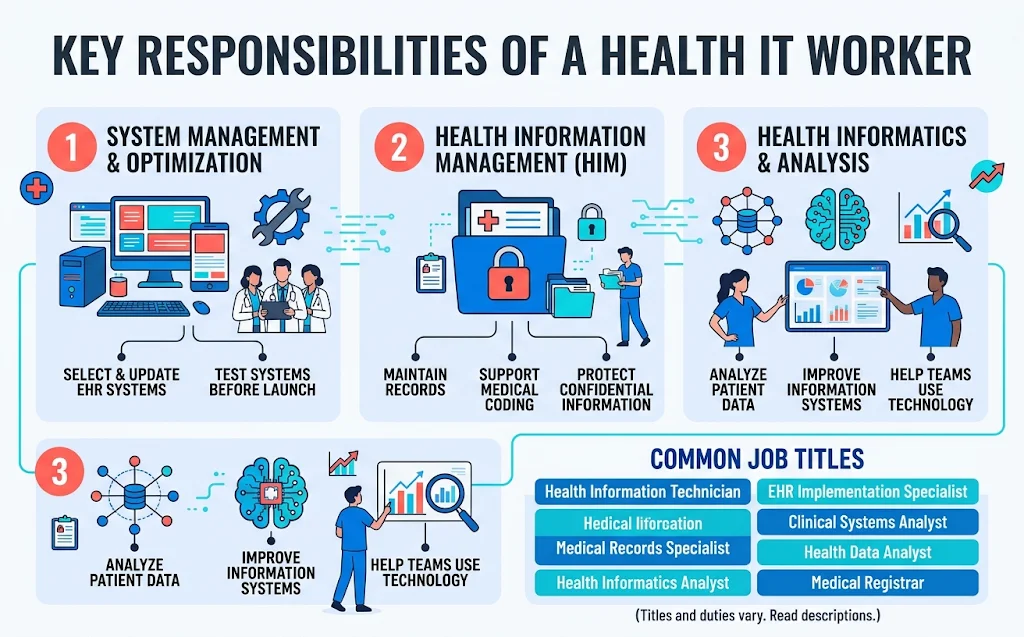
Health information technology workers help health care organizations manage computerized systems and clinical data. Depending on the job, they may help select or update an EHR, test a system before launch, train staff, prepare data reports, or check that records are accurate.
Some workers focus on health information management. They help maintain records, support coding, and protect confidential information. Others work in health informatics, where they may analyze data, improve information systems, or help teams use technology in daily care.
A real example is an EHR update at a clinic. The project may involve checking that patient information transfers correctly, showing staff how to use new screens, and reporting problems before the system goes live. The work connects technical details with clinical needs.
Common job titles include:
- Health information technician
- Medical records specialist
- Health informatics analyst
- EHR implementation specialist
- Clinical systems analyst
- Health data analyst
- Medical registrar
The titles and duties vary by employer. Read job descriptions carefully because “health information technology” can describe both recordkeeping work and more technical system roles.
Skills Used in Health Technology Jobs
Many roles combine health care knowledge with careful data work. Useful skills include:
- Medical terminology and basic health care workflows
- Data accuracy, coding, and record management
- EHR and clinical software use
- Privacy, security, and information governance
- Communication with clinicians, administrators, and technical teams
- Problem solving and attention to detail
Some jobs need programming, database, analytics, or cybersecurity skills. Others focus more on documentation, coding, or staff training. A course should match the tasks you want to do, rather than simply having “health technology” in its title.
Privacy and patient safety
In the United States, HIPAA rules apply to covered entities and their business associates. These rules set requirements for protecting certain health information. A consumer health app may not fall under HIPAA in the same way as a hospital or health plan, so users and developers should check which laws apply to the specific service.
The FDA also uses a risk based approach to certain software functions that qualify as medical devices. A wellness app and a tool that analyzes patient data to guide diagnosis may be treated differently. The intended use of the software matters.
Health Technology Courses in the United States
Health technology courses range from short introductions to associate, bachelor’s, and graduate programs. Some focus on health information management. Others teach health informatics, health data, biomedical engineering, or digital health leadership.
| Course type | Common focus | May suit |
| Short course | EHRs, digital health basics, privacy, or a specific tool | People testing their interest or adding one skill |
| Certificate | Medical records, coding, data, or system support | Learners seeking focused preparation |
| Associate degree | Health information technology or health information management | People aiming for technician and records roles |
| Bachelor’s degree | Informatics, health information management, or related fields | Learners seeking broader preparation or advancement |
| Graduate program | Health informatics, analytics, or leadership | Experienced staff moving into specialist or management work |
The US Bureau of Labor Statistics says health information technologists and medical registrars typically need at least an associate degree, though some roles require a bachelor’s or master’s degree. Medical records specialist roles may have different entry requirements. Employers may also prefer a relevant certification.
Credential and course pathways
For example, students aiming for the Registered Health Information Technician (RHIT) exam should check that their associate degree level Health Information Management program is accredited by CAHIIM. AHIMA currently says a health informatics degree alone does not qualify for the RHIT exam.
For the Registered Health Information Administrator (RHIA) exam, AHIMA lists qualifying CAHIIM accredited Health Information Management bachelor’s or master’s pathways, plus an approved post baccalaureate certificate. Check current eligibility rules and the program directory before enrolling.
If your goal is clinical data or systems work rather than HIM certification, compare syllabi for EHR practice, SQL or data analysis, interoperability, privacy, and hands on projects. Before paying, ask for total tuition, required fees, books, exam costs, transfer credit policies, and expected completion time.
How to compare programs
Before enrolling, check:
- Course content: Does it teach skills used in the jobs you want?
- Entry requirements: Do you need health care, math, or computer experience?
- Format and schedule: Is the program online, in person, or part time?
- Practice: Does it include projects, software practice, or supervised work?
- Cost and time: Compare total tuition, fees, and expected time to finish.
- Recognition: Check whether employers or certification bodies recognize the program.
For health information management or health informatics degree programs, use the CAHIIM program directory to check accreditation status. Accreditation does not guarantee a job, but it helps you verify that a program has gone through an external education review. Check the directory and the school directly because program status can change.
Choosing a Course for Your Goal
If you are new to the field, start with an introductory course in medical terminology, health data, or EHR use. If you already work in health care, a course in informatics or data analysis may help you take on digital projects. If you prefer building devices or medical imaging systems, look at biomedical engineering programs rather than programs focused mainly on records.
The phrase health care technology management may describe a different path from health informatics. It often relates to managing technology, services, or implementation across a health organization. Read the syllabus and job outcomes to see what a program actually teaches.
Ask the school these questions:
- Which job tasks does the program prepare students to perform?
- What software, data standards, or coding systems are taught?
- Are there hands on projects or work placements?
- Which credentials can graduates pursue?
- What are the full costs, including books and exam fees?
- How does the school report graduation and employment outcomes?
Do not choose a program based on a promised salary or job guarantee alone. Ask for verifiable outcomes and compare them with local job listings.
U.S. Jobs and Salary Data
The Bureau of Labor Statistics reported a May 2025 median annual wage of $68,020 for health information technologists and medical registrars. It projects employment in this occupation to grow 16 percent from 2025 to 2035, with about 3,000 openings per year on average. These are national figures for one occupational group. They are not starting salary promises, and pay varies by role, employer, location, and experience.
Medical records specialists are a related but distinct occupation. Their May 2025 median annual wage was $51,140, and the Bureau projects 8 percent employment growth from 2025 to 2035. The two figures should not be treated as interchangeable because the jobs have different duties and entry requirements.
Frequently Asked Questions
Which course is the best in health technology?
There is no single best course for everyone. Choose a CAHIIM accredited program if you want a health information management or informatics degree and accreditation matters for your goals. A short course may suit someone who wants to learn one skill before committing to a degree. Compare course content, costs, schedule, and employer requirements.
What do you do as a health information technology worker?
You may maintain or improve electronic health record systems, check health data for accuracy, prepare reports, support clinical staff, or help protect patient information. Your daily tasks depend on your job title and employer.
How long does it take to qualify in health informatics?
There is no fixed timeline. A short course may take weeks or months. A degree takes longer, with the exact duration depending on the program, study pace, and prior credits. In the United States, the Bureau of Labor Statistics says health information technologist roles typically require at least an associate degree, while some positions ask for higher education.
UK Career Questions
Does the NHS offer free courses?
Yes. The NHS Digital Academy Campus lists free, self guided digital health courses. Its current information says the campus is open to NHS staff, people considering an NHS career, and people whose work helps deliver NHS services. This is a UK resource, and access rules can depend on the course.
What is the salary range for health informatics jobs in the UK?
There is no single UK range because jobs differ by duties, employer, location, and experience. NHS roles may use Agenda for Change bands. For England in 2026/27, the published basic pay range for Band 5 is £32,073 to £39,043, while Band 7 is £49,387 to £56,515. A specific health informatics job may use another band, and supplements may apply. Check the current job advert.
What jobs pay £40,000 a year in the UK without experience?
Pay depends on the role and location, and a course cannot guarantee a £40,000 salary. Many health informatics jobs ask for relevant skills, qualifications, or experience. In the NHS, some roles may reach that level through higher pay bands or progression, but entry pay differs. Check current job adverts and their required experience before choosing a course.
Conclusion
Health technology includes systems, data, devices, and services that support health care. Jobs can involve records, informatics, analytics, or system implementation, so course choices should follow the work you want to do. Compare program content, accreditation, costs, and employer requirements before enrolling. For salary and job outlook, use current data for the exact occupation and location you are considering.


