

Wealth Management & Enterprise Technology
Wealth firms rely on software, data, and connected operations to serve clients and help advisors manage daily work. Wealth Management & Enterprise Technology is the system of platforms, tools, and controls that links those parts of a firm. When the systems work together, staff can find reliable information, handle routine tasks, and give clients a more consistent service experience.
1. What Is Wealth Management Technology?
Wealth management technology includes the software and infrastructure firms use to manage client relationships, portfolios, transactions, reporting, compliance, and service. It can support independent registered investment advisers, banks, brokerages, family offices, and other wealth businesses.
The goal is not to collect the most apps. It is to connect useful tools to real work. A firm might use a customer relationship management system, or CRM, to track client needs, a portfolio platform to view accounts, and a secure portal to share documents. If each tool holds separate or outdated information, staff may spend more time checking records than helping clients.
2. What Does a Modern Wealth Technology Stack Include?
A firm’s technology stack is the set of systems it uses and how they work together.
| Technology layer | What it supports |
| Wealth platform and portfolio systems | Account, portfolio, and investment workflows |
| CRM and advisor tools | Client records, meeting preparation, and follow up |
| Data and analytics | Reporting, business insight, and consolidated information |
| Client portal and mobile tools | Secure access to documents, updates, and service |
| Cloud and integration tools | Data exchange between approved systems |
| Cybersecurity and compliance tools | Access controls, monitoring, records, and risk management |
A small advisory firm may rely on a few connected services. A large institution may need to coordinate systems across banking, investment management, trust services, and compliance. The right setup depends on the firm’s clients, services, size, and operating model.
3. Why Do Data and Integration Matter?
Reliable information is the base of the technology stack. Data lineage means knowing where information came from and how it changed. Middleware is software that helps separate systems exchange information.
These connections can help advisors see a more complete client record. They can also reduce duplicate entry and mismatched reports. But a connection is only useful when the data is accurate, permitted for the intended use, and protected from unauthorized access.
In a Cerulli study of billion dollar RIAs, 35% named improving data visibility and use as a key challenge. The report also said 61% had started or completed a data project as part of strategic planning. These findings apply to the surveyed firms, not every wealth business.
4. How Can AI Support Wealth Firms?
AI can assist with tasks such as summarizing meeting notes, finding information in approved records, preparing client reviews, and updating CRM entries. Generative AI can draft or summarize text. More advanced agent systems may carry out steps in a workflow, but their actions need clear limits and review.
AI does not remove a firm’s duties to supervise work, protect client information, keep required records, and address conflicts. FINRA’s 2026 report flags risks when AI agents act without human validation. FINRA guidance also explains that existing communication rules apply whether a firm uses a person or a technology tool.
A practical example is meeting preparation. An approved tool may collect relevant notes and account information into a draft summary. The advisor should check it for errors and missing context before using it with a client.
5. How Does Technology Affect Advisors and Clients?
Client portals, secure document sharing, digital forms, and clear reporting can make routine service easier. Advisors can use CRM reminders and account summaries to prepare for conversations. Automation may reduce repetitive work, but it cannot replace an advisor’s judgment about a client’s goals, concerns, or changing circumstances.
The U.S. Bureau of Labor Statistics reported a median annual wage of $105,070 for personal financial advisors in May 2025. It projects 1% employment growth from 2025 to 2035 and about 17,100 openings per year on average, mostly from workers leaving the occupation. The BLS notes that AI may moderate demand, while many clients are still expected to seek human help for complex advice.
6. Where Do Mortgage, Insurance, and Spend Systems Fit?
Some enterprise systems support work around wealth management without being part of the core investment platform. Mortgage technology can help record lending information relevant to a client’s broader financial picture. Insurance technology may support the exchange of policy information when it is useful and authorized.
Spend management technology usually supports a firm’s own expenses, approvals, and payments. Firms may also connect these workflows with accounting and business automation technology to manage invoices, budgets, and records. These systems should have clear access rules so internal business data does not become mixed with client portfolio information.
7. How Should a Firm Choose and Modernize Its Systems?
Before buying a tool or replacing a platform, define the problem, affected workflows, and expected result. A technology decision can affect client access, advisor routines, data quality, vendor reliance, and long term costs.
| Question | Why it matters |
| Does it fit our services and client needs? | Avoids paying for features the firm will not use |
| Can it connect through documented APIs or controlled integrations? | Shows how records and workflows will move between systems |
| Who owns each data field, and where did it come from? | Supports data quality, lineage, and correction |
| How are access, records, and sensitive data protected? | Helps the firm assess security and compliance needs |
| How does the vendor handle incidents and subcontractors? | Supports third party risk review and ongoing oversight |
| Have integrations and user permissions been tested? | Finds data mismatches and access errors before launch |
| Can the firm export its data and leave the provider? | Clarifies portability and exit planning |
| What are setup, migration, and ongoing operating costs? | Shows the full cost, not only the subscription |
FINRA recommends due diligence and ongoing monitoring for vendors that support mission critical systems. Firms should also understand what data a vendor can access or store. These checks matter before signing a contract and throughout the relationship.
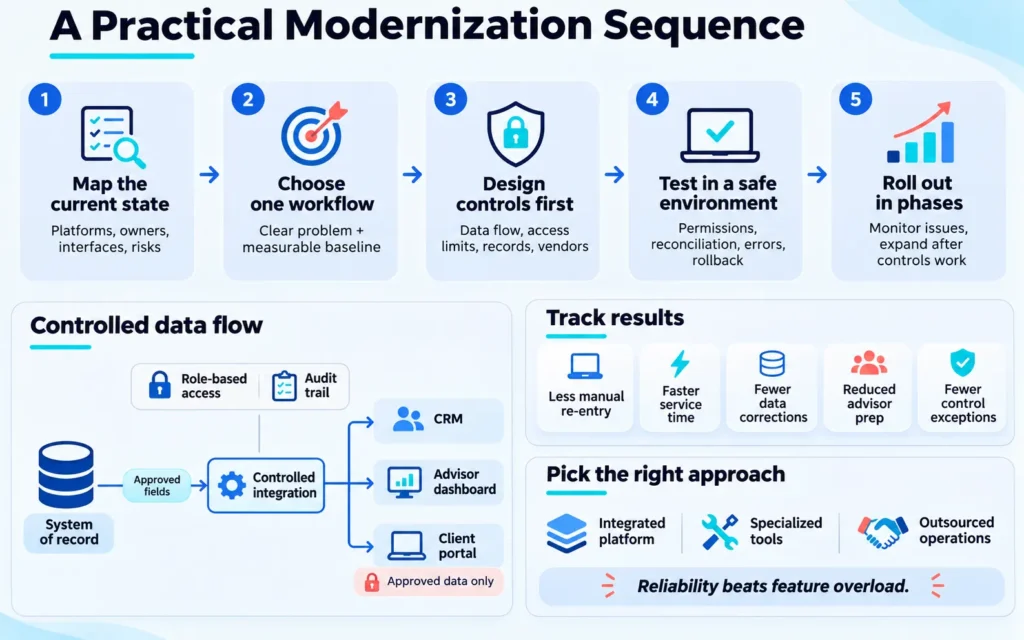
A practical modernization sequence
- Map current platforms, data owners, interfaces, manual work, and key risks.
- Choose one client or staff workflow with a clear problem and measurable baseline.
- Design the data flow, access limits, records, and vendor responsibilities before configuring tools.
- Test integrations in a controlled environment. Check permissions, data reconciliation, error handling, user acceptance, and rollback steps.
- Move users or accounts in phases, monitor issues, and expand only after the controls work.
For example, when a client updates account details, the system of record should send approved fields through a controlled integration. The CRM and advisor dashboard can receive the information they need, while a client portal displays only approved data. Access controls and audit records help the firm trace who viewed or changed information.
Track results against the starting point. Useful measures include manual re-entry, routine service time, data correction rates, advisor preparation time, and control exceptions. The goal is to learn whether the change improves the workflow without weakening oversight.
Firms may choose an integrated platform, combine specialized tools, or outsource selected operations. Each approach has trade offs. A system staff can use reliably may serve the firm better than a larger collection of features.
8. Conclusion: Connect the Firm Around Client Needs
Technology can support better service when platforms, people, and information work together. Wealth firms should begin with a clear business need, use reliable data, and set controls before expanding automation or AI. Good decisions account for integration, security, usability, vendor risk, cost, and human oversight.
9. Frequently Asked Questions
What are the top 3 wealth management firms?
There is no official top three because rankings use different measures. Morgan Stanley, J.P. Morgan Wealth Management, and Merrill are examples, not a ranking. Compare their platforms, integrations, advisor tools, and security.
Will AI take over wealth management jobs?
AI can assist with summaries and routine work, while people validate results and handle complex client needs. The BLS projects 1% growth in personal financial advisor employment from 2025 to 2035.
Who do billionaires use to manage their money?
Some families use family offices, private banks, investment managers, lawyers, and tax experts. Connected portfolio, reporting, and document systems help family offices coordinate these services.
Who are the top 5 in wealth management?
There is no universal top five. Morgan Stanley, J.P. Morgan Wealth Management, Merrill, UBS, and Wells Fargo Advisors are examples for comparison, not a performance ranking. Compare integrations, security, service, and data exit terms.
Which jobs are expected to grow by 2030?
The World Economic Forum lists big data specialists, AI and machine learning specialists, and software developers among fast growing roles. These skills can support wealth firms’ technology programs, but the forecast does not guarantee job security.
How many financial advisors make $500,000 a year?
There is no reliable public count. BLS says the highest 10% earned over $357,020 in May 2025, but does not show how many earned $500,000. Compensation alone does not measure technology or service quality.
Who is the wealthiest wealth manager?
There is no official list. Ken Griffin is a wealthy hedge fund manager, not a personal financial advisor. Individual wealth does not show how well a firm’s systems serve clients.
What did Warren Buffett say about financial advisors?
Buffett’s 2013 letter described an index fund and bond allocation for a trust set up for his wife. It was not a universal advisor or technology rule. Wealth systems should support sound advice and human judgment.
What is considered a very high net worth individual?
Definitions vary. Capgemini defines an HNWI as having at least $1 million in investable assets, excluding a primary home and certain personal assets. Firms should state which definition guides their client segments.


