

Financial Technology (FinTech) Solutions: Types, Benefits & Uses
Financial technology now covers far more than mobile banking. It includes payment systems, digital lending, investment apps, financial data tools, fraud controls, identity checks, banking software, and the systems that connect them.
Financial Technology (FinTech) Solutions are digital tools, platforms, software, and services used to deliver or improve financial services. A small business may use them to accept payments or track cash flow. A bank may use them to verify identity, monitor transactions, manage risk, or connect new products with older systems.
The value is practical. FinTech can make financial tasks faster and easier to access. It can also create new risks. Security, privacy, regulation, data quality, and vendor reliability matter as much as speed.
What Are Financial Technology Solutions?
Financial technology means using software, data, networks, and digital devices to provide financial services or support financial work. The term can describe a product, a technical system, or a company that relies on technology to offer finance-related services.
A FinTech company may focus on payments, lending, investing, insurance, or compliance. Traditional banks also use FinTech. The connection between technology and financial services has become closer because banks, software firms, retailers, and specialist providers often work together.
The World Bank describes FinTech as the application of digital technology to financial services. It also notes that digital finance can support more efficient and inclusive financial services while creating new questions about regulation, competition, market structure, and consumer protection.
FinTech vs Traditional Financial Services
FinTech and traditional finance can provide many of the same services, but they often deliver them in different ways.
| Area | Traditional Finance | FinTech |
| Customer access | Branches, websites, call centers | Apps, websites, digital platforms |
| Account opening | May involve manual checks | Often uses digital identity tools |
| Data sharing | Often limited to internal systems | APIs can connect approved services |
| Payments | Bank and card networks | Digital wallets, apps, APIs, platforms |
| Lending | Traditional applications and underwriting | Digital applications and automated tools |
| Technology | Often relies on older core systems | Often built around cloud software and APIs |
| Customer experience | Institution centered | Often designed around digital tasks |
The difference is not absolute. Many banks now use the same APIs, cloud services, fraud tools, and digital interfaces found in FinTech products.
How Do FinTech Solutions Work?
Most FinTech products combine several technical and financial layers.
The user sees an app, website, checkout page, or dashboard. Behind it, application programming interfaces can move approved data between services. Cloud systems may handle computing and storage. Identity tools confirm users. Payment networks move money. Risk systems score activity. Compliance systems review transactions against rules.
An online lender, for example, may collect an application, verify the applicant, connect to financial data with permission, assess risk, make a credit decision, send funds, and track repayment. The customer may see one screen while several providers work behind it.
This is why financial technology partners matter. A single product may depend on a bank, payment processor, identity provider, data provider, cloud provider, and compliance vendor.
Main Types of FinTech Solutions
Digital Payments
Payment technology supports card payments, bank transfers, digital wallets, mobile payments, merchant checkout, recurring billing, and person-to-person transfers.
Visa, Mastercard, PayPal, Block, Stripe, and Adyen operate in different parts of this market.
For businesses, payment choice affects fees, fraud exposure, refunds, reporting, cash flow, and the customer checkout experience. A deeper guide to payment technology, digital payments, and processing solutions can help merchants compare these systems in more detail.
Digital Banking and Neobanks
Digital banking lets customers open or manage accounts through websites and apps. Some providers are banks. Others work with regulated banks that hold funds or provide banking services.
Examples in the US market include Chime and SoFi. Users should still check who actually provides the account, what protections apply, which fees may be charged, and how support works when a transaction goes wrong.
Lending and Financing Technology
FinTech lending can digitize applications, identity checks, income review, underwriting, document collection, decisions, and repayment.
Some lenders also use bank account data or other approved financial information to assess risk. This can shorten parts of the application process, but automated lending still requires accurate data, fair lending controls, and clear reasons for important credit decisions.
Open Banking and Financial APIs
Open banking allows customers to give approved services access to certain financial information or actions. APIs can support account linking, budgeting, payment initiation, lending, and financial planning.
The US regulatory position remains unsettled. The Consumer Financial Protection Bureau states that the compliance dates for the Personal Financial Data Rights Rule were stayed by a federal court on October 29, 2025.
The CFPB had also started a reconsideration process concerning parts of the rule. Its official compliance page was last modified on January 6, 2026, and continued to state that the compliance dates were stayed.
Businesses should therefore check the latest CFPB materials instead of relying on an old compliance timetable.
Embedded Finance
Embedded finance places a financial service inside a nonfinancial product.
A marketplace may offer payments to sellers. A software platform may provide access to a business card. A retailer may make financing available during checkout.
The customer can use the financial function within the product they already use instead of visiting a separate financial website.
WealthTech and Digital Investing
WealthTech includes investing apps, digital brokerage, portfolio tools, automated advice, and software used by financial advisers.
Robinhood is one well-known consumer example.
Robo-advisers use software and predefined methods to build or manage portfolios. Users still need to understand fees, investment risk, account protections, and whether a service provides general information or regulated investment advice.
InsurTech
InsurTech applies software and data to insurance.
It can support quotes, underwriting, claims processing, policy management, fraud review, and customer service.
RegTech, KYC, and AML
RegTech helps financial firms manage compliance work.
It can support Know Your Customer checks, Anti-Money Laundering controls, transaction monitoring, sanctions screening, reporting, and record-keeping.
Software can reduce manual work, but firms remain responsible for meeting the legal duties that apply to them.
Blockchain and Crypto Technology
Blockchain can record transfers or ownership across a shared digital ledger.
Crypto technology can include wallets, exchanges, custody systems, tokenization, smart contracts, and digital asset infrastructure.
These tools form one part of FinTech. Payments, lending, insurance, banking software, compliance, and financial data systems are also major parts of financial technology.
FinTech Solutions at a Glance
| Business Need | FinTech Solution | Typical Use |
| Accept payments | Payment platform | Online or in-store checkout |
| Verify customers | Identity and KYC tools | Account opening |
| Reduce fraud | Fraud monitoring | Transaction review |
| Offer credit | Digital lending | Consumer or business loans |
| Connect account data | Financial APIs | Budgeting or underwriting |
| Manage compliance | RegTech | AML and reporting |
| Add finance to software | Embedded finance | Payments, cards, or lending |
| Automate investing | WealthTech | Portfolio management |
AI and Automation in Financial Services
Artificial intelligence can help detect unusual transactions, sort documents, support customer service, review credit data, forecast cash flow, and assist compliance teams.
A model can make a process faster, but it can also repeat problems in the data used to build or train it. In lending, fraud review, or other important financial decisions, firms need testing, monitoring, access controls, records, and suitable human oversight.
The Bank for International Settlements noted in January 2026 that financial institutions are using AI for credit underwriting, fraud detection, risk management, data processing, and back-office work.
The BIS also warns that dependence on common models, data providers, cloud services, and other technology suppliers can create operational and financial stability risks.
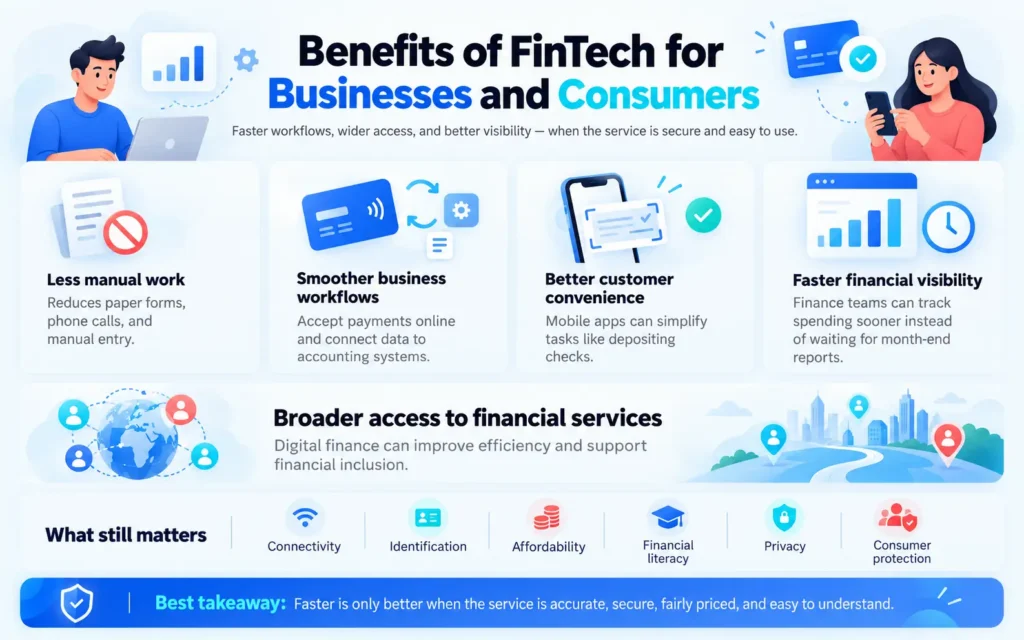
Benefits of FinTech for Businesses and Consumers
Financial software can remove steps that once required paper forms, phone calls, or manual entry.
A merchant can accept a payment online and send transaction data to an accounting system. A customer can deposit a check through a mobile app. A finance team can see spending sooner instead of waiting for a month-end report.
FinTech can also improve access to financial services. The World Bank has identified digital finance as a possible route to broader financial inclusion and more efficient financial services.
Access is not automatic. Connectivity, identification, affordability, financial literacy, privacy, and consumer protection still matter.
A faster service is useful only when it is accurate, secure, fairly priced, and understandable.
A Small Retailer Choosing a Payment Provider
Consider a small US retailer that sells products in a physical store and through an online shop.
The owner wants one payment system for both channels. Choosing the cheapest advertised transaction rate would not be enough.
The retailer should first check which cards and digital wallets customers use. It should compare transaction fees, chargeback costs, hardware requirements, settlement times, e-commerce integrations, refund tools, fraud controls, and customer support.
Suppose Provider A charges slightly less per transaction but requires separate reporting for online and store sales. Provider B costs a little more but connects both channels to the retailer’s accounting system and gives staff one dashboard for refunds and reconciliation.
Provider B may produce the lower total operating cost even though its headline transaction fee is higher.
This example shows why a FinTech product should be judged by the full business problem rather than one advertised price.
Risks and the Dark Side of FinTech
FinTech can expose users and firms to fraud, account takeover, data theft, privacy loss, poor automated decisions, unclear fees, weak customer support, and dependence on outside providers.
The Federal Trade Commission reported that consumers reported about $16 billion in total fraud losses during 2025. Reported losses from imposter scams reached about $3.5 billion.
The FTC also said some of the costliest impersonation scams begin with fake security warnings that appear to come from banks.
A polished app does not prove that a company is safe.
Users should check who owns the service, which institution holds their money, what regulator or legal framework applies, how their data is used, how disputes are handled, and what happens if the provider fails.
How to Choose the Right FinTech Solution
1. Define the Job
Start with the problem.
It may be payment acceptance, fraud review, cash flow reporting, lending, identity verification, expense control, or compliance.
2. Check Legal and Security Needs
Identify which laws, licenses, data rules, record keeping duties, and security controls may apply.
Requirements can differ by product, customer type, activity, and state.
3. Review Integrations
Check whether the product connects with your bank, accounting system, e-commerce platform, payroll software, or internal systems.
Ask how data enters the platform, where it is stored, and how it can be exported.
4. Compare the Full Cost
Look beyond the monthly subscription or advertised transaction fee.
Include processing charges, implementation work, hardware, support, training, data costs, compliance work, and the cost of changing providers later.
5. Test the Provider
Review security practices, service history, contract terms, support, data access, incident response, and the process for moving your information if the relationship ends.
6. Measure the Result
Track numbers tied to the problem you wanted to solve.
Useful measures may include payment success rate, fraud losses, manual work hours, approval time, cost per transaction, customer completion rate, and support issues.
When Financial Technology Consulting Makes Sense
Financial technology consulting can help when a project crosses several areas, such as product design, banking relationships, regulation, security, data, and systems integration.
It is most useful when a business has a defined problem but lacks the internal skills to assess vendors, map requirements, plan controls, or manage a difficult implementation.
External advice should support internal decision-making rather than replace it.
Common FinTech Mistakes to Avoid
- Choosing software before clearly defining the problem.
- Assuming a provider handles every compliance responsibility.
- Ignoring dependence on a bank partner, API, processor, or cloud provider.
- Comparing subscription prices while ignoring total operating cost.
- Measuring customer adoption without measuring fraud, cost, errors, or service quality.
- Treating security as a one-time review instead of an ongoing responsibility.
The Future of Financial Technology
AI, faster payments, embedded financial services, digital identity, tokenized assets, and stronger links between banks and software platforms are likely to remain important areas of financial technology.
The Bank for International Settlements has also highlighted tokenization as an important part of current digital finance discussions.
The larger change is that financial functions are appearing inside more digital products and business systems.
That makes governance more important. Firms need to know where money moves, where data goes, which provider handles each task, and how customers can get help when something fails.
For banks and credit unions, this also raises questions about technology banking, credit unions, and digital finance solutions as they update core systems and connect new services while managing risk.
Frequently Asked Questions
Is Fintech a Legit Company?
FinTech is not one company. It is a term for financial technology.
If a company uses FinTech in its name, check its legal business name, licenses where required, regulatory status, bank partners, fees, privacy policy, contact information, and complaint history.
What Is Fintech Financial Technology?
FinTech means financial technology.
It includes software, digital platforms, data systems, and technical infrastructure used for payments, banking, lending, investing, insurance, compliance, and other financial activities.
Who Is the CEO of a Fintech Company?
There is no single CEO of FinTech because FinTech is an industry rather than one company.
Individual FinTech companies have their own chief executives and leadership teams.
Is Fintech a Good Stock?
FinTech is a business sector, not a single stock.
A FinTech company should be assessed using factors such as revenue, earnings, cash flow, valuation, debt, competition, regulation, growth prospects, and the investor’s own goals and risk tolerance.
What Are the Dark Sides of Fintech?
Possible problems include fraud, cyberattacks, privacy loss, poor automated decisions, weak customer service, unclear fees, regulatory gaps, and dependence on third-party technology or financial providers.
Is Fintech Good or Bad?
FinTech itself is neither good nor bad.
It can make financial services easier to use and automate manual work. Poor design, weak controls, unfair decisions, security failures, or unclear terms can also cause financial or consumer harm.
Where Is the Fintech Headquarters?
FinTech has no headquarters because it describes an industry.
Individual FinTech businesses have their own registered addresses, offices, and headquarters.
What Companies Fall Under Fintech?
FinTech includes companies working in payments, lending, digital banking, investing, financial data, insurance, compliance, and digital assets.
Examples include PayPal, Block, Stripe, Chime, SoFi, Robinhood, Coinbase, and Plaid, although their products and regulatory roles differ.
How Does a Fintech Company Make Money?
FinTech companies can earn revenue from transaction fees, subscriptions, software fees, interchange, lending, advisory fees, service charges, and financial infrastructure services.
The revenue model depends on what the company provides and its role in the transaction.
Final Takeaway
Financial Technology (FinTech) Solutions cover payments, financial data, lending, investing, insurance, identity verification, compliance, and business software.
For consumers, the key questions are safety, cost, clarity, and usefulness.
For businesses, the test is stricter. A product should solve a defined problem, meet relevant security and regulatory needs, connect with existing systems, and produce results that can be measured.
The best choice is not always the product with the longest feature list or lowest advertised price. It is the one that performs the required job, protects users and data, and fits the way the business actually works.


