

Health Technology Examples: 20 Real Uses in Healthcare
Health technology examples include blood pressure monitors, hearing aids, MRI scanners, electronic health records, telehealth services, and glucose sensors. These tools help people check their health, receive treatment, share information, or manage daily tasks.
Some fit in a pocket. Others fill a hospital room. Their value depends on the problem they address, the evidence behind them, and how people use them.
This guide explains 20 examples used at home, in clinics, and in research. It also shows where technology needs trained staff, careful interpretation, or further testing.
Quick answer: Health technology examples include blood pressure monitors, continuous glucose monitors, hearing aids, telehealth, medical imaging, electronic health records, infusion pumps, remote patient monitoring, surgical assistance systems, and AI-enabled medical devices. The right technology depends on its intended use, evidence, safety, and care setting.
Medical information note: This article is for general educational purposes. It does not replace diagnosis, treatment, or individualized advice from a qualified healthcare professional.
What Counts as Health Technology?
Health technology covers tools and methods developed to address health problems. The World Health Organization includes medicines, medical devices, assistive technologies, techniques, and procedures in this definition. Staff training and well-organized care are part of using them effectively.
Digital health is one part of that broader field. The broader health tech landscape also includes medical devices, assistive tools, and other technologies used to support health services.
A hearing aid is health technology. A patient portal is digital health technology. A vaccine also fits the broader definition, although this guide focuses mainly on devices and digital tools.
A product’s purpose matters. A fitness app may track exercise without being designed to diagnose or treat disease.
Health Technology Examples at a Glance
| Technology | Main purpose | Typical setting | Main consideration |
| Blood pressure monitor | Measure blood pressure | Home or clinic | Correct cuff and technique |
| Glucose sensor | Track glucose patterns | Home and daily life | Follow device instructions |
| Hearing aid | Support hearing | Everyday use | Suitable type and fitting |
| Telehealth | Connect patients and clinicians | Remote care | Some visits need an examination |
| Patient portal | Access records and messages | Home or clinic | Response times vary |
| Medical imaging | View structures inside the body | Hospital or imaging center | Test choice depends on the problem |
| Electronic health record | Store clinical information | Healthcare organizations | Accurate, accessible records |
| Infusion pump | Control fluid or medicine delivery | Hospital or home care | Correct setup and monitoring |
| Surgical assistance system | Help surgeons control instruments | Operating room | Training and procedure suitability |
| AI imaging software | Analyze selected medical images | Clinical care | Evidence for the specific task |
Health Technology Examples for Home Use
Here are 20 health technology examples, grouped by where they are used and what they help people or healthcare teams do.
1. Digital Blood Pressure Monitors
A blood pressure monitor measures the pressure of blood against artery walls. Home readings can give a clinician information from outside the examination room.
The cuff must fit, and the user must follow the instructions. Poor positioning or movement can affect results.
The FDA warns against unauthorized products that claim to measure blood pressure, including certain wearable features. Check the exact device rather than assuming every smartwatch can perform this task.
2. Glucose Meters and Continuous Glucose Monitors
A glucose meter checks a small blood sample. A continuous glucose monitor, or CGM, uses a sensor to track glucose in fluid beneath the skin.
Meters provide individual readings. CGMs show patterns over time, which may help users understand changes around meals, activity, or treatment.
Abbott’s FreeStyle Libre systems are examples of sensor-based glucose technology listed by the FDA. Models have different instructions and approved uses.
A watch displaying data from a glucose sensor is different from a watch claiming to measure glucose by itself. The FDA warns against watches and rings that claim to measure blood glucose without piercing the skin.
3. Wearable Heart and Activity Monitors
Wearable health technology can record steps, heart rate, and other measurements. Some models include an electrocardiogram feature, often called ECG, that records electrical activity related to heart rhythm.
A useful record might show when a person noticed symptoms. It does not explain every possible cause.
Features differ by model, software, and intended use. A sleep score or activity estimate should not be treated as a complete medical assessment.
4. Telehealth Consultations
Telehealth, sometimes called telemedicine, connects patients and healthcare professionals through video, phone, or other remote services.
It can support follow-up visits, counseling, and discussion of results. A person who lives far from a clinic may avoid travel for an appointment that can safely happen remotely.
Other problems require a physical examination, imaging, or urgent care. Ask what the service can assess before booking.
5. Patient Portals and Reminder Apps
A patient portal connects people with information held by their healthcare provider. Depending on the system, users can view results, request refills, schedule visits, or send messages.
A reminder app has a narrower role. It may prompt someone to take a medicine or record a symptom.
Check whether anyone reviews submitted information. A message sent through an app does not always receive an immediate response.
6. Hearing Aids and Communication Devices
Hearing aids process and amplify sound. Communication devices can help people express needs through text, symbols, or speech output.
In the United States, hearing aids sold without a prescription are intended for adults aged 18 or older with perceived mild to moderate hearing loss. They are not suitable for every hearing problem.
Comfort, adjustment, and support matter alongside the device’s features.
Health Care Technology Examples in Hospitals and Clinics
Hospitals also use bedside monitors and ventilators. Bedside monitors track selected vital signs, while ventilators support breathing when a patient needs respiratory assistance. These are important examples of medical technology used in acute care.
7. Medical Imaging
Medical imaging helps clinicians examine structures inside the body.
X-rays and CT scans use ionizing radiation. MRI uses a strong magnetic field, while ultrasound uses sound waves. Each method answers different clinical questions.
MRI avoids ionizing radiation, but patients must tell staff about implants and other relevant safety concerns before scanning.
The most expensive scan is not automatically the right test.
8. Laboratory and Point-of-Care Tests
Laboratory tools examine samples such as blood, urine, or tissue. Tests performed near the patient can provide results during a visit.
Examples include pregnancy tests, glucose testing, and selected infection tests.
Results depend on the sample, timing, and test method. Some findings need confirmation or interpretation alongside symptoms and medical history.
9. Electronic Health Records
An electronic health record, or EHR, stores information such as diagnoses, medicines, allergies, and test results.
Systems from companies such as Epic and Oracle Health support clinical documentation. A patient portal provides access to selected information from these systems, while electronic prescribing (e-prescribing) can send prescription information through connected clinical workflows.
Federal reporting found that 99% of surveyed US hospitals enabled patients to view health information electronically in 2024. That measures an available capability, not how many patients used it.
10. Infusion Pumps
Infusion pumps deliver controlled amounts of fluid or medicine. They may be used during hospital treatment or in supervised home care. Insulin pumps are another type of medical technology designed to deliver insulin according to programmed settings and device instructions.
The pump controls delivery. Staff still need to check the medication, dose, settings, and patient.
An alarm can signal a problem, but safe care also requires someone who understands and responds to it.
11. Pacemakers and Implantable Monitors
A pacemaker helps manage certain heart rhythm problems. An implantable monitor records rhythm information over time.
These devices serve different purposes. One may provide treatment; another gathers information.
Follow-up includes checking device function, battery status, and recorded findings. The care team explains which activities or medical procedures need precautions.
12. Robotic Assisted Surgery
Surgical assistance systems let a surgeon control instruments using a console and computer software. Intuitive’s da Vinci systems are a familiar example.
The FDA explains that these devices require direct human control. They do not independently perform surgery.
Patients should ask why this approach suits their procedure, what alternatives exist, and how much experience the surgeon has.
13. Prosthetics and Rehabilitation Tools
Prosthetic limbs replace some functions of a missing limb. Rehabilitation tools help people practice movement, strength, balance, or daily activities.
Examples include walking supports, exercise sensors, and computer-guided therapy programs.
Success depends on fitting, training, comfort, and realistic goals. A complex device may be less useful than a simpler one that meets the person’s needs.
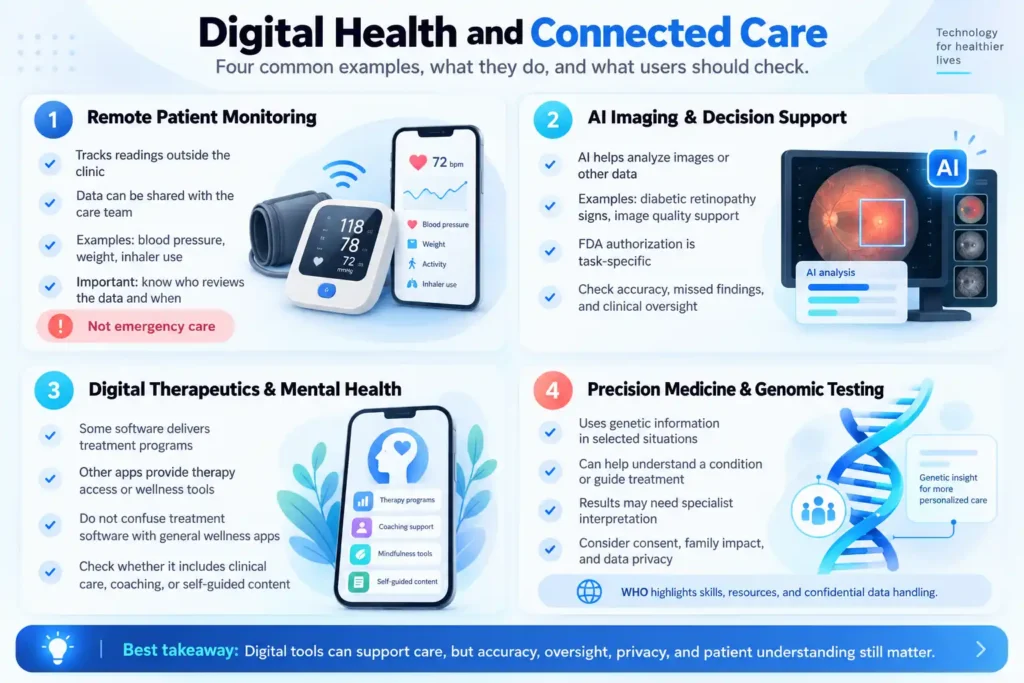
Digital Health and Connected Care
14. Remote Patient Monitoring
Remote patient monitoring combines measurements taken outside a clinic with a system for sharing and reviewing them.
A blood pressure cuff might send readings to a care team. A connected scale may support monitoring within a prescribed care plan. Some connected smart inhalers can also record inhaler use or related data for review, depending on the product and care program.
Patients need to know who reviews the data, when review happens, and what to do if symptoms develop. Data transmission alone does not provide emergency care.
15. AI Imaging and Decision Support
Artificial intelligence can analyze images or other data for a defined task. Examples include identifying signs of diabetic retinopathy in retinal images and improving image quality.
The FDA lists authorized AI devices and their intended uses. Authorization for one function does not establish that a tool can diagnose every condition.
Useful questions concern the patients studied, accuracy, missed findings, and required clinical oversight.
16. Digital Therapeutics and Mental Health Platforms
Some software delivers a treatment program for a specific condition. Other platforms connect users with therapists or offer general wellness activities.
These categories should not be confused. A meditation app and software evaluated for treating a disorder make different claims.
Look for evidence about the actual product and purpose. Check whether clinical care, coaching, or self-guided content is included.
17. Precision Medicine and Genomic Testing
Genomic testing examines genetic information. In selected situations, results can help clinicians understand a condition or choose treatment.
Precision medicine combines information about the person with evidence about available care options.
A result may need specialist interpretation. It can also have implications for relatives, consent, and data privacy. WHO identifies resources, workforce skills, and confidential data handling as important requirements.
How Do Healthcare Systems Share Information?
Information exchange allows records to move between systems. This is called interoperability.
HL7’s Fast Healthcare Interoperability Resources standard, known as FHIR, supports electronic exchange of clinical and administrative information. It helps software communicate using agreed formats.
Cloud services can host applications and records. They still need appropriate access controls, security, and reliable operation.
Understanding health technology in different care settings helps explain why a home app and a hospital system have different requirements.
Emerging Technologies and Their Evidence
18. Wearable Ultrasound and New Biosensors
Researchers are developing sensors that measure more information with less disruption to daily life.
MIT researchers reported further work on a portable breast ultrasound sensor in February 2026. The research aims to make imaging more accessible. A research report does not establish routine home availability or replace recommended screening.
Always check whether an example is a prototype, a trial device, or an available medical product.
19. 3D Bioprinting
Bioprinting places cells and materials into planned structures. Researchers use it to build tissue models for studying disease and testing substances.
A study described small printed human liver tissue models for drug research. These models are different from whole organs ready for transplantation.
An article about tissue research should not imply that hospitals routinely print replacement organs.
20. Medical Delivery Drones
Drones can carry medical supplies or emergency equipment to selected locations.
Their usefulness depends on dispatch systems, distance, weather, permissions, and what happens after delivery. An automated external defibrillator still needs a person to apply it and follow instructions.
A successful pilot in one area does not prove that the service is available nationwide.
Benefits, Limitations, and Safer Choices
Technology can help people access care, record changes, and receive treatment. Those benefits depend on implementation.
Costs may include the device, replacement supplies, subscriptions, training, and clinical services. Insurance coverage varies by plan, product, and purpose. Ask about ongoing costs before purchase.
Privacy also needs attention. HHS explains that HIPAA generally does not protect information entered into personal consumer apps unless the app is provided by a covered entity or its business associate. Other protections may apply, but a health-related label alone does not establish HIPAA coverage.
Good health technology management includes equipment checks, maintenance, staff training, and plans for failures.
A Practical Example
Consider a hypothetical patient whose clinician recommends home blood pressure monitoring.
The patient learns the measurement method and records readings as instructed. The clinic explains how to submit them and when they will be reviewed.
This plan connects the device to care. Buying a cuff without knowing how to use it or share the results leaves important steps unfinished.
Common Mistakes to Avoid
- Choosing a device because it has more features.
- Assuming every reading is accurate.
- Treating wellness scores as diagnoses.
- Believing an app is monitored continuously.
- Sharing sensitive data without checking permissions.
- Assuming authorization means a product suits everyone.
- Ignoring supplies, service fees, or maintenance.
- Changing treatment based only on an unexplained alert.
Before choosing a tool, ask what problem it addresses, what evidence supports it, and who will help interpret the information.
Frequently Asked Questions
What Are 10 Important Uses of Technology in Healthcare?
Ten important uses are:
- Viewing structures inside the body.
- Testing samples for signs of disease.
- Monitoring health measurements.
- Delivering medicines.
- Supporting surgery.
- Restoring hearing or movement.
- Connecting patients with clinicians remotely.
- Storing and sharing records.
- Supporting treatment decisions.
- Helping researchers study diseases and treatments.
Each use needs evidence, suitable equipment, and clear responsibilities.
What Are Digital Health Technology Examples?
Examples include telehealth platforms, patient portals, electronic health records, connected glucose sensors, remote monitoring systems, and selected treatment software.
Some collect information. Others deliver services or support decisions. Their functions and medical claims differ.
What Are Examples of Technology in Hospitals?
Hospitals use imaging scanners, laboratory equipment, bedside monitors, infusion pumps, ventilators, electronic records, and surgical assistance systems.
These tools support different stages of care. Staff training, maintenance, and correct interpretation remain necessary.
What Technologies Are Used in Healthcare?
Healthcare uses mechanical devices, electronics, imaging, laboratory methods, software, biotechnology, and communication systems.
Some tools prevent illness or provide treatment. Others support administration, research, rehabilitation, or daily independence.
What Are Emerging Technology Examples in Healthcare?
Examples include wearable ultrasound research, new biosensors, bioprinted tissue models, and developing uses of AI.
Some newer technologies already have specific authorized uses. Others remain under study. “Emerging” should describe the particular application, rather than imply that everything is experimental.
What Are Health Information Technology Examples?
Examples include electronic health records, patient portals, electronic prescribing, laboratory information systems, and tools for sharing records.
These systems organize and exchange information. They need accurate data, secure access, and workflows that staff can use.
What Is Digital Technology in Healthcare?
Digital technology uses computers, software, sensors, or electronic communication to support health.
A portal lets a patient read a result. A sensor collects a measurement. A clinical system helps staff document care. Digital health includes these different functions.
Which Companies Work in Health Technology?
Examples include Abbott and Dexcom in glucose monitoring, Epic and Oracle Health in clinical software, Teladoc Health in virtual care, and Intuitive in surgical systems.
Apple, Oura, and WHOOP offer wearable products. Specific features differ, and a company’s name does not establish a product’s medical suitability. These examples are not a ranking or endorsement.
Choosing Technology That Serves a Clear Purpose
The best health technology examples are useful because they solve a defined problem and fit the person or care setting. Check each tool’s intended use, supporting evidence, costs, and limitations.
For patients, the next step is often a discussion with the care team about which information or function would help. For healthcare organizations, the decision also involves staff, maintenance, security, and integration with existing services.


