

Health Technology Companies & Products
Health technology companies and products include software, devices, and services that support care, health research, or personal wellness. Examples range from electronic health records and virtual care to glucose sensors, surgical systems, and clinical AI.
There is no single best company for every reader. A hospital choosing an electronic health record has different needs from a patient comparing glucose monitors. This guide focuses on the United States, groups ten examples by product type, and gives readers a practical way to compare them.
What counts as health technology?
Health technology includes tools used to collect, store, share, or act on health information. Healthcare technology companies may serve hospitals, clinicians, patients, researchers, or consumers. Digital health companies focus on software and connected services, while medical device companies make equipment used for monitoring, diagnosis, or treatment.
A product’s intended use matters. A wellness app that tracks activity does not automatically have the same role or regulatory status as a medical device used to support diagnosis or treatment. The FDA considers intended use and technical features when regulating medical devices, including those that use AI.
The agency reported more than 1,600 AI-enabled medical devices authorized for marketing in the United States as of September 2026. That list covers varied devices and uses, so one authorization does not apply to every AI health product.
10 Ten health technology companies and products
These examples are grouped by what the products do. They are not ranked and are not endorsements. Product features, availability, and eligibility can change, so check the linked company page and current product labeling before making a decision.
| Company | Category | Example product | Typical user |
| Epic Systems | EHR and patient portal | MyChart | Patients and provider organizations |
| Oracle Health | Electronic health records | Oracle Health EHR | Clinicians and health organizations |
| Teladoc Health | Virtual care | Virtual primary care | People with access through a plan, employer, or service |
| Dexcom | Continuous glucose monitoring | Dexcom G7 | People with diabetes and their care teams |
| Abbott | Continuous glucose monitoring | FreeStyle Libre 3 Plus | People who meet the product labeling and access requirements |
| Intuitive | Robotic assisted surgery | da Vinci surgical systems | Surgeons and hospitals |
| ResMed | Sleep apnea therapy | AirSense 11 | Patients using prescribed positive airway pressure therapy |
| Tempus | Diagnostics and precision medicine | Tempus clinical and research solutions | Clinicians, health organizations, and researchers |
| Abridge | Clinical documentation software | Abridge AI platform | Clinicians and health systems |
| Apple | Wearable health features | Apple Watch ECG app | Apple Watch users where the feature is available |
1. Epic Systems: electronic health records and MyChart
Epic MyChart supports patient access to health information and related services.
2. Oracle Health: EHR systems
Oracle Health EHR is an information system for documenting, viewing, storing, retrieving, and exchanging patient information.
3. Teladoc Health: virtual care
Teladoc Health offers virtual primary care and connects users with additional services, depending on availability and eligibility.
4. Dexcom: glucose monitoring
Dexcom G7 displays glucose readings and trends through a compatible phone or receiver. Follow its labeling and care team guidance.
5. Abbott: glucose monitoring
Abbott says the FreeStyle Libre 3 Plus sensor streams glucose data to a compatible smartphone. Check current labeling, eligibility, and compatibility.
6. Intuitive: surgical systems
The da Vinci system lets a surgeon control instruments during surgery. It does not perform surgery on its own.
7. ResMed: sleep apnea therapy
AirSense 11 is a positive airway pressure device for sleep apnea therapy. A clinician determines whether it is suitable.
8. Tempus: diagnostics and precision medicine
Tempus combines diagnostic, data, and AI-enabled tools for clinical care and research. Check each solution’s intended use and evidence.
9. Abridge: clinical documentation AI
Abridge software creates draft clinical documentation from patient and clinician conversations. Clinicians should review records for accuracy.
10. Apple: wearable health features
The ECG app is available on compatible models and in supported regions. Its results do not replace medical evaluation.
The examples include established companies and health tech startups. Startups may build clinical software, patient services, data tools, or devices. Before relying on a newer product, check its intended use, supporting evidence, compatibility, privacy terms, and support arrangements.
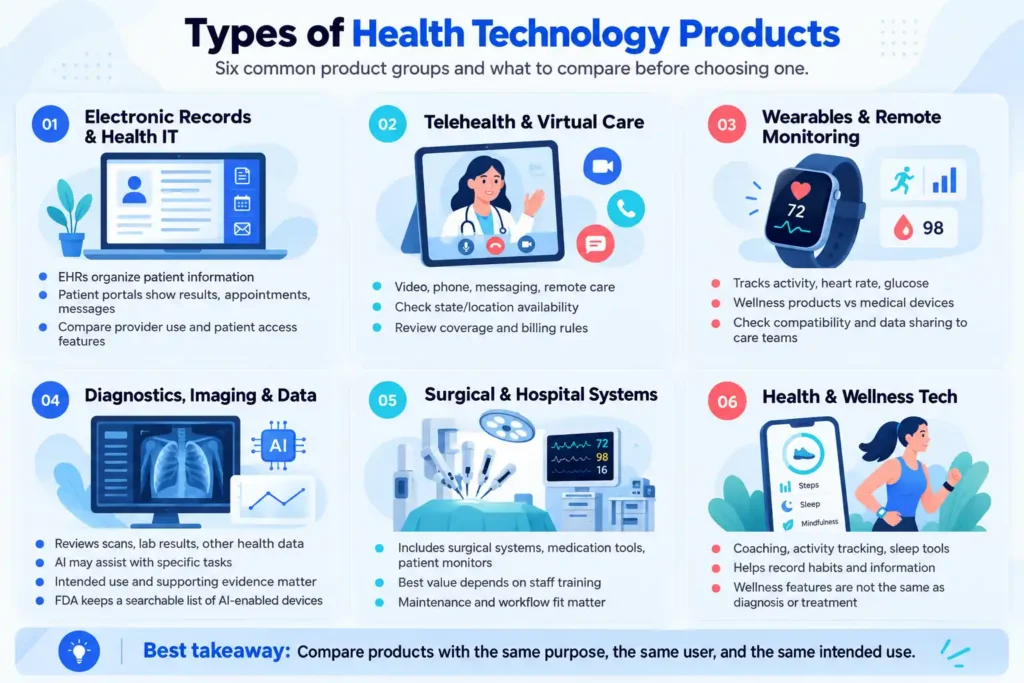
Types of health technology products
A company may offer more than one product type, and similar products can serve different users. Use these categories to narrow a search and compare products with the same purpose.
Electronic records and health IT
Electronic health records, or EHRs, store and organize patient information for care teams. Patient portals let people view selected records, test results, appointments, or messages. When comparing systems, check which providers use them and what patient access features are available.
Telehealth and virtual care
Telehealth products connect patients and clinicians through video, phone, messaging, or remote care services. Check which services are offered, whether a clinician can serve people in your state, and how the visit is covered or billed. Availability can depend on location, insurance, employer benefits, and service rules.
Wearables and remote monitoring
Wearables and sensors can collect information such as activity, heart rate, or glucose readings. Some are general wellness products. Others are medical devices with a defined use. Check the product’s intended purpose, compatible phone or receiver, and how information reaches a care team, if that is part of the service.
Diagnostics, imaging, and data products
Diagnostic products may analyze scans, lab results, or other health information. AI can assist with specific tasks, but the intended use and supporting evidence matter. The FDA maintains a searchable list of AI-enabled medical devices authorized for marketing in the United States.
Surgical and hospital systems
Surgical systems, medication tools, and patient monitors are often bought by hospitals or health systems. Their value depends on clinical use, staff training, maintenance, and fit with existing workflows.
Health and wellness technology companies
Health and wellness technology companies may offer coaching, activity tracking, sleep tools, or other consumer services. These products can help users record habits or information, but a wellness feature should not be mistaken for diagnosis or treatment.
How to compare health technology products
Start with the job the product needs to do. A home monitoring device and hospital record software should not be compared with the same checklist.
| What to check | Why it matters |
| Intended user and purpose | Shows whether the product is designed for patients, clinicians, or organizations. |
| Evidence and regulatory status | Helps separate tested product claims from marketing language. |
| Privacy and data sharing | Shows what information is collected and how it may be used. |
| Compatibility | Confirms whether the product works with a phone, device, EHR, or care team. |
| Cost and access | Identifies fees, insurance coverage, and who can use the product. |
| Training and support | Matters for safe, consistent use in clinics and at home. |
Interoperability also matters. A product may collect useful information but still have trouble exchanging it with another system. According to ASTP/ONC’s analysis of the 2024 AHA IT Supplement, 81% of US hospitals enabled patient access through apps using API specifications in their electronic records, and 70% supported apps using FHIR, or Fast Healthcare Interoperability Resources, specifications. In other clinical and administrative exchanges, hospitals used nonstandard or mixed methods more often than standards-based APIs.
Ask the company or provider how data moves, who can access it, and what happens if the product or service ends.
Secondary topic: UK health technology companies
For readers researching the UK, Beauhurst’s 2026 healthtech list ranks selected UK-headquartered companies by total equity raised. It is a funding-based list, not a score for product quality or clinical results. London accounts for 45 of the 100 companies in that list.
UK health tech jobs
Roles can include software engineering, product management, data science, clinical safety, implementation, regulatory affairs, customer support, and sales. Search company career pages and UK health technology directories for current vacancies. This jobs topic serves UK readers and is secondary to the guide’s US company and product focus.
Common mistakes when choosing a product
- Treating every top list as a ranking. A list may sort companies by funding, visibility, or another measure. Read its methodology.
- Assuming a popular product is right for everyone. Intended users, compatibility, care needs, and cost differ.
- Confusing wellness features with medical care. A tracker may record information without being designed to diagnose or treat a condition.
- Relying on a company claim alone. Look for product documentation, regulator information, and independent evidence where relevant.
Frequently asked questions
What are the top health technology companies and products?
There is no single ranking that fits every category. Examples include Epic and Oracle Health for electronic records, Teladoc Health for virtual care, Dexcom and Abbott for glucose monitoring, and Intuitive for surgical systems. The ten companies in this guide show different product categories; they are not ranked from best to worst. The right choice depends on the product’s use and the reader’s needs.
Which health tech companies are in the UK and London?
Beauhurst’s 2026 list includes selected UK healthtech companies and reports that 45 of its 100 companies are in London. Its ranking reflects equity funding, not clinical superiority. The DigitalHealth.London directory can help readers discover participating companies.
What jobs do UK health tech companies offer?
Roles can include software development, data and AI, product management, clinical safety, implementation, regulatory affairs, and customer support. Openings change, so check company career pages and current UK job listings.
Conclusion
Health technology ranges from patient apps to hospital systems and medical devices. Compare companies by product purpose, evidence, regulatory status, privacy, compatibility, cost, and support. A clear method makes a company list more useful than an unsupported best ranking.
Readers who want a definition can continue with a guide titled “What Is Health Technology?” A separate “Health Technology Examples” article can show how these tools are used in practice.


