

What Is Health Technology? Health Care Technology (Definitions & Overview)
Health technology is the set of medicines, vaccines, devices, procedures, and systems used to prevent, diagnose, and treat health problems and improve quality of life. Health care technology often refers to the tools and systems used to deliver care, from diagnostic equipment to medical records software.
A blood pressure cuff, a vaccine and an online patient portal have something in common. Each helps prevent illness, provide care or support a health decision.
The World Health Organization uses a broad definition (WHO’s health technology definition). That matters because health technology includes much more than computers, artificial intelligence, and connected devices.
For patients, students and healthcare workers, the useful questions are straightforward: What does the technology do? What evidence supports it? Who should use it? What are its limits?
Key takeaways
- Health technology is a broad umbrella: it includes medicines, vaccines, devices, procedures and systems, both digital and non-digital.
- Health care technology focuses on tools that support care delivery and operations.
- A tool works only with training, clear communication, and clinical judgment around it.
- Check evidence, privacy, cost, and limits before using any health tool.
What Is Health Care Technology?
Health care technology is technology used to support patients, clinicians, and healthcare organizations. It can help with diagnosis, treatment, communication, record-keeping, and everyday operations.
A hospital scanner supports diagnosis. An infusion pump delivers medication. Scheduling software helps a clinic organize appointments. These tools serve different purposes, but all support care.
“Healthcare technology” and “health care technology” usually mean the same thing. The spelling changes, not the basic idea.
Does Health Technology Have to Be Digital?
No. A surgical instrument, hearing aid or vaccine can qualify without an internet connection.
Digital health is one part of the broader field. The FDA includes mobile health, health information technology, wearable devices, telehealth, and personalized medicine within its digital health overview.
A useful way to look at technology and health is to focus on purpose. The question is whether a tool, treatment, or system supports a health need, not whether it looks advanced.
Health Technology vs. Digital Health vs. Health IT
These terms overlap, but they emphasize different parts of healthcare.
| Term | Main focus | Familiar example |
| Health technology | Health interventions, tools and supporting systems | A vaccine, diagnostic test or care system |
| Healthcare technology | Technology supporting care and operations | A scanner or appointment platform |
| Medical technology | Tools and techniques used for medical purposes | A surgical instrument or implant |
| Digital health | Digital tools supporting health and care | A telehealth service |
| Health information technology | Recording, managing and exchanging health information | An electronic health record |
| Health informatics | Using information and computing to improve care | Studying records to improve a clinical process |
These are practical distinctions, not strict boundaries used identically by every organization.
For example, a connected glucose monitor is a medical device. Its readings may appear in a digital app and become part of a health information system. So medical technology in practice means looking at both the physical tool and the information around it.
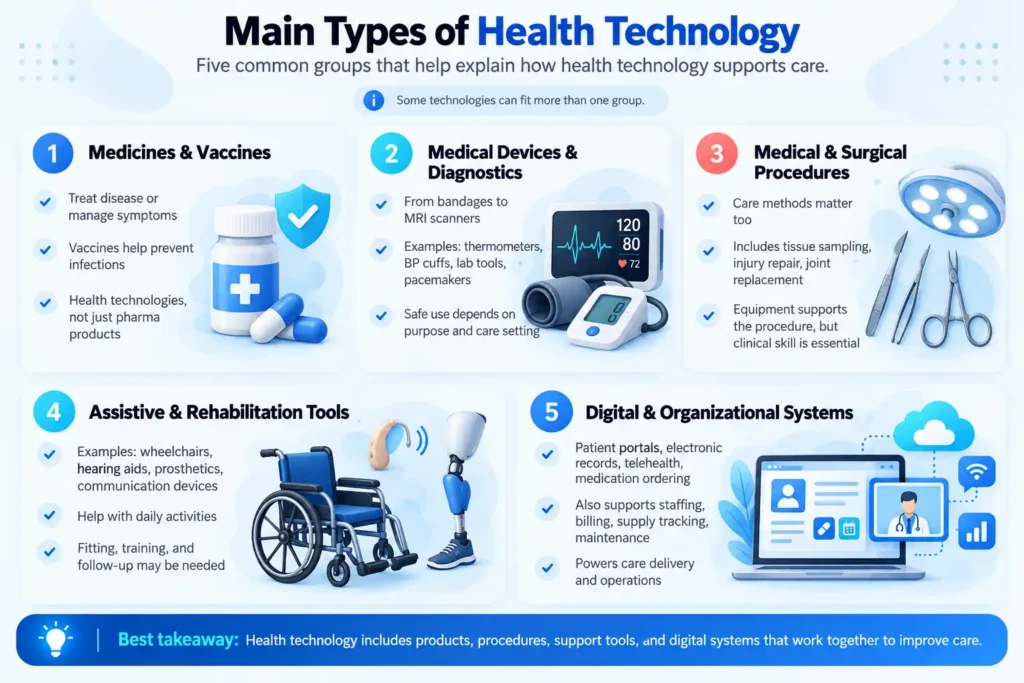
Main Types of Health Technology
The following groups provide a useful introduction. Some technologies belong in more than one group.
Medicines and Vaccines
Medicines can treat disease, relieve symptoms or help manage a condition. Vaccines help prevent particular infections and their consequences. These are health technologies even though people may think of them mainly as pharmaceutical products.
Medical Devices and Diagnostic Equipment
Devices range from simple bandages to complex imaging systems. Examples include thermometers, blood pressure cuffs, laboratory equipment, pacemakers, and magnetic resonance imaging machines, commonly called MRI scanners. Their safe use depends on the intended purpose, instructions, and care setting.
Medical and Surgical Procedures
Technology in health also includes methods used to provide care. Examples include procedures for taking tissue samples, repairing injuries, or replacing damaged joints. Equipment supports these procedures, but the method and clinical skill matter too.
Assistive and Rehabilitation Tools
Wheelchairs, hearing aids, prosthetic limbs, and communication devices help people carry out daily activities. Selecting the right tool may require fitting, training, and follow-up. A product that works well for one person may not meet another person’s needs.
Digital and Organizational Systems
These include patient portals, electronic records, telehealth platforms, and medication ordering systems. Administrative tools also support staffing, billing, supply tracking, and equipment maintenance.
Health Technology Examples: Purpose and Limits
The table below connects common examples with their purpose and limits.
| Example | Main purpose | Important limit |
| Blood pressure cuff | Measure blood pressure | Fit and measurement technique affect readings |
| MRI scanner | Produce detailed internal images | Some implants require special safety checks |
| Hearing aid | Support hearing | Fitting and adjustment matter |
| Electronic health record | Store clinical information | Records can contain errors or missing details |
| Patient portal | Provide access to records and messages | Urgent problems need an appropriate urgent response |
| Telehealth platform | Support care at a distance | Some problems require a physical examination |
| Glucose monitor | Track glucose readings | Users must follow device instructions |
| Infusion pump | Deliver fluids or medicine | Setup, maintenance and checks remain necessary |
How Technology Is Used in Health Care
Technology supports different stages of care. Its value depends on how well those stages connect.
Prevention and Diagnosis
Screening tests, laboratory systems and medical imaging help clinicians investigate health concerns. A result still needs context. Symptoms, medical history and the reason for ordering the test affect what it means. An abnormal result does not always establish a diagnosis by itself.
Treatment and Follow-Up
Treatment may involve medicines, surgical equipment, implanted devices, or rehabilitation tools. After treatment, monitoring can help a care team track changes. Depending on the condition, this might involve office visits, laboratory tests, or measurements taken at home.
Records and Communication
An electronic health record (EHR) holds information such as diagnoses, medications, allergies, and test results.
Federal health IT data report that more than 99% of US nonfederal acute care hospitals had adopted certified EHRs by 2024 (ONC Health IT Research & Analysis). This measures adoption, not whether every record is complete or easily shared.
Patient portals provide another connection. Patients may use them to view results, request appointments, or send messages.
Practical Example: A Blood Pressure Follow-Up
Consider an illustrative patient whose clinician recommends home blood pressure checks.
- The clinic records the plan in its EHR.
- A staff member explains how to use the cuff.
- The patient takes readings as instructed and shares them through an agreed channel.
- The care team reviews the readings alongside symptoms, medicines and medical history, then decides whether further assessment is needed.
The cuff alone does not provide this service. Training, communication and clinical judgment complete the process. The patient should also know who reviews the readings, how quickly staff respond, and what to do when urgent symptoms occur.
10 Reasons Technology Matters in Healthcare
Technology in health care can help in the following ways. These are potential benefits, not promises for every product or setting.
| # | Benefit | How it can help | What must work well |
| 1 | Access to care | Remote visits can reduce travel | The visit must suit the patient’s needs |
| 2 | Diagnostic support | Tests and images provide clinical information | Results need accurate interpretation |
| 3 | Treatment delivery | Devices support precise tasks | Staff need training and safety checks |
| 4 | Care coordination | Shared information supports multiple clinicians | Records must be available and correct |
| 5 | Medication safety | Ordering systems can flag some problems | Alerts need appropriate review |
| 6 | Home monitoring | Readings show changes between visits | Someone must act on relevant information |
| 7 | Rehabilitation | Assistive tools support daily activities | Tools must fit the person |
| 8 | Patient participation | Portals make information easier to access | Information needs a clear explanation |
| 9 | Administration | Software reduces some repeated tasks | Workflows must be designed carefully |
| 10 | Research | Systems support data collection and analysis | Research needs suitable methods and oversight |
These tools work best when they solve a defined problem. For example, online scheduling may help patients book routine visits. It will not solve a shortage of available appointments by itself.
Risks and Limits Patients Should Understand
Benefits deserve attention, but so do the ways a tool can fail.
Privacy Protection Depends on the Service
The Health Insurance Portability and Accountability Act (HIPAA) applies to covered organizations and relevant business associates. It does not protect every piece of health information wherever it appears.
HHS explains that information entered into many personal health apps is generally outside HIPAA protection unless the app is provided by a covered entity or its business associate. Other laws may still apply (HHS guidance on health apps).
Before sharing information, check what an app collects, whom it shares data with, and whether you can delete your account. A health-related name or logo does not establish privacy protection.
A Wellness Feature Is Not Always a Medical Function
A device may track activity without being suitable for diagnosis or treatment decisions.
The FDA warns against smartwatches and smart rings claiming to measure glucose on their own without piercing the skin. Its FDA safety communication distinguishes these products from watch apps that display readings from authorized glucose measuring devices.
Check the specific function and intended use. Do not assume every feature has the same evidence behind it.
Errors Can Come From People, Devices or Software
Poor technique can affect a home measurement. A wrong entry can affect a medical record. Software can produce an incorrect suggestion.
Patients should report incorrect information in their records. Healthcare organizations need checks that help staff notice and correct errors. More alerts are not always better: too many low-value warnings can make important ones harder to notice.
Access and Cost Can Create Barriers
A digital service may require reliable internet, a suitable device, and comfort using software. Language, vision, hearing, memory, and hand movement can also affect access.
Ask about total costs, insurance coverage, replacement supplies, and available support. A low purchase price may not reflect the full cost of use.
Current Technologies and What They Actually Do
Digital tools are important, but their abilities should be explained precisely.
Telehealth and Remote Patient Monitoring
Telehealth supports care and related services at a distance. Telemedicine usually refers more specifically to clinical care delivered remotely.
Remote patient monitoring collects health information outside a traditional visit. It may use blood pressure cuffs, scales, or other appropriate devices. These services need clear plans for reviewing information and responding. A device connection does not automatically mean someone watches every reading continuously.
Healthcare AI
Artificial intelligence can support tasks such as analyzing images, organizing information, or drafting documentation.
The FDA maintains a list of AI-enabled medical devices authorized for marketing in the United States. Authorization applies to the relevant device and intended use, not every AI product or feature.
AI output may be wrong or perform differently across patient groups. Clinical use requires suitable evidence, oversight, and checks. A general chatbot response should not be treated as a confirmed diagnosis.
Precision Medicine
Precision medicine uses information about a person to help guide prevention, diagnosis or treatment. For some conditions, genetic information can help clinicians choose an approach. It is not necessary or useful for every patient.
WHO highlights the need for infrastructure, workforce capacity and governance to support safe, ethical, and equitable precision medicine (WHO on precision medicine).
Interoperability and Cloud Systems
Interoperability means systems can exchange information and use it meaningfully. HL7’s Fast Healthcare Interoperability Resources (FHIR) is a standard for exchanging healthcare information electronically. Using a standard helps, but organizations still need correct patient matching, data quality, and access controls.
Cloud computing provides computing services through remote infrastructure. It does not make a service private, secure, or legally compliant automatically.
How Health Technologies Are Evaluated and Managed
Two related activities help organizations decide what to use and keep it working.
Health Technology Assessment (HTA)
Health technology assessment examines a technology’s value and consequences. It considers clinical effects along with economic, ethical, and social questions (Global HTA overview). Decision makers may ask whether a tool improves outcomes, what harms it could cause, and whether its cost is justified.
US regulatory review, insurance coverage, and assessment of value answer different questions. Permission to market a device does not mean every insurer covers it or every patient needs it.
Healthcare Technology Management (HTM)
Healthcare technology management includes selecting, maintaining, tracking, and eventually replacing equipment. AAMI describes HTM professionals as supporting medical device safety, security, function, and interoperability.
For example, a hospital pump needs inspection, servicing, and trained users. Buying the equipment is only the beginning of its working life.
In short, HTA helps assess whether a technology is worth adopting. HTM helps keep equipment suitable for use.
Questions to Ask Before Using a Health Tool
Start with the problem you need to solve.
- What is the tool designed to do?
- What evidence supports that use?
- Is it suitable for my needs?
- Who explains the results?
- What information does it collect?
- What happens if it stops working?
- What will it cost over time?
- Is a simpler option available?
Common mistakes include choosing by brand alone, assuming every device connects to a medical record and expecting immediate replies through a portal.
When choosing technology, health care teams should also test how it fits existing work. A tool that adds duplicate entries or unclear responsibilities may create new problems.
Frequently Asked Questions
What is the definition of health technology?
Health technology includes medicines, vaccines, devices, procedures, and systems developed to address health problems and support quality of life. It includes both digital and non-digital tools.
Are health technology and healthcare technology the same?
They often overlap. Health technology is commonly used as a broad umbrella, while healthcare technology often emphasizes tools supporting care delivery and operations.
What are some health technology examples?
Examples include vaccines, hearing aids, diagnostic tests, surgical instruments, EHRs, and telehealth platforms. Each serves a different purpose, so its usefulness depends on the task and user.
What are 10 important uses of technology in healthcare?
They include access, diagnosis, treatment, coordination, medication safety, monitoring, rehabilitation, patient participation, administration, and research. The benefits table above explains an important condition for each.
What is healthcare technology management?
It is the work of keeping medical equipment appropriate, available, and safe to use. Tasks include equipment selection, maintenance, repairs, staff support, record keeping, and replacement planning.
Where can I find a reliable health technology PDF?
WHO provides downloadable technical publications. Its 2025 report, Health technology assessment of medical devices, second edition, explains how devices are assessed. It is a technical reference rather than a simple patient guide.
What is a health tech salary in the United States?
There is no single figure, because the term covers equipment technicians, information specialists, software workers, and other roles. For one defined occupation, the BLS reports a median annual wage of $68,020 in May 2025 for health information technologists and medical registrars (BLS occupational data). This is not a starting salary or a figure for every health technology career.
Which health technology courses should I consider?
Choose courses based on the job you want. Equipment work may require electronics and biomedical equipment training, while information roles may involve health records, databases, privacy and data analysis. Check program accreditation, practical training and job requirements; CAHIIM provides a directory of accredited programs. A short course does not automatically qualify someone for a regulated clinical role.
Choosing Technology That Serves a Real Health Need
A new tool is useful only when it meets a real need. Look for evidence, understandable instructions, suitable support and clear limits.
Good technology works alongside trained people and organized care. It helps patients and professionals make better-informed decisions without hiding uncertainty.


