

Technology Investing, Portfolio Management & Planning
Technology investing gives investors exposure to businesses involved in semiconductors, software, cloud services, cybersecurity, artificial intelligence, digital payments, robotics, and other areas of technology. Buying promising technology stocks, however, is only one part of investing well.
Technology Investing, Portfolio Management & Planning also means deciding how much technology exposure fits your goals, how investments should work together, how much risk you can accept, and when the portfolio needs attention.
For U.S. investors, these decisions should begin with the full financial picture. Investor.gov explains that asset allocation depends on factors such as investment time horizon and risk tolerance, while diversification can reduce reliance on a single investment or asset category.
This guide explains how to evaluate technology investments, build an allocation, control concentration, monitor risk, use investment tools, and connect those choices with long term financial goals.
What Is Technology Investing?
Technology investing means putting money into companies, funds, or securities whose value is tied to technology businesses or technology led economic activity.
An investor may own individual technology stocks, exchange traded funds, mutual funds, index funds, or specialized funds. Private equity and venture capital can provide other forms of technology exposure, although private investments often have lower liquidity and more complex risks.
Technology itself includes many different industries. Examples include semiconductors, enterprise software, cybersecurity, cloud infrastructure, digital payments, hardware, robotics, communications, and artificial intelligence.
These businesses do not all face the same risks. A semiconductor manufacturer may depend heavily on manufacturing capacity and product cycles. A software company may depend more on subscriptions, customer retention, margins, and competition.
Technology Investing and Portfolio Management
Technology investing answers one question: what technology investments should an investor evaluate?
Portfolio management asks how those holdings should work together.
Financial planning asks whether that portfolio supports the investor’s real financial goals.
| Area | Main Question | Primary Focus |
| Technology investing | What should I evaluate? | Stocks, ETFs, funds, and themes |
| Portfolio management | How should holdings work together? | Allocation, risk, diversification, rebalancing |
| Financial planning | What is the money for? | Goals, time horizon, liquidity, risk capacity |
A strong investment idea can still create a weak portfolio if the position becomes too large or repeats exposure already held through another fund.
Investor Portfolios vs Technology Portfolios
Technology portfolio management can also describe how a company manages software, infrastructure, applications, and IT projects.
That is different from managing an investment portfolio.
For an investor, technology portfolio management means overseeing financial investments connected with technology companies and funds. It includes allocation, diversification, valuation, monitoring, and risk control.
This distinction matters because many search results for technology portfolio management focus on corporate IT planning rather than personal or institutional investing.
Why Investors Add Technology Exposure
Technology businesses provide access to areas shaped by continued digital adoption.
Cloud computing changed how companies buy computing capacity. Semiconductors support computing, communications, vehicles, data centers, and AI systems. Cybersecurity firms serve growing digital security needs. Software companies can build recurring revenue through subscription models.
Technology exposure can therefore contribute to portfolio growth.
It can also increase risk.
Technology stocks can trade at high valuations and may react strongly to changes in interest rates, earnings expectations, competition, regulation, and investor sentiment.
Technology should therefore be part of an asset allocation plan rather than a replacement for one.
The Main Risks of Technology Investing
Price volatility is one major risk. Technology stocks can rise quickly when expectations improve and fall sharply when forecasts weaken.
Valuation matters too. A strong company may still be a poor investment at a price that assumes unusually high growth for many years.
Concentration is another concern. An investor may own several technology funds and believe the portfolio is diversified even when those funds hold many of the same companies.
FINRA warns that concentration risk can arise when a large part of a portfolio depends on one investment, asset class, industry, or market segment. It also recommends looking inside mutual funds and ETFs for overlapping holdings.
Other risks include cybersecurity incidents, regulatory changes, supply chain problems, geopolitical restrictions, product failure, customer losses, and disruption from competitors.
AI investments bring an additional concern. Business opportunities may be real while stock prices already assume very strong future results.
How to Build a Technology Investment Portfolio
Portfolio construction should start with the investor rather than a stock screen.
Define the Financial Goal
A portfolio designed for retirement thirty years from now can usually handle different risks than money needed for a home purchase in three years.
Start by identifying what the money is for and when it may be needed.
Measure Risk Tolerance and Risk Capacity
Risk tolerance describes how comfortable an investor is with losses.
Risk capacity describes how much loss the investor can financially absorb without damaging an important goal.
These are not always the same.
Investor.gov directly connects asset allocation with investment time horizon and risk tolerance.
Decide How Much Technology Exposure Fits
There is no universal percentage that works for everyone.
An investor who already owns a broad U.S. index fund may already have meaningful exposure to large technology companies. Adding a technology ETF could increase the same positions instead of creating new diversification.
A better question is:
How much technology exposure do I already have across all accounts?
That review should include brokerage accounts, IRAs, 401(k) plans, ETFs, mutual funds, and individual stocks.
Choose Stocks, ETFs, or Funds
Individual stocks provide control over company selection and position size, but they also create more company specific risk.
Technology ETFs spread money across multiple companies. Some are broad, while others concentrate on semiconductors, cybersecurity, AI, cloud computing, or another theme.
Mutual funds can provide active or index based exposure. Investors should review strategy, fees, turnover, benchmark, and holdings before investing.
Investors who want deeper coverage of pooled and private market vehicles can also study Technology Investment Funds: Mutual Funds, Private Equity & Venture Capital.
Stocks vs ETFs vs Mutual Funds
| Feature | Individual Stocks | Technology ETFs | Mutual Funds |
| Company control | High | Low | Low |
| Diversification | Depends on holdings | Usually higher | Usually higher |
| Research needed | High | Moderate | Moderate |
| Company risk | High | Lower | Lower |
| Fund expense ratio | None | Yes | Yes |
| Common use | Targeted exposure | Broad or thematic exposure | Managed or index exposure |
An ETF is not automatically diversified simply because it owns many securities. A narrow fund can still depend heavily on one sector or group of companies.
FINRA notes that ETFs and mutual funds can provide diversified exposure, but investors should still examine strategy, holdings, costs, and risks.
How to Analyze a Technology Stock
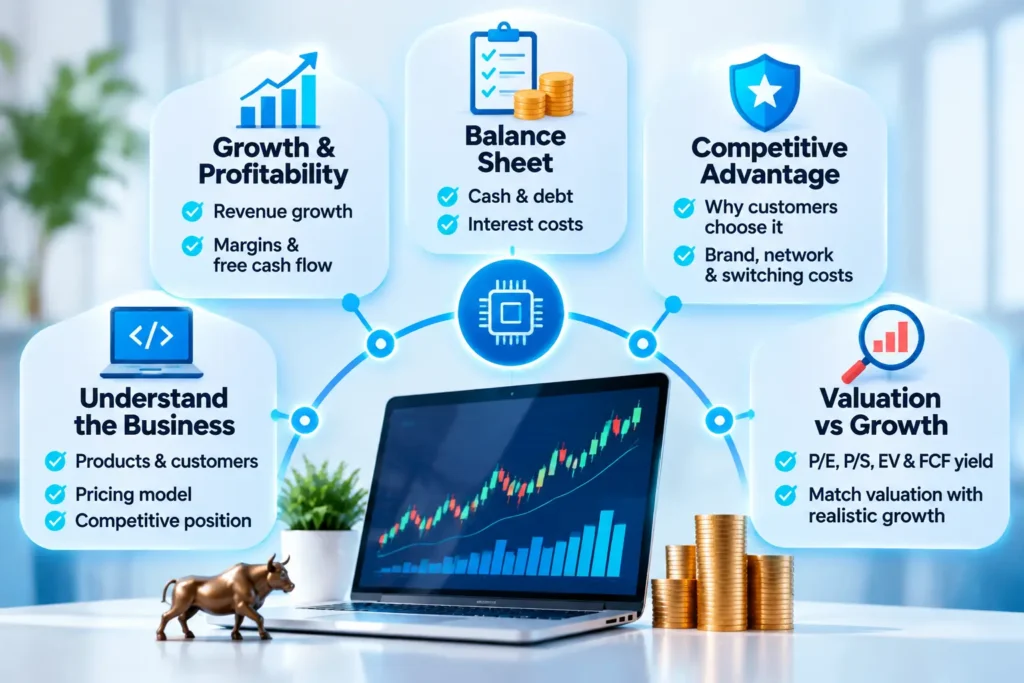
Technology stock analysis should connect business quality with the price being paid.
Understand the Business
Start with the company’s products, customers, pricing model, and competitive position.
A software company may earn recurring subscription revenue. A semiconductor company may depend more on unit demand, manufacturing economics, and product cycles.
Study Growth and Profitability
Revenue growth matters, but investors should ask what creates it.
Is the company gaining customers, raising prices, buying competitors, or entering new markets?
Gross margin, operating margin, and free cash flow can help show whether growth is turning into stronger economics.
Examine the Balance Sheet
Review cash, debt, interest costs, and major financial obligations.
A heavily indebted company may have less flexibility during periods of weaker demand or higher borrowing costs.
Assess Competitive Advantage
Ask why customers choose the company, whether switching is difficult, how strong the brand or network is, and how much the business must spend to remain competitive.
Technology leadership can change quickly.
Compare Valuation With Growth
Useful valuation measures may include price to earnings, forward price to earnings, price to sales, enterprise value relative to earnings, and free cash flow yield.
Different metrics suit different businesses.
A fast growing software firm that is not yet profitable should not be analyzed exactly like a mature, profitable technology company.
The main goal is to compare the current price with realistic business expectations.
Technology Investment Opportunity Matrix
A simple framework can help investors avoid treating every technology area as the same opportunity.
| Technology Area | Maturity | Main Portfolio Issue | Possible Role |
| Semiconductors | Established | Cycles and supply chains | Core or focused |
| Cloud software | Established | Competition and valuation | Core or focused |
| Cybersecurity | Growing | Competition and execution | Focused |
| AI infrastructure | Growing | High expectations | Focused |
| Robotics | Developing | Adoption pace | Focused |
| Early technology themes | Early | High uncertainty | Speculative |
These labels are research categories, not return forecasts. The financial condition, competitive position, and valuation of the actual investment still matter.
Investors interested in assets outside standard public technology stocks may also explore Alternative Technology Investments & Market Trends.
How to Diversify a Technology Heavy Portfolio
More tickers do not always mean more diversification.
An investor might hold an S&P 500 fund, a technology ETF, a Nasdaq linked fund, and several large technology stocks. Those holdings may repeatedly expose the portfolio to the same companies.
Check fund holdings before adding another product.
Then review exposure by company, industry, geography, company size, and asset class.
Diversification outside technology may matter even more. Bonds, cash, international equities, and companies from other sectors can respond differently to changing economic conditions.
Investor.gov says diversification should occur both across asset categories and within them.
How to Monitor Portfolio Risk
Portfolio reviews should look beyond total return.
Concentration shows whether too much capital depends on one company or theme.
Volatility measures how widely returns move.
Maximum drawdown shows how far an investment fell from a previous high.
Beta estimates how strongly an investment has moved relative to a benchmark.
Correlation helps show whether different holdings tend to move together.
None of these measures predicts the future.
Investors can also use simple stress scenarios. Consider what might happen if interest rates rise, technology valuations fall, semiconductor demand weakens, or a major holding reports disappointing earnings.
When Should a Portfolio Be Rebalanced?
Rebalancing means bringing a portfolio back toward its intended allocation.
Suppose technology was meant to represent a certain share of a portfolio. After strong market gains, that exposure may become much larger than planned and create more risk.
Investor.gov notes that some investors review allocations every six or twelve months, while others rebalance when holdings move beyond a chosen threshold. It also notes that rebalancing tends to work best when done relatively infrequently.
Investors can rebalance by selling overweight positions, directing new contributions toward underweight investments, or using both methods.
Taxes and transaction costs should be considered before selling assets in a taxable account.
Common Technology Investing Mistakes
One common mistake is chasing recent performance. A stock or theme rises quickly, and investors assume the trend must continue.
Another is confusing a good company with a good investment at any price. Strong business results do not prevent a stock from falling if expectations were even higher.
ETF overlap can create another problem. Several funds may have different names while owning many of the same companies.
Investors can also hurt results by making decisions based on fear or excitement. Fear of missing out may encourage buying after large gains, while panic can lead to selling after a sharp decline.
A written investment plan can make these decisions easier to judge.
Investment Management Technology and Portfolios
Investment management technology includes portfolio accounting, analytics, risk systems, research tools, trading platforms, automated advice, and AI based analysis.
BlackRock’s Aladdin platform is one institutional example. Its risk tools combine portfolio data, risk analysis, scenario testing, and public and private market analytics.
Individual investors often use simpler technology. Brokerage dashboards can show allocations and returns. Portfolio trackers can combine accounts. Screening tools can compare company fundamentals. Risk tools can help identify concentration and overlapping funds.
AI can assist with document analysis, research, portfolio construction, and risk work.
CFA Institute reported that AI is being used across investment strategy, portfolio management, risk analysis, and trading, while transparency, accountability, human judgment, and governance remain important.
AI can process information quickly, but it can also use incomplete data or produce incorrect conclusions. Investors should verify important information before acting on an AI generated recommendation.
What to Check in Portfolio Software
Portfolio software should make financial information easier to understand.
Useful features may include:
- Account aggregation
- Asset allocation reporting
- Sector and company exposure
- Performance reporting
- Benchmark comparisons
- Fund holdings and overlap
- Risk measures
- Data security controls
Investors should also understand what permissions a platform receives and whether it can trade in an account or only display information.
Marketing around investment management technology often promotes AI, automation, and analytics. When reviewing investment management technology marketing, focus on independently verifiable features, transparent fees, risk disclosures, methodology, and security rather than product labels alone.
Portfolio Management and Long Term Planning
Technology exposure should support a financial plan rather than control it.
An investor saving for retirement many years away may have a different ability to accept volatility than someone who expects to withdraw money soon.
Liquidity matters too. Money needed for near term expenses should not depend on a volatile stock being at a favorable price on the exact date cash is required.
U.S. investors should also consider account type. Taxable brokerage accounts, traditional retirement accounts, and Roth accounts can have different tax treatment.
Investors interested in the systems connecting financial institutions and capital markets can separately explore Investment Banking Technology & Financial Market Innovation.
Technology Portfolio Health Check
A periodic review can focus on a few direct questions.
| Area | Question to Ask |
| Concentration | Is one company or theme too large? |
| Fund overlap | Do several funds own the same stocks? |
| Valuation | Does the price require very strong future growth? |
| Risk | Could I tolerate a large decline? |
| Diversification | Does the portfolio depend too much on technology? |
| Investment thesis | Are the reasons I invested still valid? |
| Allocation | Has market performance changed my intended mix? |
| Goal | Does the portfolio still fit when I need the money? |
The goal of this review is not constant trading. It is to check whether market movements have changed the portfolio into something the investor did not intend to own.
Frequently Asked Questions
What is technology portfolio management?
For an investor, technology portfolio management is the process of selecting, allocating, monitoring, and rebalancing technology related investments while managing concentration, valuation, and risk.
In a business setting, the same phrase can describe management of software, IT infrastructure, applications, and technology projects.
What is the salary of a portfolio manager?
Portfolio manager pay varies by employer, location, experience, asset class, and bonus structure.
Different salary databases use different job definitions and reporting methods, so salary figures should be treated as estimates rather than one official national number.
How much fees do PMS charge?
There is no single U.S. portfolio management fee.
Some advisers charge a percentage of assets under management. Others use hourly, flat, subscription, or planning fees.
Before hiring an adviser, review Form ADV. The SEC requires registered investment advisers to disclose their advisory fees and other costs in their brochure.
What are the top 3 investment management companies?
It depends on the measure used.
Using assets in U.S. domiciled open end mutual funds and ETFs, Morningstar’s June 30, 2026 data placed Vanguard ahead of BlackRock and Fidelity among the largest U.S. fund managers.
Size does not mean a company or fund is right for every investor.
What are the four types of portfolio management?
A common classification includes active, passive, discretionary, and non discretionary portfolio management.
Active management seeks to beat a benchmark.
Passive management generally tracks an index or benchmark.
Discretionary management gives an authorized manager decision making authority within an agreed mandate.
Non discretionary management leaves final approval with the client.
These classifications can overlap.
How much does a portfolio manager cost?
Costs depend on the service model, portfolio size, services provided, and pricing structure.
Advisers may charge an asset based fee, flat fee, hourly rate, subscription, or separate planning fee.
Investors should compare the total cost with the services they receive.
How much do I need to invest to make $1,000,000?
The amount depends on starting capital, future contributions, time, investment returns, fees, and taxes.
For illustration, assuming a steady 7 percent annual return, about $508,000 invested today could reach $1 million in 10 years, about $258,000 in 20 years, or about $131,000 in 30 years.
These are mathematical examples, not forecasts. Real investment returns are uneven and are not guaranteed.
Is it worth it to have a portfolio manager?
It may be worth the cost when an investor needs help with portfolio design, rebalancing, taxes, retirement planning, behavioral decisions, or a complex financial situation.
Someone with a simple portfolio may prefer lower cost funds and occasional professional advice.
The value depends on the investor’s needs and the total fee.
Is $100,000 enough to work with a financial advisor?
Yes. Some advisers work with clients who have $100,000 or less, although other firms set higher minimums.
Investors can also consider hourly advisers, flat fee planners, subscription services, and robo advisers.
The SEC recommends reviewing a robo adviser’s fees, investment approach, information used to make recommendations, and level of human interaction.
Conclusion
Good technology investing starts with business research, but portfolio management goes further.
Investors need to know what they own, how much exposure they have, whether several holdings depend on the same companies or themes, what expectations are built into valuations, and how those positions fit their financial goals.
Technology Investing, Portfolio Management & Planning works best when security selection, diversification, risk control, rebalancing, and financial planning operate as one process.
Technology can provide exposure to important areas of economic growth, but high valuations, concentration, and changing expectations can also produce large losses.
The goal is not to predict every market move. It is to own a portfolio that can still support the investor’s plan when markets do something unexpected.


