

Payment Technology, Digital Payments & Processing Solutions
Payment Technology, Digital Payments & Processing Solutions cover the systems that let people and businesses move money electronically. They include card networks, digital wallets, bank transfers, gateways, processors, merchant accounts, payment rails, security controls, and the software that connects them.
For a business, accepting a payment is only the visible step. Behind a card tap or checkout button, several systems may authenticate the customer, check available funds, approve the transaction, route payment information, settle funds, record the sale, and screen for fraud.
The scale is large. The Federal Reserve reported 236.6 billion US consumer and business noncash payments in 2024. Cards represented 79 percent of those payments by number, while ACH accounted for almost three quarters of noncash payment value.
This guide explains how digital payments work, what each participant does, which payment methods businesses can use, how payment security works, what processing costs may include, and which trends are changing payments in 2026.
What Is Payment Technology?
Payment technology is the hardware, software, networks, security systems, and financial infrastructure used to initiate, authorize, process, settle, and record electronic payments.
A retail terminal is payment technology. So is an ecommerce checkout, mobile wallet, QR payment system, ACH connection, payment API, or software that routes transactions among processors.
Modern digital payments usually connect four groups:
- Customers who send money
- Merchants or other recipients
- Financial institutions that hold or move funds
- Technology providers and networks that carry payment information
The participants depend on the payment method. Card payments may involve an issuer, acquirer, processor, gateway, and card network. ACH uses bank based infrastructure. Instant payments in the United States may use FedNow or The Clearing House RTP network.
Digital Payments vs Payment Processing
A digital payment is an electronic transfer of value between a payer and recipient.
Payment processing is the technical and financial work needed to complete that transfer.
Apple Pay, for example, can initiate a payment, while banks, token services, card networks, processors, security controls, and settlement systems work behind it.
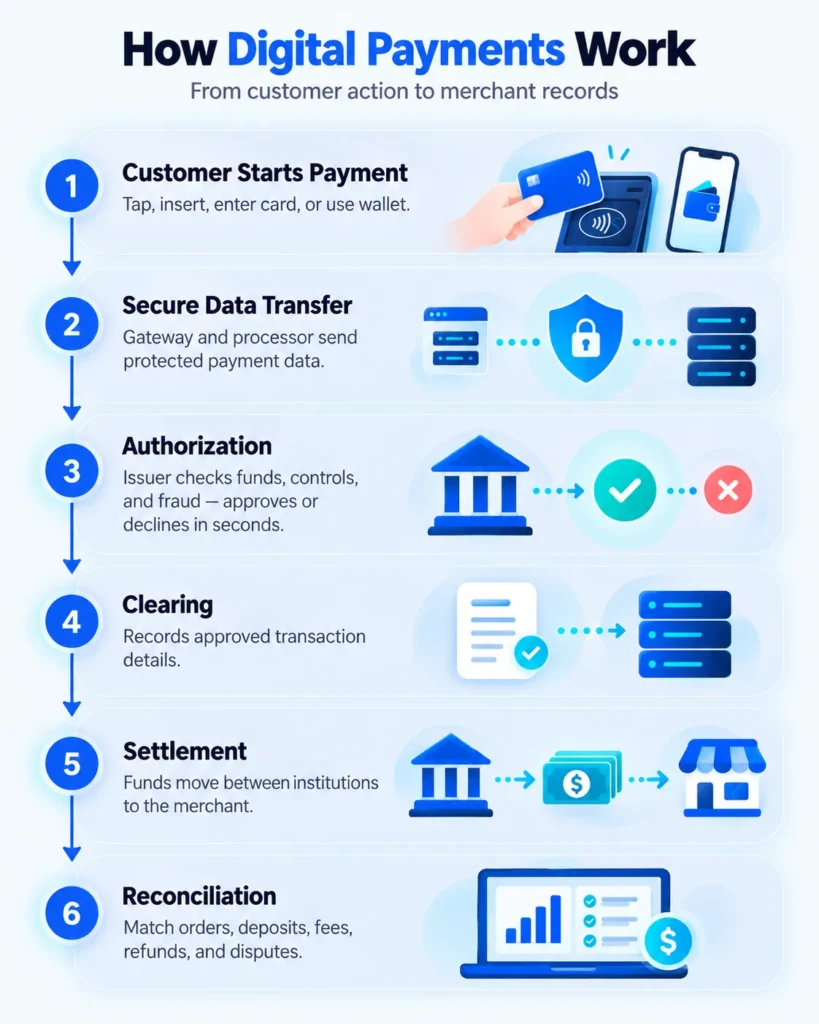
How Do Digital Payments Work?
The route changes by payment method, but a card purchase shows how many of the main participants work together.
1. The Customer Starts the Payment
The customer enters card information, taps a contactless card, uses a digital wallet, or inserts a chip card.
The merchant creates a transaction request containing the amount, payment credential, merchant information, and other necessary data.
2. Payment Data Is Sent Securely
For an online purchase, a payment gateway can capture payment details and send them to a processor.
Merchants can reduce exposure to raw card information by using tokenized credentials, hosted payment pages, and provider controlled payment fields.
3. The Transaction Is Authorized
The processor routes a card request through the acquiring side and card network to the issuing bank.
The issuer checks account status, available funds or credit, card controls, and fraud signals. It then approves or declines the transaction.
This often takes only seconds.
4. Clearing Records the Transaction
An authorization does not mean the merchant already has the money.
Approved transactions are submitted for clearing, where payment participants exchange information needed to calculate their financial obligations.
5. Settlement Moves the Funds
Settlement moves funds between financial institutions and eventually to the merchant according to the provider’s settlement schedule.
6. Reconciliation Matches the Records
The merchant matches orders with deposits, fees, refunds, disputes, and accounting records.
Reconciliation becomes more important when a business operates across several stores, currencies, processors, or sales channels.
Payment Processing Technology Explained
Payment processing technology connects merchants with financial institutions and payment networks so electronic transactions can be authorized and settled.
Several terms appear together but perform different jobs.
| Component | Main Role | Where It Fits |
| Payment gateway | Captures and securely sends payment information | Checkout and transaction entry |
| Payment processor | Routes transaction messages | Between merchant and financial network |
| Acquirer | Supports the merchant side | Merchant financial relationship |
| Issuer | Issues the customer’s card or account | Customer side |
| Card network | Connects participants and sets network rules | Card transaction infrastructure |
| Payment rail | Carries payment information or value | ACH, FedNow, RTP and other systems |
Payment Gateway
A gateway captures payment information and sends it securely into the payment flow. It is especially important in ecommerce and mobile applications.
Payment Processor
A processor manages transaction routing between the merchant side, financial institutions, and payment networks.
Some providers combine gateway and processing services.
Acquirer and Issuer
The acquiring institution supports the merchant side of a card payment.
The issuing institution provides the customer’s card or account and decides whether the transaction can be approved.
Card Networks and Payment Rails
Visa, Mastercard, American Express, and Discover are examples of card networks.
A payment rail is the infrastructure that carries payment instructions or funds. ACH, FedNow, RTP, and card networks can all serve this broader payment function in different ways.
Types of Digital Payments
The right payment mix depends on customer preferences, transaction value, business type, geography, risk, and settlement needs.
Credit and Debit Cards
Cards remain heavily used in the United States.
Federal Reserve data shows that cards represented nearly four fifths of US noncash payment transactions in 2024, with debit cards accounting for the majority of card payments.
Cards work across physical retail, ecommerce, subscriptions, travel, services, and many other business models.
Digital Wallets
Digital wallets can connect customers with cards, bank accounts, stored value, and other funding sources.
Examples include Apple Pay, Google Pay, PayPal, and Cash App.
Worldpay’s 2026 Global Payments Report found that digital wallets represented 56 percent of global ecommerce spend and 33 percent of in person spend in 2025. In the United States, wallets represented 40 percent of online transaction value and 17 percent of point of sale value.
Wallet growth does not necessarily mean cards are disappearing. Many wallet payments still use a credit or debit card as the underlying funding source.
ACH Payments
ACH supports direct deposit, bills, business payments, account transfers, and other bank based transactions.
Nacha reported that the ACH Network processed 35.2 billion payments worth $93 trillion in 2025.
ACH may suit recurring bills and larger account based payments, though settlement timing, return rules, and customer experience differ from cards.
Real Time Payments
Instant payment systems can move funds and payment information quickly between participating institutions.
In the United States, FedNow and RTP are two important systems.
Possible uses include disbursements, account transfers, supplier payments, insurance payments, and other time sensitive transactions.
Peer to Peer and QR Payments
Person to person applications let users send money electronically without cash or checks.
QR systems allow a phone to scan or display payment information. They can support digital acceptance without requiring the same checkout experience as a traditional card terminal.
Buy Now Pay Later
Buy now pay later services let eligible customers divide purchases into installments.
Merchants should compare customer demand, fees, returns, dispute handling, approval experience, and regulatory requirements before adding one.
Stablecoin and Crypto Payments
Some companies accept digital assets directly or use providers that convert them into traditional currency.
Stablecoins are also being explored for cross border payments and settlement. Regulation, custody, conversion, accounting, liquidity, and consumer protections remain important considerations.
Contactless Payment Technology
Contactless payment technology lets a customer pay by placing a compatible card, phone, or wearable near a reader.
Near field communication, or NFC, is commonly used for tap payments.
A contactless transaction still passes through security and processing controls. Depending on the payment method, these may include device authentication, tokenization, issuer checks, fraud screening, and card network processing.
Contactless Cards vs Mobile Wallets
A contactless card communicates directly with a compatible terminal.
A mobile wallet uses a phone or wearable to present a payment credential. Wallets may also use device authentication and tokenized card credentials.
QR vs NFC Payments
NFC depends on compatible short range payment hardware.
QR payments use a code displayed or scanned by a device.
The better option depends on customer behavior, merchant hardware, local payment habits, security design, and the payment system being used.
Payment Technology Solutions for Businesses
Payment technology solutions now cover more than basic card processing.
Businesses may use:
- Ecommerce checkout systems
- Payment gateways
- Card processing
- Point of sale systems
- Mobile payment acceptance
- Recurring billing
- Digital invoices and payment links
- Marketplace payouts
- Cross border payment platforms
- Fraud and identity tools
- Payment orchestration
- Reporting and reconciliation software
A smaller business may need only a few of these tools. Large ecommerce businesses and platforms may use several.
Payment Methods Compared
| Method | Common Use | Speed | Main Strength | Key Consideration |
| Cards | Retail and ecommerce | Fast authorization | Broad acceptance | Fees and disputes |
| Digital wallets | Mobile and online checkout | Fast | Convenient checkout | Funding source matters |
| ACH | Bills and business payments | Varies | Bank based payments | Timing and returns |
| Instant payments | Transfers and payouts | Seconds | Fast movement | Network participation |
| QR payments | Mobile commerce | Fast | Simple acceptance | Adoption varies |
| BNPL | Retail purchases | Fast approval | Installment payments | Cost and credit rules |
How Payment Security Works
No single security control protects every transaction. Payment security works through several layers.
Encryption and Tokenization
Encryption protects information by turning readable data into protected data.
Tokenization replaces a sensitive payment credential with another value. Proper tokenization can reduce how widely the original card number is exposed.
PCI DSS
The Payment Card Industry Data Security Standard sets security requirements for organizations that store, process, or transmit cardholder data.
PCI DSS version 4.x introduced new requirements for modern payment environments. Requirements that were treated as future dated controls became effective on March 31, 2025.
PCI DSS compliance reduces risk but does not make fraud impossible.
EMV and 3D Secure
EMV chip technology makes traditional counterfeit card attacks harder than older magnetic stripe payments.
3D Secure can add authentication to online card transactions. An issuer may require additional customer verification when risk or network rules call for it.
Authentication and Fraud Detection
Authentication can use passwords, phones, security keys, fingerprints, face recognition, or other signals.
Fraud systems may also evaluate device information, transaction amount, account history, behavior, location signals, and previous activity.
Machine learning can detect patterns at large scale, but businesses still need clear risk rules and dispute procedures.
Benefits and Risks of Digital Payments
Electronic payments let businesses accept remote purchases, automate subscriptions, support more customer payment choices, connect transaction data with business software, and reduce dependence on cash or paper checks.
Digital records can also make reporting and reconciliation easier.
The tradeoffs include fraud, disputes, processing costs, failed payments, technical outages, compliance work, and data protection responsibilities.
Businesses should not add a payment method simply because it is available. Each option should solve a customer or operational need.
Healthcare Payment Technology
Healthcare payment technology includes patient portals, online billing, digital invoices, card acceptance, payment plans, and reconciliation tools.
Healthcare adds concerns around privacy, patient identity, insurance, billing records, and access controls.
Payment card information and protected health information are not the same data category. Depending on system design, a healthcare organization may have payment security duties as well as healthcare privacy obligations.
Payment systems should keep sensitive payment, clinical, and billing information appropriately separated and controlled.
Payments Technology in Banking and Fintech
Banks, credit unions, processors, and fintech companies use payments technology to support faster settlement, digital wallets, new payment rails, merchant services, fraud controls, and richer transaction information.
Payment technology also overlaps with banking technology and digital finance solutions, especially when deposit accounts, payment systems, lending, treasury tools, and digital customer experiences connect.
Not every fintech company is a bank. Some fintech firms work with regulated financial institutions that provide banking or deposit services.
Payments are also part of broader financial technology solutions that can include billing, treasury management, fraud tools, lending, account services, and financial reporting.
Real Time Payments and Modern Payment Rails
A payment method describes how someone chooses to pay.
A payment rail is infrastructure used to carry payment information or funds.
ACH is an important US payment rail. FedNow and RTP support instant payments. Card networks provide infrastructure for card transactions.
Cross border payments can involve national payment systems, correspondent banking, card networks, foreign exchange providers, and financial messaging systems.
ISO 20022
ISO 20022 is an international standard for financial messaging.
It provides a common approach for defining financial messages and business information. More structured data can support reconciliation, automation, payment screening, and operational processing.
The current ISO 20022 standard includes multiple parts and is maintained for financial services use.
Payment Orchestration
Large merchants may work with several processors, acquiring partners, payment methods, and fraud tools.
Payment orchestration creates a software layer that connects these systems.
A business can route different transactions according to payment method, geography, cost, provider availability, or performance.
The model can improve flexibility and resilience, but it also creates more technical, reporting, and vendor management work.
Most small businesses do not need a complex orchestration setup.
What Does Payment Processing Cost?
There is no universal processing rate.
Costs depend on payment method, provider, business type, transaction value, sales channel, country, currency, risk, and contract.
Common costs may include:
- Interchange
- Network charges
- Processor markup
- Gateway charges
- Account fees
- Cross border charges
- Currency conversion
- Chargeback costs
- Hardware
- Additional fraud or billing services
Flat Rate Pricing
A business pays a defined pricing formula for eligible transactions.
It is easier to understand but may not produce the lowest cost for every merchant.
Interchange Plus Pricing
The merchant pays the underlying interchange amount plus a processor charge.
It offers more cost detail, although monthly statements can be more complex.
Enterprise Pricing
Larger merchants may negotiate based on volume, geography, payment mix, risk, and required services.
Price should not be judged alone. Approval rates, fraud losses, downtime, settlement timing, reporting, and integration costs can have a larger financial effect than a small difference in quoted transaction fees.
Popular Payment Processing Companies
Payment companies do not all perform the same role. Some focus on merchant processing, some provide broader commerce platforms, and others operate payment networks.
| Company | Common Fit | Notable Focus |
| Stripe | Online and software businesses | APIs, ecommerce, subscriptions |
| PayPal | Consumer and ecommerce payments | Wallet and online payments |
| Square | Small and physical businesses | POS and merchant payments |
| Adyen | Larger international merchants | Unified global payments |
| Worldpay | Mid sized and enterprise merchants | Global acquiring and processing |
| Checkout.com | Digital and global businesses | Online payment infrastructure |
| Braintree | Ecommerce | PayPal owned payment platform |
| Authorize.net | Small and midsize merchants | Gateway services |
| J.P. Morgan | Large businesses | Banking, acquiring and payment services |
| Visa and Mastercard | Banks, issuers and merchants | Global card networks |
This table should be used as an orientation tool rather than a ranking. Businesses should verify current pricing, countries, integrations, and product capabilities directly with each provider.
How to Choose a Payment Processing Solution
Start with what customers need and how the business operates.
Match Payment Methods to Customers
An ecommerce store may prioritize cards, digital wallets, and PayPal.
A business that sends invoices may care more about ACH.
International businesses may need local payment methods and several currencies.
Calculate the Full Cost
Compare more than the advertised transaction rate.
Include processor charges, disputes, refunds, account costs, currency conversion, fraud tools, hardware, and staff time needed for reconciliation.
Review Security and Settlement
Check how the provider handles tokenization, account access, fraud screening, PCI responsibilities, authentication, settlement timing, and incident management.
Test the Technology
Developers should inspect APIs, webhooks, documentation, testing tools, error handling, and software development kits.
Nontechnical teams should test dashboards, checkout setup, reports, exports, and customer support.
Plan for Growth
Consider whether the provider can support future payment methods, currencies, markets, subscriptions, physical sales, and higher transaction volume.
A provider suitable for a small online store may not fit a large marketplace later.
Payments Technology Trends in 2026
Digital Wallets Keep Growing
Worldpay reports that digital wallets accounted for 56 percent of global online spend and 33 percent of in person spend in 2025.
Wallet strategy is becoming more local because consumers fund and use wallets differently across markets.
ACH and Instant Payments Are Expanding
Nacha reported 1.4 billion Same Day ACH payments worth $3.9 trillion in 2025.
At the same time, instant payment systems are giving businesses and consumers more ways to move bank based funds quickly.
AI Is Entering Payment Decisions
Artificial intelligence is being used in fraud detection, risk analysis, software operations, and payment routing.
A newer development is agentic commerce.
In agentic commerce, software may make some purchase decisions within limits set by a user or business.
McKinsey’s 2026 Global Payments Report describes a shift in which payment decisions can move away from visible checkout screens and into software controlled processes.
That creates new questions around identity, consent, spending limits, audit records, disputes, and responsibility.
Tokenization Is Expanding
Tokenization is moving beyond basic stored card details.
Network tokens can reduce exposure of primary card numbers and may help keep payment credentials current when supported by the network and issuer.
Stablecoins Are Being Tested
Stablecoins are being explored for cross border payments, treasury movement, and settlement.
Their usefulness depends on the specific transaction. Regulation, custody, liquidity, conversion, accounting, and counterparty risk still matter.
Common Payment Technology Mistakes
Choosing Only by Price
The lowest quoted processing rate does not always produce the lowest total payment cost.
Fraud, declines, disputes, downtime, settlement, and operational work also affect profitability.
Adding Too Many Payment Methods
More payment choices are useful only when customers use them.
Every added method creates reporting, support, and reconciliation needs.
Ignoring Reconciliation
Accepting money is only one part of payments.
Businesses also need to match orders, deposits, refunds, fees, disputes, and accounting records.
Storing Card Data Without Need
Direct storage of sensitive card information increases security responsibilities.
Tokenized or provider hosted payment options can reduce unnecessary exposure.
Confusing Payment Providers
Gateways, processors, acquirers, banks, payment service providers, networks, and wallets perform different functions.
Businesses should compare providers according to the service they actually need.
Frequently Asked Questions
Is Paymentech owned by Chase?
Yes. Chase states that Paymentech and Chase Merchant Services combined their merchant businesses in 2005 to create Chase Paymentech. Chase Paymentech became a wholly owned division of JPMorgan Chase in 2008. Chase Merchant Services was rebranded as Chase Payment Solutions in 2022.
What are digital payment technologies?
Digital payment technologies are systems used to initiate, authenticate, process, and settle electronic payments. They include card networks, digital wallets, ACH, gateways, processors, QR payments, NFC payments, instant payment systems, tokenization, and payment software.
What bank does fintech use?
There is no single bank used by fintech companies. Some fintech firms are banks, while other fintech companies work with one or more regulated financial institutions to provide accounts, deposits, payment access, or other banking services.
Is Stripe a PSP?
Yes. Stripe operates as a payment service provider and offers businesses tools for accepting and managing electronic payments.
What is the most popular digital payment system?
It depends on the metric. Worldpay reported that digital wallets led global ecommerce by transaction value in 2025, accounting for 56 percent of online spend. In the United States, Federal Reserve data shows that cards remain dominant by number of noncash transactions.
What is an example of fintech?
A mobile payment application is an example of fintech. Digital banking, online lending, payment processing software, automated investment tools, and fraud detection platforms are other examples.
What is the largest digital payment company?
There is no single answer without defining the metric. Companies can be compared by market value, payment volume, revenue, users, cards, or merchant reach. Visa is one of the world’s largest publicly listed payment companies, but rankings change depending on the measurement used.
Do digital payments require a bank account?
No. Some digital payments can use prepaid balances, credit cards, stored value, or wallet funds without requiring the user to pay directly from a traditional bank account.
Final Takeaway
Payment Technology, Digital Payments & Processing Solutions now extend far beyond basic card acceptance.
A small store may need a reliable point of sale system and contactless payments. An ecommerce business may need card processing, digital wallets, fraud controls, and recurring billing. A global platform may require several processors, local payment methods, orchestration, and detailed reconciliation.
The right setup depends on customer preferences, transaction type, cost, security, settlement, technical needs, and the markets a business serves.
Payments will continue to change as instant payment systems, digital wallets, tokenization, artificial intelligence, and newer settlement models develop. Businesses do not need every new tool. They need payment technology that solves a clear customer or operational problem while keeping payment data and money movement controlled.