

Alternative Technology Investments & Market Trends
Technology investing is no longer limited to buying shares of large software and semiconductor companies. Artificial intelligence, private markets, data centers, robotics, power infrastructure, cybersecurity and space technology are creating investment opportunities across a wider set of assets.
For US investors, Alternative Technology Investments & Market Trends cover both the technologies attracting capital and the ways investors can access them. Those routes include public stocks and funds, venture capital, private equity, private credit and infrastructure.
The opportunity is broad, but so are the risks. Private investments can be hard to sell. Young technology companies may never become profitable. New industries can attract capital faster than demand develops.
The useful question is not simply which technology is growing. Investors need to know where economic value is being created, how they can gain exposure and what could go wrong.
What Are Alternative Technology Investments?
Alternative technology investments provide exposure to technological change outside a simple portfolio of conventional large public technology stocks.
They can include private technology companies, venture capital, private equity, private credit, infrastructure, data centers, technology focused real estate and digital assets.
Investor.gov identifies private equity funds, hedge funds and crypto assets among examples of alternative investments. It also advises investors to consider risk, fees, diversification and liquidity before choosing an investment product.
The term can cover two ideas. Investors may use alternative asset classes to gain technology exposure, while technology itself is changing how alternative assets are researched, managed and accessed.
Alternative Technology vs Traditional Tech Stocks
Traditional technology investing normally means owning publicly traded technology companies or funds that hold them.
Alternative exposure can reach other parts of the same economic system.
Growing AI demand, for example, creates demand for chips. Chips need servers. Servers need data centers. Those facilities require networking, cooling and large amounts of electricity. Building that infrastructure also requires debt and equity capital.
An investor studying AI therefore has more choices than buying an AI software stock.
Why Alternative Tech Matters in 2026
Technology spending is moving into physical infrastructure while private markets finance more business growth.
J.P. Morgan Asset Management estimates private markets are now worth nearly $20 trillion. It also notes that many businesses are remaining private for longer, allowing more growth to occur before a public listing.
For investors, public stocks and private capital increasingly finance the same technology themes. This makes access, liquidity and valuation as important as identifying the technology itself.
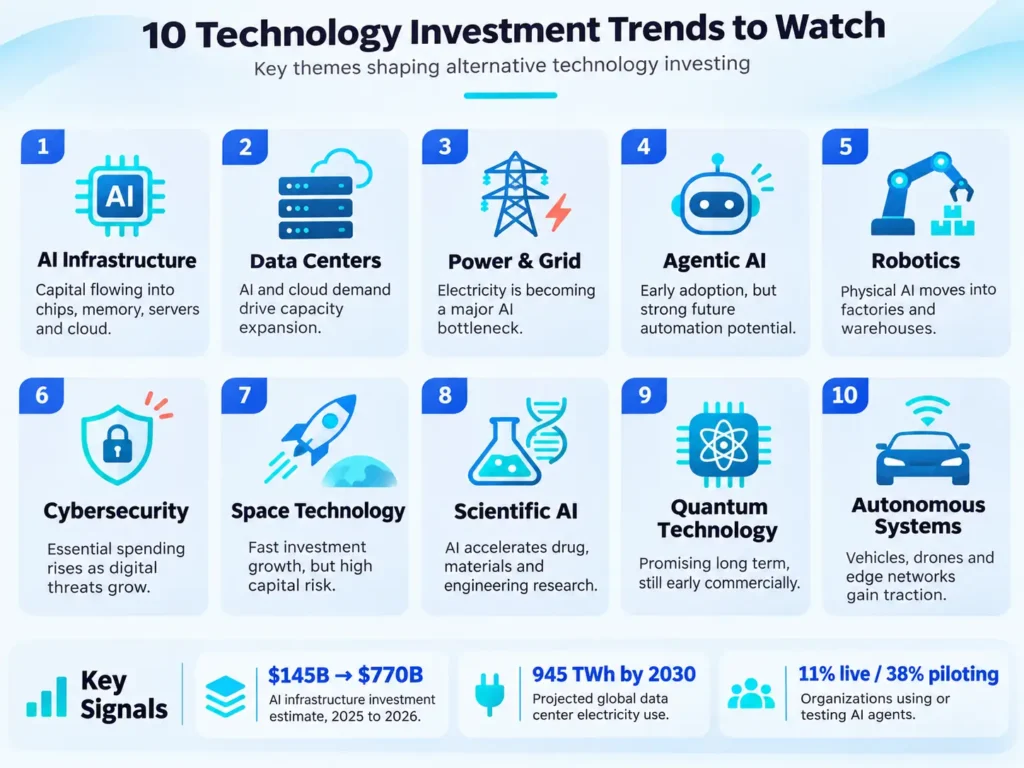
10 Technology Investment Trends to Watch
McKinsey tracks technology trends using investment, patents, research, search interest, news coverage and talent demand. Its 2026 research shows particularly strong investment momentum in agentic software, space technology, AI infrastructure, scientific AI and robotics.
1. AI Infrastructure and Advanced Computing
AI applications receive much of the attention, but the systems behind them require large computing resources.
Capital is moving into processors, high bandwidth memory, advanced packaging, networking equipment, servers and cloud infrastructure.
McKinsey estimates that investment in AI infrastructure and model architectures could rise from about $145 billion in 2025 to roughly $770 billion in 2026 if the pace recorded in the first half continues.
That is an extrapolation, not a guaranteed outcome. It does show how strongly capital is moving toward the physical foundation of AI.
Deloitte also reports that inference costs have fallen sharply while large scale AI use can still create very large computing bills.
2. Data Centers and Digital Infrastructure
More computing requires more data center capacity.
Investors may gain exposure through listed operators, real estate structures, infrastructure funds or private investments.
Demand from AI and cloud computing supports the investment case. The main constraints include electricity availability, network access, construction time and changing customer demand.
3. Power and Grid Infrastructure
Electricity is becoming an important constraint on AI growth.
The International Energy Agency expects global data center electricity use to reach about 945 terawatt hours by 2030 in its base case, more than twice the 2024 level.
In the United States, the IEA expects data centers to account for nearly half of electricity demand growth through 2030.
That brings utilities, power generation, grid equipment, cooling and related infrastructure into the technology investment story.
4. Agentic AI
Agentic AI systems can plan and perform multi step tasks with less human input than conventional software tools.
Commercial adoption remains early.
Deloitte reports that only 11 percent of surveyed organizations had AI agents in production, while 38 percent were piloting them.
Investors should therefore watch customer use, revenue, cost savings and retention rather than assuming every company selling agent technology will benefit equally.
5. Robotics and Physical AI
AI is moving from screens into machines.
Industrial robots, warehouse systems, autonomous equipment and newer general purpose robots can combine sensors, machine vision and AI models to operate in physical environments.
The key investment question is whether these machines can produce reliable economic value at scale, not whether a demonstration looks impressive.
6. Cybersecurity
Every new digital system creates something else that must be protected.
AI can help security teams detect threats, but attackers can also use it to automate fraud, social engineering and software attacks.
This supports demand for identity security, cloud protection, threat detection and automated defense.
Cybersecurity can differ from more speculative technology themes because much of the spending is driven by necessity.
7. Space Technology
Commercial launch services, satellite networks, communications, Earth observation and defense applications are turning space into a broader technology market.
McKinsey’s 2026 research shows space technology among the areas with the fastest investment growth.
The risk remains high. Projects require large amounts of capital, development cycles can be long and delayed programs can destroy value.
8. AI for Scientific Discovery
AI is being applied to drug research, materials science and engineering.
This creates investment opportunities where software meets healthcare, biotechnology and industrial research.
Commercial timelines still matter. Finding a promising molecule with AI does not remove years of clinical testing and regulatory review.
9. Quantum Technology
Quantum computing, sensing and networking remain early commercial markets.
The long term opportunity could be significant, but investors should focus on technical progress, paying customers and realistic commercial uses.
A strong scientific result does not automatically produce a profitable company.
10. Autonomous Systems and Connectivity
Autonomous vehicles, drones, private networks and edge computing connect software intelligence with physical systems.
The opportunity covers chips, sensors, networking equipment, software and industrial hardware.
Commercial adoption, safety, regulation and capital requirements will determine which businesses capture lasting value.
The AI Investment Value Chain
AI becomes easier to evaluate when investors stop treating it as a single industry.
Applications and software
These companies build tools used by consumers and businesses.
Semiconductors and compute
AI models require processors, memory and networking hardware.
Data centers
Servers need buildings, cooling and fast connections.
Power and grids
AI infrastructure requires dependable electricity.
Financing
Large infrastructure projects may rely on private credit, infrastructure funds and other forms of private capital.
BlackRock expects another $5 trillion to $8 trillion of AI related capital spending through 2030. Its research points to opportunities extending into utilities, infrastructure and private capital.
This helps explain why AI exposure can extend well beyond technology stocks.
Technology Investment Opportunity Matrix
The same growth story can carry very different investment risks. This matrix compares major themes by maturity, access and liquidity.
| Theme | Market Maturity | Typical Access | Liquidity | Risk |
| AI infrastructure | Scaling | Stocks, funds, private infrastructure | Medium to high | High |
| Data centers | Scaling | Listed operators, real estate, private funds | Medium | Medium to high |
| Robotics | Early to scaling | Stocks, funds, venture capital | Medium | High |
| Cybersecurity | Established to scaling | Stocks, funds, private equity | Medium to high | Medium to high |
| Space technology | Early to scaling | Stocks, funds, venture capital | Low to medium | Very high |
| Scientific AI | Early | Stocks, venture capital | Low to medium | Very high |
| Quantum technology | Early | Stocks, private capital | Low to medium | Very high |
| Power infrastructure | Established to scaling | Utilities, infrastructure funds | Medium to high | Medium |
These ratings are general comparisons rather than investment recommendations. Risk can differ widely between individual companies, funds and private deals.
How Investors Can Access These Themes
Technology trends can be accessed through several investment routes.
| Route | Access | Liquidity | Main Consideration |
| Public stocks | Easy | Usually high | Company and valuation risk |
| ETFs and funds | Easy | Usually high | Fees and portfolio overlap |
| Listed infrastructure | Easy to moderate | Usually high | Rates and capital costs |
| Venture capital | Limited | Low | Failure and exit risk |
| Private equity | Limited | Low | Fees and long holding periods |
| Private credit | Limited | Low to moderate | Credit and borrower risk |
| Private infrastructure | Limited | Low | Capital and project risk |
Public markets generally provide easier trading and more disclosure.
Private markets may provide access before an initial public offering, but investors can face long holding periods and limited information.
Investor.gov warns that private equity investments may need to be held for several years and that investors should review fees and expenses carefully.
A broader technology investing, portfolio management and planning process should consider liquidity, concentration and time horizon before private exposure is added.
Public vs Private Technology Investing
Public companies must provide regular disclosures and their securities generally trade in established markets.
Private companies provide less information to ordinary investors, and pricing can be less transparent.
Investor.gov warns that private placements can involve limited disclosure, severe illiquidity and the possibility of total loss.
Private technology investing is not automatically unsuitable. It simply requires a different level of due diligence and a willingness to accept less liquidity.
Alternative Investment Technology
Alternative investment technology is also changing how private markets operate.
Digital platforms can simplify reporting, document management, portfolio monitoring and access to certain private assets.
Tokenization can represent ownership interests digitally, while fractional structures may lower the amount of capital required to access some assets.
Neither feature removes investment risk.
A digital token representing a private asset does not guarantee a buyer will exist when the owner wants to sell.
Investors should separate easier access from real liquidity.
Investment Management Technology Trends
Current investment management technology trends include artificial intelligence, alternative data, automated research, portfolio analytics and digital reporting.
Alternative data can include transaction records, web activity, geolocation, satellite observations, app usage and sentiment signals.
Asset managers use these sources to study demand, identify business changes and monitor companies faster than they could with periodic financial reports alone.
The quality of the source still matters. More data does not guarantee a better decision.
How to Evaluate a Technology Investment
A useful investment process starts with evidence rather than excitement.
Check the Problem Being Solved
Ask whether customers face a real problem and whether the technology improves cost, speed, quality or capability enough to justify paying for it.
Measure Commercial Adoption
A technology can be scientifically impressive without becoming a strong business.
Look for customers, revenue, repeat use and measurable economic benefits.
Find Where Value Is Captured
The most famous company is not always the business earning the best economics.
AI growth, for example, may create value for chipmakers, electricity suppliers, network providers and data center owners.
Compare Growth With Valuation
Strong growth can still make a poor investment if the price assumes unrealistic future results.
Review Capital Requirements
Robotics, semiconductors, data centers and space systems can require large amounts of capital.
Businesses that constantly need fresh financing carry different risks from profitable software companies.
Study Liquidity
Liquidity describes how easily an investment can be bought or sold without a major price effect.
This is particularly important in private assets, where an investor may not have an active market when they want to exit.
Review Regulation and Security
AI, digital assets, biotechnology, autonomous systems and financial technology can face new rules.
Regulation can affect market access, costs and business models.
Main Risks Investors Should Consider
A fast growing technology market does not guarantee good investment returns.
Major risks include high valuations, weak liquidity, competition, technical failure, cybersecurity problems, financing costs and regulatory changes.
Concentration also matters.
An investor may own several different securities that all depend on the same AI spending cycle. That portfolio may look diversified while remaining exposed to one economic driver.
Common Mistakes Investors Make
One common mistake is buying a theme without understanding the business behind it.
Another is assuming fast market growth guarantees strong shareholder returns.
Private investors can also underestimate fees, lockup periods and valuation risk.
Treating every AI company as the same investment creates another problem. A software vendor, semiconductor manufacturer, utility and data center operator may all benefit from AI growth, but their business models are very different.
Investors should also avoid making decisions based only on financial markets news. Earnings, cash flow, customer adoption, capital requirements and valuation usually matter more over longer periods.
What Investors Should Watch Next
Capital spending remains one of the most useful signals.
A slowdown in AI infrastructure spending could affect chips, data centers, utilities and construction.
Electricity availability also matters because data center demand is rising faster than many parts of the power system can expand.
Investors should also track private market fundraising, mergers, initial public offerings and secondary transactions. These indicators can show whether private investors have realistic exit routes.
Another key measure is return on AI spending. Companies that turn technology investment into measurable revenue, productivity or cost savings may be better placed than businesses selling an AI story without clear economic results.
These developments also connect with investment banking technology and financial market innovation as new financing structures grow around digital infrastructure and private capital.
Frequently Asked Questions
What are the current market trends in technology?
Important 2026 trends include AI infrastructure, agentic AI, robotics, cybersecurity, space technology, scientific AI, quantum technology, data centers and power infrastructure.
McKinsey’s 2026 research shows especially strong investment momentum in agentic software, space technology, AI infrastructure, scientific AI and robotics.
What are key trends in alternative investments for the future?
Private equity, private credit, infrastructure and secondary markets are becoming more important as companies remain private for longer and large technology projects need private financing.
J.P. Morgan estimates the private market universe at nearly $20 trillion.
What are the top 10 technology trends?
For investors, ten important themes are AI infrastructure, data centers, power infrastructure, agentic AI, robotics, cybersecurity, space technology, scientific AI, quantum technology and autonomous systems.
The strongest opportunity depends on valuation, adoption and the investor’s ability to accept risk.
What are some examples of alternative investments?
Examples include private equity, hedge funds, private credit, real estate, infrastructure, commodities and certain digital assets.
Alternative investments often differ from conventional public stocks and bonds in liquidity, fees, access and disclosure.
What are the top 10 technology trends for 2026?
Ten relevant 2026 themes are AI infrastructure, agentic AI, robotics, data centers, energy infrastructure, cybersecurity, space technology, scientific AI, quantum systems and autonomous technologies.
Different research firms classify technology markets differently, so investors should focus on the underlying economic trends rather than the exact number of categories.
What are the top 5 trends?
McKinsey’s September 2026 investment analysis highlights five areas on pace to receive more than twice their 2025 investment: agentic software development, space technology, AI infrastructure and model architectures, AI for scientific discovery and robotics.
What are the best alternative investment platforms?
There is no single platform that is best for every investor.
Availability, accreditation rules, fees, asset selection, liquidity, custody and regulatory status vary. US investors should verify the firm and understand exactly what asset they are buying before committing capital.
What are the top 3 safest investments?
No investment is completely free of risk.
For US investors focused mainly on capital preservation, short term US Treasury securities and eligible federally insured bank deposits generally carry lower risk than stocks or alternative technology assets. Government money market funds may also hold high quality short term securities, although they are not the same as insured bank deposits.
What are the 7 main investment types?
A broad classification includes stocks, bonds, cash and cash equivalents, mutual funds and ETFs, real estate, commodities and alternative investments.
These categories can overlap. An ETF may own stocks, while an alternative fund may hold private companies, credit or infrastructure.
How do alternative tech investments differ from ETFs?
Technology ETFs usually provide liquid exposure to a basket of publicly traded companies.
Alternative technology investments can include private equity, venture capital, private credit and infrastructure. They may offer access to businesses or assets not held in standard ETFs, but they often involve lower liquidity, higher minimum investments and less public disclosure.
Conclusion
Alternative Technology Investments & Market Trends are becoming more connected as AI pushes capital into computing, data centers, electricity, robotics and private financing.
Some value may be captured outside the most visible technology companies, including semiconductor suppliers, infrastructure owners, private lenders, utilities and private businesses.
Those opportunities come with tradeoffs.
Investors should compare commercial adoption, valuation, capital needs, liquidity and regulation before deciding whether a technology theme belongs in a portfolio.


