

Technology Scholarships, Education & School Programs
Technology Scholarships, Education & School Programs can help students lower education costs, develop technical skills, explore STEM careers, and prepare for work in computer science, cybersecurity, engineering, data science, artificial intelligence, and information technology.
These opportunities do not all work the same way. A scholarship usually gives financial support to a student. A school grant may pay for equipment, labs, teacher training, or classroom projects. Education programs may provide research experience, mentoring, internships, competitions, or career training instead of direct tuition aid.
Students and families should first identify the type of support they need. Schools and teachers should also check whether an opportunity accepts individual applicants or only institutions.
Technology Scholarships and Programs Explained
Technology funding comes from colleges, government agencies, foundations, professional groups, nonprofit organizations, and private companies.
A technology scholarship usually supports a student studying computer science, information systems, cybersecurity, engineering, software development, robotics, data science, or another eligible technical field.
A fellowship often supports graduate education or research. Some fellowships include tuition support and a living stipend.
A school technology grant normally goes to a school, college, district, nonprofit organization, or another eligible institution. Funding may support devices, STEM labs, curriculum, research, teacher training, or student programs.
An education program may offer classes, mentoring, research, competitions, internships, or hands on career experience without paying the full cost of college.
Scholarship, Grant, Fellowship, or Program?
| Opportunity | Usually For | Common Support | Typical Applicant |
| Scholarship | Students | Tuition, fees, books, living costs | Individual student |
| Fellowship | Graduate students or researchers | Tuition, stipend, research costs | Student or researcher |
| School grant | Schools and organizations | Equipment, programs, training | Institution |
| Education program | Students or teachers | Learning, mentoring, experience | Varies |
| Scholarship for service | Students | Tuition and living support | Student with work obligation |
Always read the official rules before applying. A scholarship may carry internship, employment, location, academic, or service requirements.
Technology Scholarships at a Glance
| Program | Best For | Funding | Main Requirement | Current Status |
| Amazon Future Engineer | U.S. high school seniors | Up to $40,000 plus internship opportunity | Eligible computer related major and financial need | 2025 to 2026 cycle closed |
| SMART Scholarship | Undergraduate and graduate STEM students | Full tuition plus stipend and other support | Eligible STEM degree and service commitment | Check current cycle |
| NSF S STEM | Low income STEM students at participating colleges | Support through funded institutions | Enrollment at participating institution | Institution based |
| Latinos in Technology | Eligible Latino STEM students | Up to $18,000 over three years | STEM major, location, need and GPA rules | Check current cycle |
| Chick fil A Community Scholars | Community minded students | $25,000 | Academic record, service and financial need | Open through November 3, 2026 |
Program rules and deadlines change. Verify the current application cycle on the official provider’s website before applying.
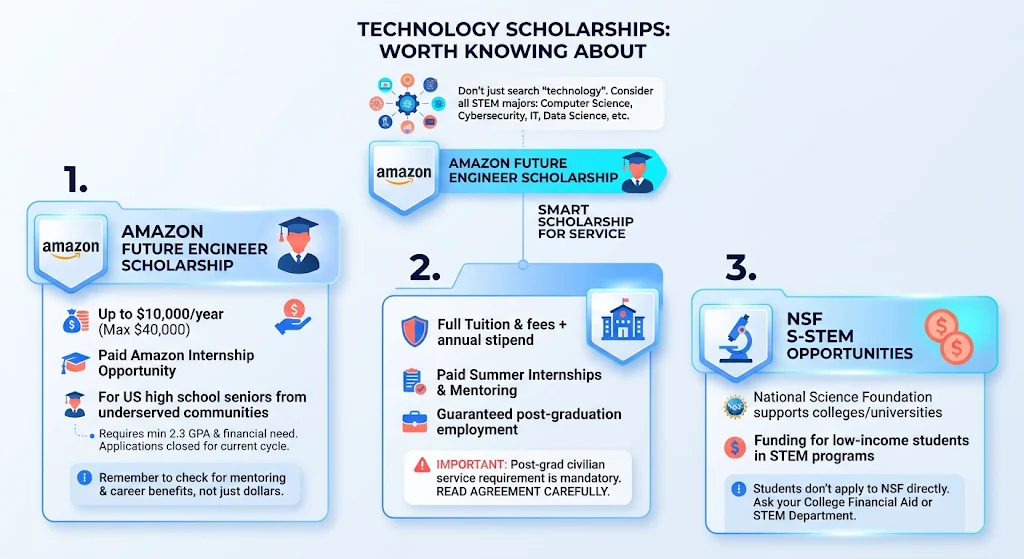
Technology Scholarships Worth Knowing About
Students should not limit their search to awards containing the word “technology.” Many STEM scholarships accept majors such as computer science, software engineering, information technology, electrical engineering, cybersecurity, mathematics, and data science.
Amazon Future Engineer Scholarship
Amazon Future Engineer supports U.S. high school seniors from underserved communities who plan to study computer science or an eligible related field.
The scholarship can cover unmet financial need up to $10,000 per year for four years, for a maximum potential award of $40,000. Selected students also have an opportunity for a paid Amazon internship.
Applicants need at least a 2.3 cumulative GPA on a 4.0 scale and must meet the program’s financial need, study, and U.S. work authorization requirements.
As of October 7, 2026, applications for the 2025 to 2026 cycle are closed. Amazon advises students to sign up for updates about the next application cycle.
Students should compare more than the dollar amount. Internship access, mentoring, and career experience may add value beyond tuition support.
SMART Scholarship for Service
The SMART Scholarship for Service Program supports eligible undergraduate and graduate students in approved STEM disciplines.
Benefits may include full tuition and eligible education fees, an annual stipend, paid summer internships, allowances, mentoring, and employment after graduation.
SMART comes with a service requirement. Scholars commit to civilian employment after graduation based on the length of funded study.
Students should read the current service agreement carefully before accepting an award.
NSF S STEM Opportunities
The National Science Foundation S STEM program supports colleges and universities that provide scholarships and academic support to eligible low income STEM students.
Students generally do not submit an S STEM proposal directly to NSF. Colleges and universities receive program funding and then support eligible students enrolled in qualifying STEM programs.
Students should ask their college financial aid office or STEM department whether the institution participates in an active S STEM project.
Scholarships by Technology Field
Searching by field can uncover opportunities that do not appear under a general technology scholarship search.
Information Technology Scholarships
Information technology students can search for awards connected with information systems, networking, cloud computing, database administration, information science, cybersecurity, and IT infrastructure.
Professional associations, universities, technology employers, and local foundations may offer field specific funding.
Computer Science Scholarships
Computer science scholarship searches can include software development, programming, computer engineering, computational science, informatics, and applied mathematics.
Amazon Future Engineer is one example of a program supporting students planning to pursue computer science and related fields.
Cybersecurity Scholarships
Cybersecurity students should check government programs, universities, security organizations, professional associations, and scholarship for service programs.
NSF announced the first CyberAICorps Scholarship for Service awards in 2026, combining artificial intelligence and cybersecurity education with public sector workforce development.
AI and Data Science Scholarships
Students studying artificial intelligence, machine learning, data science, or related computing subjects should search both technology scholarships and broader STEM opportunities.
Some programs name AI or data science directly. Others place these subjects under computer science, mathematics, statistics, engineering, or information science.
Engineering and Robotics Scholarships
Engineering students should search by their specific discipline.
Useful categories include computer engineering, electrical engineering, mechanical engineering, robotics, automation, manufacturing technology, and materials science.
Searching by the exact major can uncover funding that a broad technology search misses.
Scholarships for Different Student Groups
A student’s year in school, location, financial need, citizenship, academic record, and career plans can change which opportunities are available.
High School Students
High school students can prepare for technology scholarships before senior year.
Coding projects, robotics teams, cybersecurity competitions, science fairs, dual enrollment courses, volunteer work, and internships can provide useful evidence of technical interest.
Keep records of projects and results. A simple portfolio can make scholarship applications easier to complete.
Undergraduate and Graduate Students
College students should search through their financial aid office and academic department as well as public scholarship databases.
Faculty members, research centers, department newsletters, and professional groups may know about opportunities connected with a particular major.
Graduate students should also search for fellowships and research funding.
Latinos in Technology Scholarship
The Latinos in Technology Scholarship is funded by the Hispanic Foundation of Silicon Valley and administered through the Silicon Valley Community Foundation.
Current program information lists awards of up to $18,000 over three years, with up to $6,000 per year. Applicants must meet the program’s current STEM major, geographic, academic, enrollment, and financial need requirements.
The current criteria also list a minimum 3.0 cumulative college GPA.
The program may provide access to professional development, networking, mentorship, and internship opportunities in addition to scholarship funding.
Scholarships for Women and Other Groups
Some STEM awards support groups that have historically had lower representation in technical fields.
Eligibility may relate to gender, ethnicity, disability, military status, first generation status, financial need, location, or another factor.
Do not assume eligibility based only on the scholarship title. Read the current official rules.
Technology Scholarships for International Students
International students can find technology and STEM funding, but eligibility varies.
Some U.S. programs require citizenship, permanent residence, or authorization to work in the United States. Amazon Future Engineer, for example, has a U.S. work authorization requirement.
Other university scholarships may accept international students.
International applicants should check:
- Citizenship or visa requirements
- Eligible institutions
- Eligible degree programs
- International student eligibility
A university’s international student office and financial aid office can also help identify institution specific scholarships.
Technology Programs for Schools and Students
Scholarships are only one part of technology education.
Students may also benefit from coding courses, robotics clubs, summer research, engineering competitions, cybersecurity training, maker programs, college bridge programs, and career focused technical education.
For younger students, a useful technology program should provide more than device access. Students should have clear learning goals and opportunities to build, test, solve, create, or explain something.
NSF Education Programs
The National Science Foundation maintains a range of STEM education programs.
Current NSF programs cover areas such as scholarships, graduate research, advanced technical education, teacher preparation, and research on learning technologies.
Some NSF opportunities support students, while others fund colleges, universities, researchers, or education projects.
Schools and students should check who is eligible to apply before preparing an application.
Technology Grants for Schools
Schools may need funding for computers, software, internet access, STEM labs, robotics programs, professional training, or career education.
A scholarship directory is usually not the best place to search for institutional funding. Schools should also check government agencies, foundations, nonprofit organizations, local education partners, and corporate giving programs.
A broader guide to Technology Grants, Philanthropy & Industry Support Programs can help schools compare funding sources intended for organizations rather than individual students.
Before applying for a school technology grant, confirm:
- The school or district is eligible.
- The planned expense is permitted.
- The application deadline is current.
- Reporting requirements are manageable.
- The funding period matches the project schedule.
A large award has little value if its rules do not allow the school to pay for what it actually needs.
Technology Programs and Funding for Teachers
Teachers may qualify for STEM education programs, professional development, classroom funding, and teacher preparation support.
NSF Robert Noyce Teacher Scholarship Program
The NSF Robert Noyce Teacher Scholarship Program supports efforts to recruit, prepare, and retain K to 12 mathematics and science teachers and teacher leaders in high need school districts.
The program may support STEM undergraduate majors and professionals preparing to become STEM teachers.
NSF currently lists the program as waiting for a new publication, so educators and institutions should check the official program page for the next funding announcement.
Teachers can also search for professional development opportunities, classroom grants, local foundation funding, and technology training offered by universities or education organizations.
What Technology Scholarships Can Pay For
Scholarship rules differ.
Some awards pay only tuition. Others may cover fees, books, housing, equipment, or other approved education expenses.
Amazon Future Engineer bases its scholarship amount on unmet financial need up to the program’s annual award limit.
Chick fil A Community Scholars currently awards thirteen $25,000 scholarships each year. Funds may be used for tuition, fees, books, and eligible education expenses at accredited colleges, universities, or vocational and technical schools.
The scholarship payment goes to the school rather than directly to the student.
Never assume that receiving a $10,000 scholarship means receiving $10,000 as unrestricted cash.
How to Check Scholarship Eligibility
Read the complete eligibility rules before spending hours on an application.
Common requirements include:
- Education level
- Eligible major
- Enrollment status
- GPA
- Financial need
- Citizenship or residency
- Geographic location
- Community service
- Leadership
- Technical projects or work experience
Requirements can vary sharply.
Amazon Future Engineer currently lists a minimum 2.3 cumulative GPA along with requirements related to education level, field of study, financial need, and U.S. work authorization.
The Latinos in Technology Scholarship currently lists a minimum 3.0 cumulative college GPA along with other eligibility rules.
Some scholarships do not publish a minimum GPA at all.
How to Apply for Technology Scholarships
Start with opportunities that match your actual profile.
Do not write one generic essay and send it to every organization.
Check the Rules
Confirm the deadline, eligible major, school year, citizenship requirements, location rules, GPA, and required documents.
Prepare Your Records
Common documents include:
- Academic transcripts
- Financial aid information
- Resume
- Recommendation letters
- Proof of enrollment
- Essays
- Project or activity records
Technical scholarships may also ask about coding, research, engineering projects, internships, or other technical work.
Show What You Have Built or Solved
A useful technology project does not need to be a startup.
A school app, robotics project, website, cybersecurity lab, data project, repair project, or community technology activity can demonstrate technical ability.
Explain the problem, your role, what you built, and the result.
Submit Early
Do not wait until the last hour.
Transcripts, recommendation letters, online portals, financial records, and file uploads can cause delays.
Track applications in a spreadsheet with the scholarship name, award, deadline, application status, and result.
Full Scholarships and Service Obligations
“Full tuition” and “full ride” do not always mean the same thing.
A full tuition scholarship may pay tuition but leave housing, food, transportation, books, and other expenses to the student.
A full ride usually covers more of the total cost of attendance, but every program defines its benefits differently.
Scholarship for service programs need extra attention.
SMART provides substantial financial support but connects funded education with later civilian employment.
Compare the complete terms, not only the advertised award amount.
Technology College Costs and Financial Aid
Scholarships make more sense when students compare them with the real cost of attending a school.
Tuition is only one part of the bill. Housing, meals, fees, transportation, books, and required tools may change the total.
A detailed guide to Technology University Costs, Tuition & Education Programs can help students compare these expenses before selecting a school.
Thaddeus Stevens College of Technology Cost
Students researching thaddeus stevens college of technology cost should use the school’s current tuition information rather than an old third party estimate.
For the 2026 to 2027 academic year, Thaddeus Stevens College of Technology lists full time tuition at $4,725 per semester. Housing and meal plans carry separate charges.
The amount a student pays may be lower after grants and scholarships. Compare the published cost with your individual financial aid offer.
How to Spot a Scholarship Scam
A professional looking scholarship still needs to be checked.
Look for:
- An identifiable sponsoring organization
- Official eligibility rules
- A clear deadline
- Contact information
- A stated award amount or selection process
- Clear information about how funds are paid
Be cautious if someone guarantees that you will win, pressures you to pay immediately, asks for unnecessary banking information, or says a fee guarantees financial aid.
Also check whether the opportunity is still active. A genuine scholarship from a previous year may no longer accept applications.
Common Scholarship Mistakes
One mistake is applying only for large national awards.
Smaller local, employer, college, and field specific scholarships may receive fewer applications.
Another mistake is ignoring institutional aid. Colleges may offer department scholarships that never appear on large scholarship websites.
Students also waste time by beginning an application before checking eligibility.
Do not send the same essay everywhere without editing it. A scholarship focused on community service should receive an application that explains your relevant service.
Finally, check the current application year. Award amounts, deadlines, names, and requirements can change between cycles.
Frequently Asked Questions
Can you get a scholarship for a tech school?
Yes. Some scholarships can be used at technical schools, vocational programs, community colleges, career schools, or degree programs when the scholarship rules allow it.
Check the school’s accreditation and the sponsor’s eligible institution requirements before applying.
What is the $7000 grant for college students?
People searching for a $7,000 college grant often mean the Federal Pell Grant.
There is no universal federal $7,000 grant automatically available to every college student.
For the 2026 to 2027 award year, Federal Student Aid lists the maximum Pell Grant at $7,395. A student’s actual award depends on federal eligibility rules and financial aid calculations.
Students apply for federal student aid through the FAFSA.
What is the Chick fil A scholarship program?
Chick fil A operates scholarship programs for eligible restaurant Team Members and students from local communities.
The Chick fil A Community Scholars program awards thirteen $25,000 scholarships each year. Applications for the 2027 Community Scholars program are currently open and close on November 3, 2026.
Eligible Team Members can also apply through the Remarkable Futures Scholarship program.
Is the Niche $10,000 scholarship real?
Yes. Niche ran an official $10,000 No Essay Summer Scholarship in 2026.
That scholarship had a July 31, 2026 deadline and has ended. One winner was to be selected through a random drawing.
As of October 7, 2026, students should check Niche’s current scholarship listings rather than try to apply through the expired $10,000 page.
What GPA gets you a full ride scholarship?
There is no single GPA that guarantees a full ride.
Strong grades can improve a student’s chances for merit scholarships, but colleges and scholarship providers may also consider financial need, test scores, leadership, service, essays, talent, location, or field of study.
Check each award’s published criteria.
Is the Niche $50,000 scholarship real?
Yes. Niche previously offered an official $50,000 No Essay Scholarship.
The cycle with a December 31, 2025 deadline has ended. Niche’s scholarship winner records list a $50,000 No Essay Scholarship recipient in January 2026.
As of October 7, 2026, Niche is offering a $40,000 No Essay Scholarship with an October 15, 2026 deadline. Eligible high school and college students, as well as certain people planning to attend college or graduate school in the next year, can review the current official rules before applying.
Which companies offer scholarships?
Companies that offer current or recent education funding include Amazon and Chick fil A.
Amazon Future Engineer supports eligible students planning to study computer science and related subjects. Chick fil A offers scholarships for eligible Team Members and community students.
Students can also check technology employers, corporate foundations, local businesses, and professional associations.
Does Chick fil A pay 100% of college tuition?
Not automatically.
Chick fil A offers scholarships and other education benefits, but students should not assume every employee receives full tuition coverage.
Scholarship amounts, qualifications, and education benefits depend on the specific program.
Is $10,000 a lot for a scholarship?
A $10,000 scholarship can make a meaningful difference for many students.
Its value depends on tuition, housing, other financial aid, total cost of attendance, and what expenses the scholarship permits.
A renewable $10,000 scholarship can also be worth far more over several years than a one time award.
Conclusion
The best scholarship search starts with fit rather than the largest dollar figure on a page.
Students should compare eligibility, award rules, deadlines, covered expenses, renewal terms, and service requirements. Schools should separate scholarships for individuals from grants intended for institutions.
Technology Scholarships, Education & School Programs can support many paths into STEM. Verify current information with the official provider, prepare applications early, and apply to opportunities that match your education level, field, location, and financial situation.