

Technology Company News & Market Updates in 2026
Technology Company News & Market Updates in 2026 are being shaped by one main issue: how much money companies can turn into real returns from artificial intelligence.
Microsoft, Alphabet, Amazon, Meta and Nvidia are spending heavily on computing capacity, chips, data centers and AI products. Higher borrowing costs, regulation, chip supply, acquisitions and pressure on profit margins are also giving investors more to judge than simple AI growth stories.
For US readers, the useful question is no longer just which company announced a new AI product. It is whether that product can attract customers, produce revenue and justify the cost of the infrastructure behind it.
Technology Market Snapshot for 2026
The largest technology companies remain closely tied to AI demand, cloud computing and semiconductor spending. Recent results show strong revenue growth at several industry leaders, but the cost of supporting that growth is also rising.
| Company | Recent Verified Update | Main Area to Watch |
| Nvidia | Q2 fiscal 2027 revenue reached $96.2 billion | AI chips and data centers |
| Microsoft | Q4 fiscal 2026 revenue reached $90.0 billion | Azure, cloud and AI |
| Alphabet | Q2 2026 revenue reached $119.8 billion | Search, Gemini and Google Cloud |
| Amazon | Q2 2026 sales reached $200.6 billion | AWS and AI infrastructure |
| Meta | Q2 2026 revenue reached $60.8 billion | AI systems and infrastructure |
Nvidia reported that revenue more than doubled from the same period a year earlier. Microsoft reported 43 percent growth in Azure and other cloud services. Alphabet said Google Cloud revenue grew 82 percent, while Amazon reported 37 percent growth in AWS sales.
Those figures help explain why AI infrastructure remains one of the biggest forces in technology company news.
Big Tech Is Spending Heavily on AI
Big Tech is no longer treating AI as a small research project. It now affects capital spending, cloud capacity, software products, and company financing.
The main question for companies and investors is how quickly new infrastructure can produce enough economic value to support the money being spent on it.
Microsoft Cloud Demand Stays Strong
Microsoft ended fiscal 2026 with quarterly revenue of $90.0 billion, an 18 percent increase from a year earlier. Microsoft Cloud revenue reached $59.3 billion, while Azure and other cloud services grew 43 percent.
The cost side matters too. Microsoft has been investing heavily in CPUs, GPUs and cloud capacity. The company also said Azure customer demand continued to exceed available capacity.
That makes Microsoft’s results useful for tracking both AI demand and the cost of meeting it.
Alphabet Pushes More Capital Into AI
Alphabet reported second quarter 2026 revenue of $119.8 billion, up 24 percent from a year earlier. Google Cloud revenue climbed to $24.8 billion, an 82 percent increase. Enterprise AI infrastructure and AI solutions helped support that growth.
Google has also expanded its position in cloud security through its acquisition of Wiz. Security and AI infrastructure are becoming more closely connected as businesses move sensitive workloads into cloud platforms.
Amazon AWS Growth Supports More AI Spending
Amazon reported second quarter sales of $200.6 billion. AWS sales rose 37 percent to $42.2 billion, the fastest AWS growth rate in 18 quarters.
AI infrastructure is also changing how large technology companies think about financing. Data centers require chips, power systems, cooling equipment, land, and large amounts of capital.
This means AI growth is not only a software story. It is also a hardware, energy, real estate, and financing story.
Meta Is Trading Margin for AI Capacity
Meta reported second quarter 2026 revenue of $60.8 billion, up 28 percent. Costs and expenses increased 55 percent, while operating income fell 8 percent compared with the same quarter in 2025.
The numbers show why AI spending deserves attention alongside revenue growth.
For investors, the test is simple. Higher spending may support future products and revenue, but those investments eventually need to produce returns.
Nvidia and the Semiconductor Race
AI demand has made semiconductors one of the most closely watched parts of the US technology market.
Nvidia Data Center Revenue Keeps Rising
Nvidia reported second quarter fiscal 2027 revenue of $96.2 billion, up 106 percent from a year earlier. Data Center revenue reached $89.0 billion, an increase of 117 percent. Nvidia said Blackwell Ultra infrastructure helped drive the growth.
That level of growth explains why Nvidia news can affect more than semiconductor stocks. Cloud providers, data center suppliers, power companies and other businesses tied to AI infrastructure can also respond to changes in chip demand.
Strong company results do not remove market risk. Nvidia shares and other semiconductor stocks can move quickly when investors change their expectations for interest rates, valuations, export controls, AI investment, or future demand.
Smaller Chip Firms Are Finding New Niches
Not every semiconductor story involves Nvidia.
GSI Technology is developing compute-in-memory technology and new processing hardware. In its first quarter of fiscal 2027, the company reported $6.3 million in revenue. It also said its Smart City project remained on schedule and that development of its Plato chip remained targeted for a March 2027 tape-out.
Smaller semiconductor businesses can provide useful clues about where new computing designs and specialized AI hardware are developing.
Technology M&A News and Strategic Deals
Technology M&A news matters because acquisitions can give companies faster access to software, patents, customers, manufacturing capacity, or skilled teams.
Security, AI infrastructure, semiconductors and cloud technology remain important areas to follow.
SkyWater Becomes Part of IonQ
One of the notable 2026 transactions involved quantum computing company IonQ and semiconductor manufacturer SkyWater Technology.
IonQ completed its acquisition of SkyWater Technology on July 31, 2026. SkyWater continues to serve customers as a US based semiconductor foundry while operating as an IonQ subsidiary.
The deal gives IonQ direct access to semiconductor manufacturing capabilities that may support its quantum computing plans.
It also shows why some technology companies want greater control over critical parts of their supply chains.
Google Adds Security Through Wiz
Google’s purchase of Wiz connects cybersecurity more closely with its cloud business.
As companies place more sensitive applications and data in cloud platforms, security tools can affect customer trust and enterprise buying decisions.
Large cloud providers increasingly compete on more than computing capacity. Security, AI tools, software integration, and data management all influence how customers choose platforms.
Company Updates Beyond Big Tech
Technology company news should not stop with Apple, Microsoft, Nvidia, Alphabet, Amazon, and Meta.
Smaller public companies can reveal demand patterns that are harder to see in the results of companies worth hundreds of billions or trillions of dollars.
Align Technology News
Align Technology is a medical technology company known for Invisalign clear aligners, iTero scanners, and digital dentistry software.
The latest Align Technology news shows second quarter 2026 revenue of $1.06 billion, up 4.3 percent from the previous year. Clear Aligner revenue increased 8.2 percent, while clear aligner shipments rose 7.4 percent.
These results give readers a view of technology demand outside AI, cloud computing and semiconductors.
GSI Technology News
Recent GSI Technology news centers on its computing research, Smart City work and development of the Plato chip.
The company reported $6.3 million in first-quarter fiscal 2027 revenue. Its current size is small compared with major semiconductor companies, so progress on new products and commercial projects deserves close attention.
SkyWater Technology News
SkyWater Technology news changed after the IonQ acquisition.
Rather than viewing SkyWater only as an independent semiconductor company, readers now need to follow how its manufacturing operations fit into IonQ’s quantum computing plans.
Manufacturing capacity, customer contracts, and integration progress are useful areas to watch.
What Is Moving Tech Stocks Right Now?
Technology stocks are affected by company results, but the wider market can quickly change the direction of share prices.
Interest rates are one major factor. Higher borrowing costs can make expensive growth projects harder to finance. They can also reduce the value investors place on profits expected many years in the future.
Other major forces include:
- AI revenue and customer demand
- Capital spending and data center costs
- Earnings and company guidance
- Semiconductor supply
- Export controls
- Mergers and acquisitions
- Cybersecurity incidents
- Government regulation
- Inflation and interest rates
- Valuation compared with expected growth
A strong earnings report does not always produce a higher stock price. Markets react to expectations as well as reported results.
How to Read Technology Company News
A headline should be the start of the research process, not the end.
First, check the original source. For earnings, use the company’s investor relations page or SEC filing. For regulatory matters, check the relevant government source when possible.
Next, separate reported facts from company guidance. Revenue already earned is a reported result. Management’s estimate for a future period is a forecast.
Then compare the number with an earlier period. A large revenue figure means little without knowing whether the business is growing or shrinking.
Finally, look at the cost of growth. An AI business can report higher sales while spending much more on chips, electricity, data centers, and financing.
Readers who want broader exposure instead of following individual companies can also compare technology ETFs and technology funds. Fund fees, holdings, and concentration can change the type of risk an investor takes.
This article provides information and market context. It does not recommend buying or selling any security.
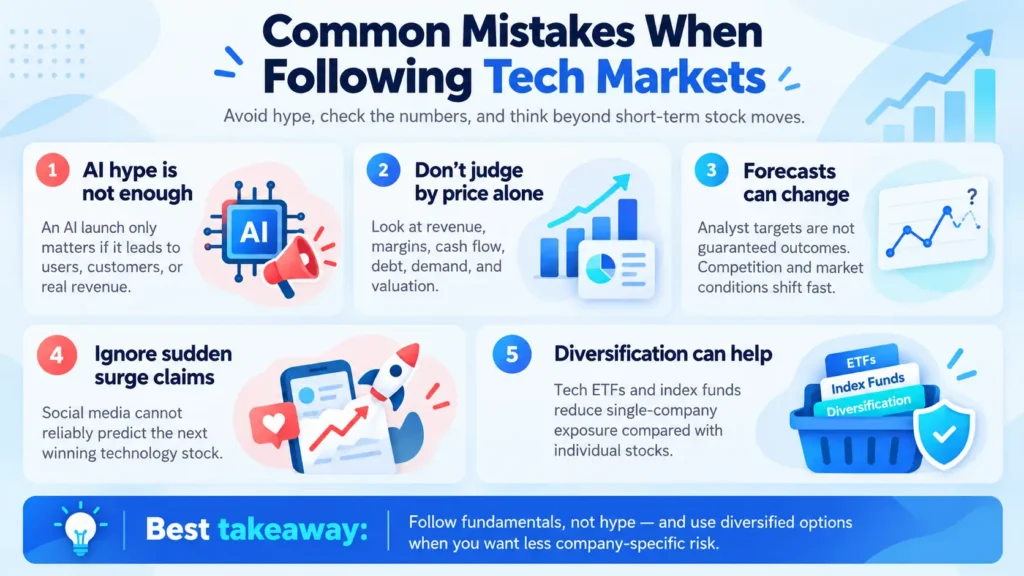
Common Mistakes When Following Tech Markets
One mistake is treating every AI announcement as a financial success. A product still needs users, customers, or another path to revenue before its business value becomes clear.
Another mistake is using stock price alone to judge a company. Revenue, margins, cash flow, debt, customer demand and valuation can tell a different story.
Readers should also avoid treating analyst forecasts as guaranteed outcomes. Forecasts can change when competition, economic conditions, or company performance changes.
The same applies to social media claims about a stock that will suddenly surge. No one can reliably know which technology stock will produce the highest future return.
For investors who want less company-specific exposure, a comparison of Vanguard technology ETFs and index funds can help explain how diversified technology investing differs from choosing single stocks.
What to Watch Through the Rest of 2026
AI infrastructure spending remains one of the main issues to watch. Microsoft, Amazon, Alphabet, and Meta are committing large sums to computing equipment and data center capacity.
Chip demand is another. Nvidia’s recent growth is strong, but competition from AMD, custom chips, and cloud company silicon could affect the market over time.
Financing also deserves attention. Large AI projects require capital, and the cost of that capital can influence future returns.
Regulation will remain part of technology strategy as governments consider AI safety, competition, export restrictions, privacy, and cybersecurity.
The companies that deserve the most attention are not necessarily those announcing the largest number of AI products. The stronger test is whether they can turn demand into recurring revenue while keeping costs under control.
Frequently Asked Questions
What are the latest tech market news?
Major technology market themes in 2026 include large AI infrastructure investments, strong cloud demand, semiconductor growth, data center expansion, and greater attention to the cost of funding those projects.
Nvidia, Microsoft, Alphabet, Amazon and Meta remain among the companies most closely tied to these trends.
What are the latest technology news developments?
Recent technology developments include strong cloud growth at Microsoft, Alphabet and Amazon, rapid Nvidia Data Center revenue growth, continued AI infrastructure spending and new company activity in semiconductors, cybersecurity and quantum computing.
Because technology news changes quickly, readers should check the page’s Last Updated date and verify major developments with primary company sources.
What is going on with the tech stock market?
Technology stocks are responding to strong AI-related business growth as well as concerns about spending, valuations, borrowing costs, and interest rates.
Company earnings matter, but economic news and changes in investor expectations can also cause large price moves.
What is the best news source for technology news?
No single publication is best for every technology topic.
Reuters is useful for fast factual reporting. Financial Times and Bloomberg provide business and market analysis. CNBC and Yahoo Finance connect company developments with financial markets. TechCrunch covers startups and venture activity.
For company financial figures, investor relations pages and SEC filings are usually the strongest sources.
What are the top 5 tech stocks to buy right now?
There is no universal list of five technology stocks that everyone should buy.
Large companies such as Nvidia, Microsoft, Apple, Alphabet, Amazon, and Meta are widely researched, but company size does not guarantee future returns.
Investors should consider valuation, revenue growth, cash flow, debt, competition, and their own risk tolerance before making decisions.
What are the top 10 technologies today?
Ten technology areas receiving attention in 2026 are artificial intelligence, AI agents, advanced semiconductors, cloud computing, data centers, cybersecurity, robotics, quantum computing, autonomous systems and enterprise AI software.
Who is dumping Nvidia stock?
There is no evidence that one investor group explains all selling in Nvidia shares.
Millions of retail and institutional investors trade Nvidia. Selling can reflect profit taking, portfolio rebalancing, valuation concerns, interest rates, regulation, or changing expectations for future AI spending.
What stock will skyrocket in 2026?
No credible source can know in advance which stock will rise the most.
Companies with strong expected growth can still carry high valuation, competition, and execution risk. Claims that promise a specific future stock winner should be treated cautiously.
Why is the Nvidia stock falling?
The reason Nvidia shares fall can change from one trading session to another.
Possible factors include profit taking, semiconductor sector weakness, interest rates, valuation concerns, export policy, and changes in expectations for AI spending.
Nvidia’s latest reported business results remained strong, with second quarter fiscal 2027 revenue increasing 106 percent from the prior year. A short-term share price decline therefore does not automatically mean the underlying business has weakened.
Sources and Editorial Method
Financial figures in this article were checked against company investor relations releases, SEC filings and other primary corporate sources.
Primary sources were preferred for earnings, revenue, corporate transactions, and product information. Company guidance is treated as management’s expectation rather than a guaranteed future result.
What Matters Now
The strongest theme in Technology Company News & Market Updates is no longer simply AI adoption. It is the economics behind AI.
Cloud revenue is growing. Semiconductor demand remains high. Data center investment is expanding. At the same time, companies are spending large amounts of money to support that growth.
For readers, a useful way to follow the technology market is to ask four questions about each major headline: What changed? What are the verified numbers? What did it cost? What does it mean for customers, competitors, and company finances?
That approach provides more context than following stock price headlines alone.


