

Health Information Technology (HIT): What It Is & Definitions
Health information technology, often shortened to HIT or health IT, includes the electronic systems and tools used to create, store, access, manage, and exchange health information.
Electronic health records are one familiar example, but health information technology covers much more. Patient portals, electronic prescribing systems, clinical decision support tools, laboratory systems, health information exchanges, and other digital systems can all be part of health IT.
In the United States, HIT also has a formal legal definition. Understanding that definition helps explain where health information technology fits within modern health care and how it differs from health informatics, health information management, and digital health.
What Is Health Information Technology?
In simple terms, health information technology is the use of electronic technology to work with health information.
A doctor may enter a diagnosis into an electronic health record. A laboratory may send test results electronically. A patient may open a portal to see medications or visit notes. A pharmacist may receive a prescription from a clinician without a paper form.
All of these activities depend on health information and technology working together.
The Office of the National Coordinator for Health Information Technology defines health IT under Section 3000 of the Public Health Service Act and 45 CFR 170.102. The definition includes hardware, software, integrated technologies, licenses, upgrades, intellectual property, and service solutions that support the electronic creation, maintenance, access, or exchange of health information.
In plain English, health IT includes the digital tools and systems used to handle health information electronically.
This official health information technology definition is broader than one software product or one type of medical record.
What Does HIT Mean in Health Care?
HIT stands for Health Information Technology.
When someone asks what HIT health information technology means, the simplest answer is this:
HIT is technology that helps patients and health care organizations create, manage, access, exchange, or use health information electronically.
The phrase health info technology is sometimes used informally for the same idea.
What Does Health Information Technology Do?
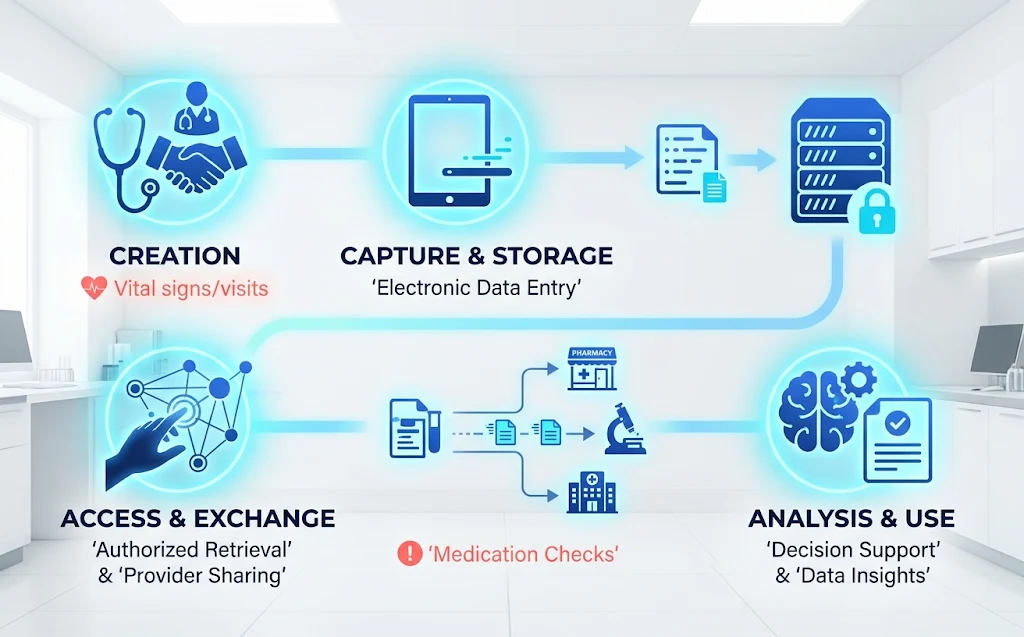
Health information technology connects health data with the people and systems that need to use it.
A typical process may include several steps.
First, health information is created. This may happen during a medical visit, laboratory test, imaging study, prescription, or other health service.
The information is then entered or captured electronically. A health care system can store it in an electronic record, laboratory system, imaging system, or another secure application.
Authorized users may later retrieve the information. Some systems can also exchange it with another provider, pharmacy, laboratory, patient, or health organization.
Health IT may also help organize data, check medications, support clinical decisions, create reports, and give patients electronic access to their own information.
So, what does health information technology do in practical terms? It helps turn health data into information that authorized people and systems can use.
What Does Health Information Technology Include?
Health information technology in healthcare includes many different systems.
| HIT Category | Examples | Main Purpose |
| Electronic records | EHRs and EMRs | Record and manage clinical information |
| Patient systems | Patient portals and PHRs | Give patients access to information |
| Medication systems | Electronic prescribing | Send and manage prescriptions |
| Decision tools | Clinical decision support | Help clinicians use relevant information |
| Exchange systems | Health information exchange | Share information between authorized users |
| Laboratory systems | Laboratory information systems | Manage test orders and results |
| Imaging systems | RIS and PACS | Store and manage imaging information |
| Remote care tools | Telehealth and remote monitoring | Support care outside traditional settings |
| Data systems | Reporting and analytics tools | Study clinical and population data |
These are broad categories. A hospital may use dozens or hundreds of connected applications.
Readers looking for a more detailed breakdown can also explore health information technology examples across clinical care, patient access, pharmacy, diagnostics, and health administration.
Common Examples of Health Information Technology
Several types of HIT appear often in hospitals, clinics, pharmacies, and other care settings.
Electronic Health Records
An electronic health record, or EHR, contains health information in digital form.
Depending on the system and setting, it may include diagnoses, medications, allergies, laboratory results, clinical notes, immunizations, and other information used in patient care.
EHRs are one of the best known examples of information technology in health care.
Electronic Medical Records
An electronic medical record, or EMR, is also a digital clinical record.
The terms EHR and EMR are sometimes used in similar ways, but EHR usually refers to a record designed for broader use and exchange across care settings. EMR often refers more closely to the digital record used within one practice or organization.
Actual product use can vary, so the terms should not be treated as having perfectly fixed boundaries.
Personal Health Records
A personal health record, or PHR, gives an individual a way to maintain or manage personal health information.
A PHR is different from a provider controlled EHR because the individual usually has more control over the information kept in it.
Patient Portals
Patient portals give patients electronic access to selected health information and services.
A portal may allow a patient to view test results, request appointments, review medications, read visit information, or communicate with a care team.
Electronic Prescribing
Electronic prescribing lets an authorized prescriber send prescription information to a pharmacy electronically.
It can reduce the need for handwritten prescriptions and allows prescription information to move through digital systems.
Health Information Exchange
Health information exchange, or HIE, allows authorized health care professionals, patients, and organizations to access or securely share health information electronically.
ONC describes HIE as both the electronic exchange of health information and, in some contexts, an organization that provides services for secure exchange.
Clinical Decision Support
Clinical decision support tools present information that can help clinicians make care decisions.
Examples include medication alerts, allergy warnings, reminders, order sets, and other information shown during clinical work.
These tools support decisions. They do not replace the judgment of a qualified health professional.
Laboratory and Imaging Systems
Laboratory information systems help manage laboratory orders, specimens, and results.
Radiology information systems and picture archiving and communication systems help manage imaging records and medical images.
These systems show why information technology for the health professions reaches far beyond electronic medical records.
How Health Information Technology Works
Health IT is easier to understand when viewed as a flow of information.
A patient visits a clinic. A clinician records symptoms, observations, and a diagnosis in an electronic record.
The clinician orders a laboratory test. The order moves electronically to the laboratory.
The laboratory completes the test and sends the result back through connected systems.
The result appears in the patient’s record. A clinical system may alert the clinician if the result needs attention. The patient may later see the result through a portal.
If the patient visits another authorized provider, health information exchange may help that provider obtain relevant information.
This process depends on more than storing data. Systems must identify, organize, protect, and exchange information in ways other systems can understand.
EHR vs EMR vs PHR
These three terms are related, but they do not mean exactly the same thing.
| Term | Main Focus | Typical Control | Common Use |
| EMR | Digital medical record | Provider or organization | Clinical documentation |
| EHR | Broader electronic health record | Health care organizations | Care and information exchange |
| PHR | Personal health information | Individual | Personal access and management |
The exact differences can vary among organizations and products.
The main point is that all three involve electronic health information, but their purpose, scope, and users can differ.
Health IT vs Health Informatics
Health information technology and health informatics overlap, but they are not the same.
Health IT focuses on the systems and technology used to handle health information.
Health informatics is a field of study and practice concerned with how health data, information, people, processes, and technology can be used to support health and health care.
An EHR is health information technology. Studying how clinicians use EHR data to improve a workflow is closer to health informatics.
Health IT vs Health Information Management
Health information management, often called HIM, focuses on managing health information throughout its life cycle.
This can involve data quality, records management, privacy, compliance, coding, governance, and access.
HIT is more focused on the technology that supports electronic health information.
The two fields work closely together. A health information management professional may depend on HIT systems every day.
Health IT vs Digital Health
Health IT and digital health are related, but digital health is usually the broader term.
Health IT focuses strongly on health information systems and electronic health data.
Digital health may also include mobile health apps, wearable devices, remote care tools, digital therapeutics, connected devices, and other technologies used for health.
The categories can overlap. They should not automatically be treated as exact synonyms.
Why Health Information Technology Matters
Health care depends on information.
Clinicians need medication histories, test results, diagnoses, allergies, and other facts when making decisions. Patients may need access to their own records. Hospitals need information for care, reporting, billing, quality work, and operations.
Health IT helps make that information available electronically.
Electronic exchange can also help information follow a patient between care settings. ONC notes that health information exchange can support secure information sharing among authorized clinicians, public health professionals, pharmacists, patients, and other users.
Health IT can also support public health reporting, research, analytics, patient access, and health care administration.
Its value depends on how well the technology is designed, connected, secured, and used.
Benefits of Health Information Technology
HIT can offer several practical benefits.
| Potential Benefit | How HIT Can Help |
| Access | Makes information electronically available to authorized users |
| Coordination | Helps information move between care settings |
| Patient access | Lets patients view selected health information |
| Efficiency | Reduces some manual information tasks |
| Decision support | Gives clinicians useful alerts and information |
| Data analysis | Makes structured data available for reporting and research |
| Public health | Supports reporting and population level analysis |
These benefits are not automatic.
A poorly designed system can slow work, create extra documentation, or make information difficult to find. Technology must fit clinical and administrative needs.
Limits and Challenges of Health IT
Health information technology also creates problems that organizations need to manage.
Interoperability
Different systems do not always store or exchange information in the same way.
Even when two systems can send data, the receiving system must be able to understand and use it correctly.
Standards help address this problem, but technical standards alone do not solve every issue.
Cybersecurity
Health organizations hold sensitive information, which makes security a serious concern.
Access controls, authentication, staff training, system updates, monitoring, backups, and risk management all affect security.
Privacy
Electronic access makes information easier to use, but organizations must control who can see or disclose protected information.
Under the HIPAA Privacy Rule, protected health information includes individually identifiable health information protected by the rule when it is held or transmitted by covered entities or their business associates.
Data Quality
Technology cannot correct every data problem.
Incorrect, incomplete, duplicate, or outdated information can still enter an electronic system. Good data practices remain necessary.
Usability
A system can contain the right information and still be difficult to use.
Poor screen design, excessive alerts, extra clicks, and confusing workflows can increase staff burden.
Cost and Maintenance
HIT systems require software, hardware, implementation work, training, maintenance, security, and technical support.
Smaller organizations may have fewer resources for these needs.
Health IT Standards and Interoperability
Modern health IT depends on standards that let different systems represent and exchange information more consistently.
HL7 and FHIR
Health Level Seven International, or HL7, develops standards used in health information exchange.
FHIR stands for Fast Healthcare Interoperability Resources. HL7 defines FHIR as a standard for exchanging health care information electronically.
FHIR can help applications exchange structured health information using modern technical methods, including APIs.
USCDI
The United States Core Data for Interoperability, or USCDI, identifies standardized health data classes and elements used for interoperable exchange.
ONC released USCDI Version 7 on July 23, 2026. USCDI provides a foundation for the access, exchange, and use of electronic health information.
TEFCA
The Trusted Exchange Framework and Common Agreement, or TEFCA, provides a national framework for health information networks to exchange information under common rules.
It supports nationwide interoperability without creating one government database containing everyone’s medical records.
Privacy, Security, and HIPAA
HIPAA is closely connected with health information technology, but HIT and HIPAA are not the same thing.
The HIPAA Privacy Rule establishes federal standards that protect medical records and other individually identifiable health information when the rule applies. It also gives people certain rights over their protected health information.
Not every piece of health related data on every device or app is protected by HIPAA.
For example, information stored in a consumer health app may fall outside HIPAA when the app is not acting for a HIPAA covered entity or business associate.
That distinction matters as more people use mobile apps, connected devices, and online health information technology.
Who Uses Health Information Technology?
Many groups use HIT for different reasons.
Physicians and nurses use clinical systems to document and review care.
Pharmacists use electronic prescription and medication information.
Laboratories use systems to receive orders and report results.
Patients use portals and other tools to access information and communicate with care teams.
Health information professionals work with records, information quality, privacy, governance, and related systems.
Public health agencies may use electronic information for reporting and population health work.
Researchers may use properly authorized or permitted health data for approved research.
Health plans, health care administrators, and technical teams also depend on health information systems.
What Does a Health IT Professional Do?
Health IT roles vary widely.
A health care IT technician may install, maintain, troubleshoot, or support computers, networks, devices, and health information systems.
Other professionals may work with EHR configuration, system implementation, clinical workflows, data quality, cybersecurity, interoperability, analytics, or user support.
Some jobs are strongly technical. Others sit between technology, health care operations, and information management.
This is why there is no single health IT job description.
Common Mistakes About Health IT
One common mistake is assuming health IT means only electronic health records. EHRs are important, but HIT covers many other technologies.
Another mistake is treating health informatics and health information technology as the same field. They overlap, but their focus is different.
It is also incorrect to assume that HIPAA protects every piece of health data everywhere. HIPAA applies in defined situations and to specific regulated entities.
A fourth mistake is assuming electronic technology always improves care by itself. The result depends on system design, data quality, staff training, workflow, security, and interoperability.
Frequently Asked Questions
What is the definition of health information technology HIT?
Health information technology is technology designed for the electronic creation, maintenance, access, exchange, storage, or use of health information. Under the official U.S. definition, HIT can include hardware, software, integrated technologies, related licenses, upgrades, intellectual property, and certain services used by health care entities or patients.
What is the biggest challenge in health information technology?
There is no single challenge that applies to every organization. Interoperability remains a major issue because different systems need to exchange data in forms that other systems can understand and use. Cybersecurity, privacy, usability, cost, and data quality are also important concerns.
Is health information technology hard?
It can be challenging because the field combines technology with health care rules, workflows, data, and privacy requirements. Entry level roles may require basic technical skills, while jobs in cybersecurity, interoperability, analytics, or system design may need more specialized knowledge.
What does a healthcare IT tech do?
A healthcare IT technician may set up and maintain computers, devices, networks, software, and health information systems. The role may also include troubleshooting, user support, account management, system updates, and helping staff use technology safely.
Will AI replace health informatics?
AI is more likely to change health informatics work than remove the field. Health informatics also involves data governance, workflow design, clinical needs, privacy, standards, implementation, evaluation, and human judgment. AI tools can support some of these tasks, but people still need to decide how health information should be collected, interpreted, protected, and used.
Why do we not currently have a nationwide HIE?
The United States has nationwide exchange infrastructure, but it does not rely on one national HIE or one central database. Health information remains distributed among hospitals, clinics, HIEs, health plans, vendors, networks, and other organizations.
TEFCA provides a national framework that helps qualified networks exchange health information under common rules. Local, regional, state, and national exchange arrangements can continue to operate alongside it.
What are 5 examples of PHI?
Examples may include a patient’s name linked with a diagnosis, an address linked with medical treatment, a birth date linked with a health condition, a Social Security number linked with medical information, or an identifiable medical record containing test results.
An identifier by itself is not automatically PHI in every situation. It generally needs to be connected with protected health information and fall within a context covered by HIPAA.
Conclusion
Health Information Technology connects health information with electronic systems that help people create, store, access, exchange, and use it.
EHRs are a major part of HIT, but the field also covers patient portals, electronic prescribing, health information exchange, decision support, laboratory systems, imaging systems, interoperability tools, and many other technologies.
The most useful way to understand health information technology is not as one product, but as a group of systems that support electronic health information.
In the United States, standards such as FHIR and USCDI and exchange efforts such as TEFCA shape how information can move between systems. Privacy, security, data quality, usability, and interoperability remain important parts of the same picture.


