

Health Technology in Specific Settings & Industries
Health technology includes the devices, software, information systems and digital services used to support health and medical care. Its role depends on where it is used. A hospital may use electronic records and imaging systems, while an ambulance team may use dispatch tools and digital patient reports. At home, a care team may review readings from a blood pressure monitor or glucose meter.
This guide covers health technology in specific settings and industries across the United States. It explains what these tools can support and what organizations should consider before adopting them.
Health technology, health IT and digital health
These terms overlap, but they do not mean exactly the same thing.
Health technology is the broadest term. It can include medical devices, diagnostic equipment, software, clinical tools and digital services.
Health information technology, often called health IT, focuses on the computer systems used to record, store and exchange health information. Electronic health records, patient portals and health information exchange systems are examples.
Digital health includes technology used to support care, health services, research and health information. The World Health Organization’s digital health classification groups interventions by their purpose and use in health systems.
Health Technology in Specific Settings and Industries
| Setting | Common uses | Practical example |
| Hospitals | EHRs, imaging, patient monitoring, equipment tracking | A care team reviews test results and patient records in one system |
| Primary care clinics | Patient portals, telehealth, e prescribing | A patient requests a visit and views test results online |
| Emergency services | Dispatch, digital patient reports, connected equipment | An ambulance team sends patient information to the receiving hospital |
| Home health | Remote monitoring, mobile care tools | A care team reviews blood pressure readings between visits |
| Public health | Disease reporting, surveillance, laboratory data | A health department tracks reported infections |
Hospitals and health systems
Hospitals use electronic health records to document visits, diagnoses, medicines, allergies, notes and test results. Imaging systems support X rays, CT scans and MRIs. Patient monitors can track measures such as heart rate, oxygen levels and blood pressure.
Technology can also support hospital operations. For example, equipment tracking systems help staff locate devices, while patient flow tools help teams coordinate admissions, transfers and discharges. These tools work best when staff can access accurate information without adding unnecessary steps to care.
Primary care and outpatient clinics
Clinics use scheduling systems, patient portals, telehealth platforms and electronic prescribing. A portal may let patients send messages, review test results or request prescription refills.
Telehealth can help patients who have trouble traveling to a clinic. It can also support follow up visits when an in person exam is not needed. For rural communities, HHS provides guidance on using telehealth to improve access to care.
Emergency services
Emergency services health technology can include dispatch systems, digital patient care reports, mobile communication tools and connected medical equipment. These systems can help ambulance teams share details with a hospital before a patient arrives.
The technology must work under pressure. Poor connectivity, difficult software or missing information can slow a team down. Emergency tools should fit the way paramedics and dispatchers work, and staff need training before relying on them.
Home health and community care
Remote patient monitoring lets a care team review some health readings from outside the clinic. Common devices include blood pressure monitors, smart scales, glucose meters, heart rate monitors and pulse oximeters. Some send readings automatically. Others require the patient to enter them in an app or portal.
For example, a clinician may ask a patient with high blood pressure to record regular readings at home. The care team can review changes and decide whether follow up is needed. Remote monitoring supports care between visits, but it is not an emergency service. Patients should know whom to contact if they have urgent symptoms.
Public health agencies
Public health departments use data systems to receive reports about certain diseases, review trends and coordinate responses. The CDC’s National Electronic Disease Surveillance System Base System helps local, state and territorial health departments manage reportable disease data and send required information to the CDC.
Technology can help teams organize reports, but useful surveillance depends on complete and timely data. Health departments also need systems that can exchange information with laboratories and healthcare providers.
Technology in health care industry settings
Technology in health care industry settings supports more than direct patient care. It also plays a role in research, product development, insurance operations and pharmacy services.
Medical devices and diagnostics
Medical devices range from imaging equipment to wearable sensors and connected monitors. Some devices collect data for a clinician to review. Others help detect, measure or treat a health condition.
The FDA distinguishes low risk general wellness products from products intended to diagnose, treat, prevent or manage disease. A fitness tracker and a medical device may look similar, but their intended use and regulatory status can differ.
Pharmaceutical research and biotechnology
Pharmaceutical and biotechnology companies use computer tools to support drug research, clinical trials and analysis of biological data. These uses differ from tools used during a patient visit. A system used to organize trial data, for example, does not itself show that a medicine is safe or effective.
A 2023 review describes digital health applications across medical devices, pharmaceutical research and biotechnology, including clinical trial data and precision medicine. It also discusses privacy, security, interoperability and regulation as challenges.
Pharmacies and health insurance
Pharmacies use digital systems to manage prescriptions, dispensing and medication records. Health insurers and other payers use technology for claims, member services and prior authorization.
These systems often need to exchange information with providers. CMS has set requirements for certain payer data APIs, and its 2026 proposal would add or update interoperability standards for some prior authorization processes. The proposal should be described as proposed, not as a final requirement.
Computer technology in health care
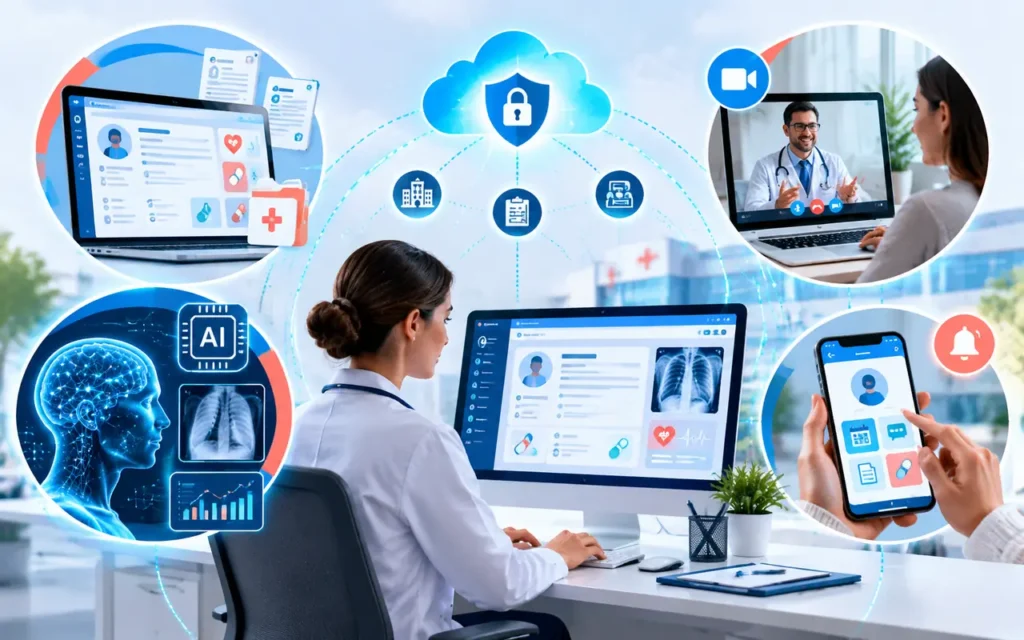
Computer technology in health care connects records, services and people involved in care.
Electronic health records and data exchange
An electronic health record stores information such as diagnoses, medicines, allergies, notes and test results. When information can move between authorized systems, clinicians may be able to see relevant records from different organizations.
The exchange is not always simple. ONC’s analysis of 2024 hospital data found that hospitals shared information with third party technology for uses such as telehealth and remote monitoring, but proprietary and nonstandard methods remained common.
Telehealth and patient portals
Telehealth includes remote visits and other forms of care delivered with communication technology. Patient portals may provide access to records, messages and appointment information. These tools can support care delivery, but they do not replace every in person visit.
Artificial intelligence and data analysis
AI tools can process information such as medical images, notes or sensor readings. A tool may flag an image for review or help organize information for a clinician. Its output still needs appropriate human oversight and evaluation.
The FDA maintains a list of AI enabled medical devices authorized for marketing in the United States. Checking the specific device and its intended use is more reliable than assuming every healthcare AI product has the same status.
Health and wellness technology
Health and wellness technology includes fitness trackers, sleep apps and other consumer tools that help people record habits or activity. These products can support personal tracking, but a wellness feature does not automatically provide a medical diagnosis.
People should check what a device measures, how it presents results, what data it collects and whether a clinician recommends its use. FDA guidance explains its policy for low risk products that promote a healthy lifestyle.
Why technology matters in healthcare
Technology can support healthcare in several practical ways:
- Access: Telehealth can connect patients with care when travel is difficult.
- Coordination: Shared records can help care teams review relevant patient information.
- Monitoring: Home devices can provide readings between appointments.
- Diagnosis: Imaging and diagnostic tools can help clinicians examine health information.
- Communication: Portals and messaging can help patients contact care teams.
- Medication management: Digital prescription systems can organize medication workflows.
- Emergency response: Dispatch and digital reports can support communication between EMS and hospitals.
- Public health: Disease reporting systems help agencies review surveillance data.
- Research: Digital tools can organize clinical trial and laboratory information.
- Operations: Scheduling and administrative systems can help organizations manage routine tasks.
These are possible uses, not guaranteed results. A tool’s value depends on the quality of its data, how it fits into work and whether patients and staff can use it.
Common challenges and mistakes
Health technology can create problems when organizations focus only on buying a tool.
- Poor system connections: Records may not move easily between providers or vendors.
- Privacy and security risks: Electronic health information needs safeguards. HIPAA obligations apply to covered entities and business associates, not automatically to every consumer health app.
- Unequal access: Patients may lack broadband, devices, digital skills or accessible interfaces.
- Limited staff training: A tool can add work if staff do not know how to use it.
- Unclear evidence: New technology may not yet have strong evidence of benefit in a specific setting.
- Overstated claims: A device or AI feature should not be described as improving outcomes unless reliable evidence supports that claim.
Before adoption, organizations should define the problem, identify users, check compatibility, assess privacy and safety, train staff, and measure whether the tool helps. Ongoing health technology management helps teams maintain systems, support users and review whether tools continue to meet care needs.
Frequently asked questions
What are examples of technology in healthcare?
Examples include electronic health records, telehealth, medical imaging, patient portals, remote monitoring devices, electronic prescriptions, laboratory systems and AI enabled medical devices. The right example depends on the setting and task.
Where can I find a health technology PDF?
For reliable reading, look for downloadable reports from government agencies, universities or peer reviewed journals. The WHO’s Classification of Digital Interventions, Services and Applications in Health is one reference for digital health terms and use cases. Check the publication date and scope before relying on a PDF.
What are 10 importance of technology in healthcare?
Technology can support access, coordination, monitoring, diagnosis, communication, medication management, emergency response, public health surveillance, research and routine operations. Its impact depends on safe design, good data and effective use.
What is “technology in healthcare SAGE”?
This search may refer to healthcare technology journals published by SAGE. SAGE lists journals such as Technology and Health Care, Health Informatics Journal and DIGITAL HEALTH. Check each journal’s scope to see whether it fits your research.
How does technology support healthcare delivery?
It can help providers record information, communicate with patients, coordinate referrals, review test results and deliver some services remotely. HHS describes remote patient monitoring as one type of telehealth that can collect health readings at home for a provider to review.
What health technology courses can I take?
Relevant study areas include health informatics, health information management, health IT, biomedical engineering and data analytics. For example, Boston University lists an online graduate certificate in health informatics, and the University of Illinois Chicago lists online health informatics programs. Compare prerequisites, course content, accreditation and cost when choosing health technology courses.
Is there a journal called Healthcare and Technology?
There are several journals covering healthcare technology and informatics. SAGE’s titles include Technology and Health Care, Health Informatics Journal and DIGITAL HEALTH. Their topics and publication requirements differ.
What is the salary for a healthcare technology job?
There is no single salary for all healthcare technology jobs. The U.S. Bureau of Labor Statistics reports a May 2025 median annual wage of $68,020 for health information technologists and medical registrars. This is one occupation group, not a salary estimate for every health IT, engineering or digital health role.
Conclusion
Health technology in specific settings and industries serves hospitals, clinics, emergency teams, home health, public health and related businesses in different ways. To understand what a tool can do, look at its purpose, users, evidence, data needs and fit with the care setting. That gives patients, students and healthcare organizations a clearer way to compare technologies without relying on broad promises.


