

Health Technology Trends, Research & Future
Health technology now reaches beyond hospital equipment and electronic records. It includes artificial intelligence, telehealth, wearable sensors, digital tools used in research, and systems that help health organizations exchange information.
For U.S. readers, the main question is how well these tools work in real care. This guide reviews current health care technology trends, what research can tell us, and which future developments still need stronger evidence.
Which health care technology trends matter in 2026?
These ten areas are shaping healthcare technology and research. Their readiness varies, so a technology in a research trial should not be treated as a routine care option.
| Trend | Current or developing use |
| 1. Clinical AI | Imaging support, risk review, and clinical decision support |
| 2. Generative AI | Drafting notes, summarizing records, and research support |
| 3. Wearables and remote monitoring | Tracking selected readings outside clinics |
| 4. Telehealth | Video, phone, and online visits |
| 5. Interoperable records | Sharing health data across systems |
| 6. Precision medicine | Using patient and genetic data to guide care. For example, tumor testing can help clinicians match some cancers with targeted treatments. |
| 7. Digital clinical trials | Collecting some study data remotely |
| 8. Digital therapeutics | Software based care for a specific health need. A structured app may guide patients through a treatment program alongside clinician support. |
| 9. Cybersecurity tools | Protecting connected devices and patient information with access controls, encryption, backups, and security monitoring. |
| 10. Robotics and digital models | Supporting selected procedures, training, and research |
The table is a guide to areas of activity, not a ranking of proven benefits. For each tool, intended use and evidence matter.
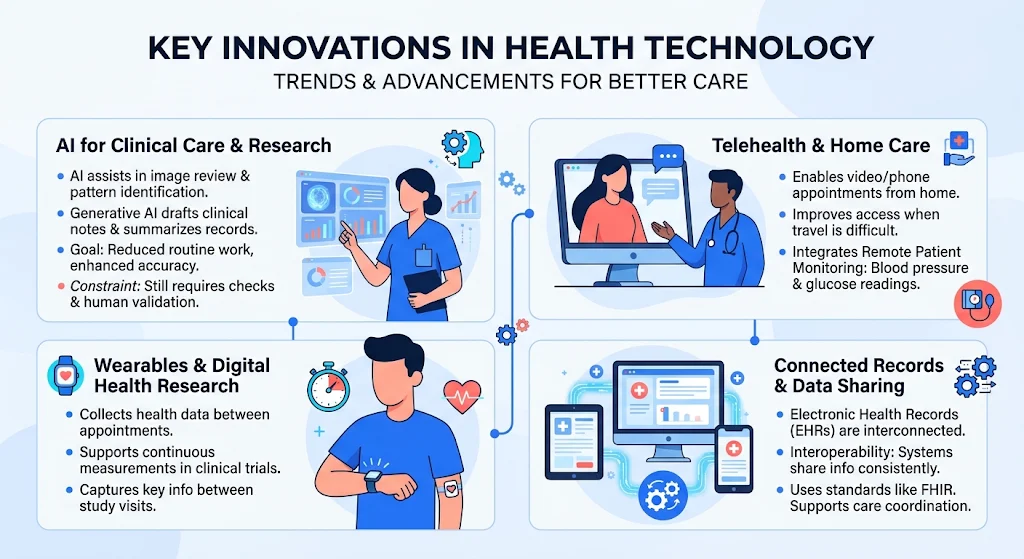
What is new in health technology?
AI for clinical care and research
AI can help clinicians review images, organize information, or identify patterns in data. Generative AI can also help draft clinical notes or summarize records. These tools may reduce some routine work, but they can produce errors and need suitable checks.
The U.S. Food and Drug Administration (FDA) reported that it had authorized more than 1,600 AI enabled medical devices for marketing in the United States by September 2026. The FDA list is not comprehensive. Its entries are tied to specific intended uses and applicable review pathways, so the number does not show that every tool works for every patient or care setting.
Another emerging area is “agentic AI,” which can carry out a sequence of tasks with limited prompting. In October 2026, the U.S. Department of Health and Human Services announced $1.5 million in awards for projects that include agentic AI in clinical care and improved laboratory data exchange. These awards show that the topics are receiving research and development attention. They do not show that autonomous AI care is already standard practice.
Telehealth and care at home
Telehealth lets patients meet a clinician by video, phone, or another digital service. It can make some appointments easier to attend, especially when travel is difficult. It may not suit every condition, examination, or patient.
A June 2026 report from the National Center for Health Statistics found that 80% of U.S. office based physicians used telemedicine in 2024. The share was lower than in 2021, when it was 86.5%, but telemedicine remained part of care delivery.
Remote patient monitoring can add readings from a patient’s home, such as blood pressure or glucose measurements. A care team needs a clear plan for reviewing readings, responding to alerts, and helping patients use the equipment.
Wearables and digital health research
Smartwatches, sensors, and other devices can collect information between appointments. Researchers are also studying how these devices can measure health changes during clinical trials.
The FDA describes digital health technologies as tools that can collect frequent or continuous measurements and support remote data collection in clinical research. That may help researchers capture information between study visits. The measurements still need validation, and study teams must consider whether participants can use the devices correctly.
Connected records and data sharing
Electronic health records store health information. Interoperability means different systems can exchange and use that information in a consistent way. This can support care coordination, research, and patient access to records.
In 2026, the Office of the National Coordinator for Health Information Technology (ONC) published an updated Interoperability Standards Advisory. It describes standards that can address health data exchange needs across clinical care, public health, research, and administration. Standards such as Fast Healthcare Interoperability Resources (FHIR) help define how health information can be represented and shared.
What does health technology research show?
Health technology research looks at more than whether a device or software can perform a task. Strong studies also ask whether it improves a meaningful outcome, works safely in the intended setting, and can be used by the people it is meant to serve.
Researchers may use clinical trials, diagnostic studies, usability testing, or real world data. The right method depends on the technology. A tool that reads medical images, for example, needs careful testing against appropriate clinical standards and across relevant patient groups.
Research quality also depends on who took part. If a study includes few people from certain age, racial, or health groups, its results may not apply equally to everyone. Studies should explain their participants, setting, outcome measures, and limits.
The FDA’s January 2026 final guidance on clinical decision support software explains how certain software functions may or may not fall under the legal definition of a medical device. The intended use and function matter. A general wellness app, a clinician support tool, and software that makes a medical recommendation may be treated differently.
The World Health Organization’s 2026 report on AI related health research also calls attention to ethics review and oversight. Researchers and institutions need to consider privacy, bias, human rights, and public trust when they study or use AI in health research.
How to assess a new health technology
Before adopting a new tool, a clinic or health system can ask:
- What health problem is it designed to address?
- What evidence supports its intended use?
- Which patients and settings were studied?
- What happens when the result is wrong or incomplete?
- Does it fit the clinical workflow?
- Who can access the data, and how is it protected?
- How will the organization check performance after launch?
For example, a clinic considering AI support for eye screening should review the tool’s intended use, evidence in the relevant patient group, referral process for uncertain results, and staff training needs. The clinic should also decide how it will monitor errors and patient outcomes over time.
Benefits and risks of health technology
Health technology can help people receive care at home, give clinicians more information, and support faster research. Benefits depend on implementation. A device that collects useful readings may still fail if patients cannot use it or care teams cannot respond.
Common mistakes
- Treating a wearable alert as a diagnosis.
- Assuming FDA authorization means a product works for every patient or purpose.
- Using a prediction as a substitute for clinical judgment.
- Buying a system before checking how it will fit existing records and workflows.
- Ignoring privacy, security, training, and access needs.
Health technology also raises policy questions about safety, access, data sharing, and accountability. Readers who want to explore those issues further may find health policy and technology a useful related topic. Organizations comparing a technology’s benefits, risks, and costs may also want to learn about health technology assessment.
What is the future of health technology?
The future of health technology will depend on whether new tools prove useful in everyday care. Near term work is likely to focus on making AI safer to use, improving data exchange, supporting care at home, and collecting better evidence from digital devices.
Some areas remain early. Digital twins, which are computer models of a person or body system, may support research or planning, but their value depends on the quality of the data and how well the model reflects real biology. Robotics, virtual reality, and 3D printing also have specific uses, but their benefits differ by procedure and setting.
A useful way to read future claims is to ask whether a tool is already used in care, being tested in a study, or still a proposal. This helps readers separate available services from emerging health care technology that needs more evaluation.
Frequently asked questions
What are the current trends in healthcare technology?
Key trends include clinical AI, generative AI, telehealth, remote monitoring, wearable devices, interoperable health records, precision medicine, digital clinical trials, cybersecurity, and selected uses of robotics and digital models.
What are the key healthtech trends for 2026?
In 2026, U.S. health technology work includes AI enabled medical devices, clinical decision support, agentic AI research, telehealth, remote data collection, and interoperability. Some are in use today; others remain under study.
What are the top 10 tech trends?
For healthcare, ten important areas are clinical AI, generative AI, wearables and remote monitoring, telehealth, interoperable records, precision medicine, digital trials, digital therapeutics, cybersecurity, and emerging robotics or digital models. The order is not a measure of effectiveness.
What are four current trends in health care?
Four major trends are AI in clinical work, telehealth, wearable and remote monitoring, and connected electronic health records. Precision medicine is another important area.
What are the newest health trends?
Newer developments include agentic AI research, AI assisted clinical documentation, digital measures in clinical trials, and connected home monitoring. A new technology for health still needs evidence for its intended use. Adoption and evidence differ by tool and setting.
Who are the big 3 in healthcare?
There is no single official “Big 3” for the whole U.S. healthcare system. The phrase may refer to health insurers, hospital systems, pharmaceutical companies, or pharmacy benefit managers. The leaders differ by sector and by measure: insurer membership or revenue, hospital beds or revenue, drug sales or market value, and prescriptions managed by pharmacy benefit managers. A useful answer should name the sector and measure.
Conclusion
Health technology can support care, research, and data sharing, but new does not automatically mean effective. For patients and healthcare organizations, the useful questions are whether a tool has evidence for its intended use, protects people’s information, fits real workflows, and improves outcomes.


