

Vanguard Technology ETFs & Index Funds Explained
Vanguard gives U.S. investors two closely related ways to track the information technology sector: the Vanguard Information Technology ETF, known by ticker VGT, and the Vanguard Information Technology Index Fund Admiral Shares, known by ticker VITAX.
Both follow the MSCI US Investable Market Information Technology 25/50 Index. They invest in many of the same companies and use the same sector benchmark. The main difference is how investors buy and hold them.
VGT trades on an exchange like a stock. VITAX is a mutual fund share class bought at its net asset value after the market closes.
These funds own hundreds of stocks, but they are still concentrated in one sector. A few companies, especially NVIDIA, Apple and Microsoft, can have a large effect on returns.
This guide explains how Vanguard technology funds work, what they own, how VGT differs from VITAX, how they compare with VOO, VTI and VUG, and what risks investors should understand before using a technology sector fund.
Quick Answer
The main Vanguard technology ETF is the Vanguard Information Technology ETF, ticker VGT. Its mutual fund counterpart is the Vanguard Information Technology Index Fund Admiral Shares, ticker VITAX.
Both seek to track the MSCI US Investable Market Information Technology 25/50 Index. Vanguard currently reports a 0.09% expense ratio for both. As of July 31, 2026, each held 319 stocks.
VGT trades during market hours. VITAX uses the mutual fund structure and trades once per day at net asset value.
Vanguard Technology Funds at a Glance
| Feature | VGT | VITAX |
| Full name | Vanguard Information Technology ETF | Vanguard Information Technology Index Fund Admiral Shares |
| Investment type | ETF | Mutual fund |
| Benchmark | MSCI US Investable Market Information Technology 25/50 Index | Same benchmark |
| Expense ratio | 0.09% | 0.09% |
| Holdings | 319 | 319 |
| Trading | During market hours | Once daily at NAV |
| Main focus | U.S. information technology stocks | U.S. information technology stocks |
| Management style | Passive index tracking | Passive index tracking |
Fund data is based on Vanguard information available in 2026. Holdings, returns, yields and portfolio weights can change.
What Vanguard Technology Funds Are Available?
Vanguard Information Technology ETF (VGT)
The vanguard information technology etf is VGT.
The vanguard information technology etf (vgt) started on January 26, 2004. Vanguard reported $147.6 billion in VGT net assets as of August 31, 2026, and 319 holdings as of July 31, 2026.
VGT seeks to match the return of an index made up of U.S. companies classified in the information technology sector.
The portfolio includes large, medium and small companies, but the largest firms account for much of the fund’s value.
VGT is passively managed. Vanguard normally tries to hold the stocks in the benchmark at similar weights. If rules prevent exact replication, Vanguard can use sampling to stay close to the index.
Because VGT is an ETF, investors can buy or sell shares during market hours. Its trading price can move slightly above or below the value of the securities held by the fund.
Vanguard Information Technology Index Fund
The vanguard information technology index fund is commonly represented by VITAX, the Admiral Shares class.
VITAX began on March 25, 2004. Vanguard reported $22.7 billion in VITAX net assets and $170.2 billion in total fund assets as of August 31, 2026.
VITAX follows the same technology benchmark used by VGT and reports the same 0.09% expense ratio.
What Does Vanguard Technology Fund Mean?
Searches for vanguard technology fund can refer to VGT, VITAX or the broader Vanguard Information Technology Index Fund strategy.
The investment idea is similar in each case. Investors get concentrated exposure to U.S. information technology companies. The main difference is whether the investment is held through an ETF or a mutual fund share class.
How Does VGT Work?
VGT tracks the MSCI US Investable Market Information Technology 25/50 Index.
MSCI states that the index covers large, medium and small U.S. companies that fall within the Information Technology sector under the Global Industry Classification Standard, or GICS.
This is important because VGT does not simply buy every company that consumers think of as a technology business. Companies must meet the index’s formal classification rules.
How Market Weighting Affects VGT
VGT is mainly weighted by market value.
In simple terms, larger companies usually receive larger positions in the fund.
That is why NVIDIA, Apple and Microsoft have much bigger weights than smaller software, semiconductor and hardware companies.
As of July 31, 2026, Vanguard reported these major positions:
| Company | VGT Weight |
| NVIDIA | 17.15% |
| Apple | 16.24% |
| Microsoft | 10.96% |
| Broadcom | 4.21% |
| Micron Technology | 3.82% |
| Advanced Micro Devices | 3.18% |
| Cisco Systems | 1.91% |
| Applied Materials | 1.69% |
| Intel | 1.65% |
| Lam Research | 1.54% |
NVIDIA, Apple and Microsoft alone represented about 44% of the portfolio in that snapshot.
This is why the number of stocks alone does not tell you how diversified a fund is.
What Industries Does VGT Hold?
Technology includes several different businesses.
VGT owns semiconductor companies, software firms, hardware makers, communications equipment companies and IT service providers.
Vanguard reported the following subindustry weights as of July 31, 2026:
| Subindustry | Weight |
| Semiconductors | 36.25% |
| Technology hardware and peripherals | 20.42% |
| Systems software | 16.02% |
| Application software | 8.57% |
| Semiconductor equipment | 5.75% |
| Communications equipment | 4.23% |
| Electronic components | 1.93% |
| Internet services and infrastructure | 1.92% |
| IT consulting and services | 1.75% |
Semiconductors are especially important. Changes in chip demand, artificial intelligence spending, data center investment and semiconductor cycles can have a noticeable effect on the fund.
Why Are Some Famous Tech Companies Missing?
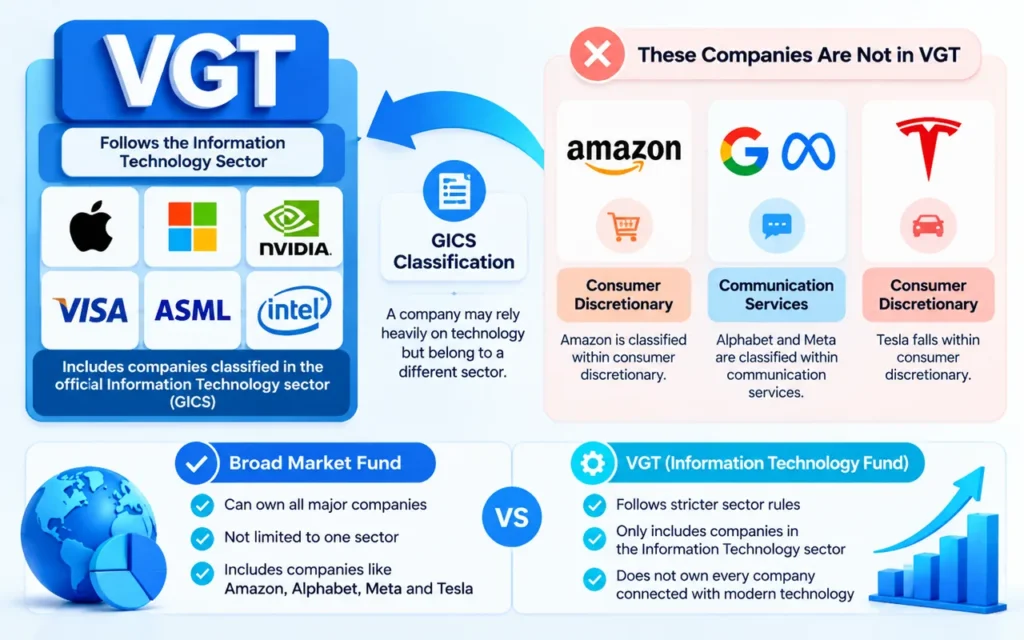
Some companies that people often call technology companies may not appear in VGT.
The reason is GICS classification.
MSCI includes companies that fall inside the official Information Technology sector. A company may rely heavily on technology while its formal market classification places it in another sector.
Amazon, for example, is classified within consumer discretionary.
Alphabet and Meta are classified within communication services.
Tesla falls within consumer discretionary.
A broad market fund can own all of these companies because it is not limited to one sector. An information technology index follows stricter sector rules.
This is why VGT should not be viewed as a fund that owns every company connected with modern technology.
VGT vs VITAX
VGT and VITAX are much more similar than their different tickers suggest.
Both track the same benchmark. Both had 319 holdings as of July 31, 2026. Both reported a 0.09% expense ratio. Their largest positions were also the same.
The main difference is the investment structure.
| Feature | VGT | VITAX |
| Structure | ETF | Mutual fund |
| Pricing | Market price | End of day NAV |
| Trading time | Throughout market hours | Once per day |
| Benchmark | Same | Same |
| Expense ratio | 0.09% | 0.09% |
| Portfolio | Nearly identical | Nearly identical |
| Intraday price movement | Yes | No |
| Bid ask spread | Yes | No exchange spread |
For most investors comparing the two, the bigger question is not which companies they own. It is how the investor prefers to trade, automate purchases and manage the account.
Is VGT Both an ETF and an Index Fund?
Yes.
ETF and index fund describe two different parts of an investment.
An ETF describes how shares are bought and sold.
An index fund describes the investment strategy.
VGT is an ETF because it trades on an exchange. It is also an index fund because it seeks to track an index instead of relying on a manager to select stocks.
VITAX also follows an index, but it uses a mutual fund structure.
How VGT Compares With VOO, VTI and VUG
Investors often compare VGT with other Vanguard funds, but they are built for different types of exposure.
| Fund | Main Exposure | Holdings | Expense Ratio |
| VGT | Information technology sector | 319 | 0.09% |
| VOO | Large U.S. companies in S&P 500 | 505 | 0.03% |
| VTI | Broad U.S. stock market | 3,507 | 0.03% |
| VUG | Large cap growth stocks | 147 | 0.03% |
Current Vanguard data shows VOO, VTI and VUG each with a 0.03% expense ratio.
VGT vs VTI
VTI represents the wider U.S. stock market.
As of August 31, 2026, Vanguard reported 3,507 holdings in VTI. Its portfolio includes technology, finance, health care, industrial companies, retailers and many other industries.
VGT focuses on information technology.
If an investor already owns VTI and adds VGT, the result is usually a larger technology allocation rather than exposure to a completely new part of the market.
VGT vs VOO
VOO tracks the S&P 500 and holds large companies from many sectors.
It also owns NVIDIA, Apple and Microsoft, so VGT and VOO can overlap.
The main difference is concentration.
VOO spreads its investments across the wider S&P 500. VGT places much more weight on technology companies. Vanguard reported 505 holdings in VOO as of July 31, 2026.
VGT vs VUG
VUG follows large cap growth companies.
Growth is an investment style, not a sector.
This means VUG can own companies from several sectors. VGT is limited to companies classified in information technology.
Vanguard reported 147 holdings in VUG as of August 31, 2026.
The two funds can share major stocks, but their investment rules are different.
How Diversified Is VGT?
VGT owns many companies inside one sector.
It is not broadly diversified across the U.S. economy.
Owning 319 stocks can reduce the effect of problems at one small company. It does not protect an investor from a broad decline in the technology sector.
Technology stocks can fall together when valuations drop, chip demand weakens, software spending slows or interest rates rise.
Concentration also exists at the company level.
In Vanguard’s July 31, 2026 holdings data, NVIDIA, Apple and Microsoft made up about 44% of the portfolio.
Investors should therefore look at both the number of holdings and the size of the largest positions.
VGT Fees and Trading Costs
VGT reports an expense ratio of 0.09%.
That equals an approximate annual fund cost of:
| Investment | Approximate Annual Fund Cost |
| $1,000 | $0.90 |
| $10,000 | $9 |
| $100,000 | $90 |
This calculation only illustrates the expense ratio. It does not include taxes, possible brokerage fees or trading spreads.
VGT also has a bid ask spread because it trades on an exchange. Vanguard reported a 30 day bid ask spread of 0.01% in September 2026.
The bid ask spread is the difference between the highest price a buyer is offering and the lowest price a seller will accept.
NAV and Market Price
NAV means net asset value.
It is the value of the fund’s assets, minus liabilities, divided by the number of shares.
An ETF also has a market price.
The market price can move slightly above or below NAV during the trading day because buyers and sellers set the price in the market.
Large financial firms known as authorized participants can create or redeem large blocks of ETF shares. This process helps keep the ETF’s market price close to the value of the investments it owns.
Small differences between market price and NAV are normal.
Does VGT Pay Dividends?
Yes.
VGT distributes investment income to shareholders.
Vanguard’s official 2026 distribution schedule lists quarterly distribution dates for the Information Technology ETF.
Vanguard also reported a dividend yield of 0.44% as of July 31, 2026.
VGT is not designed mainly as an income fund. Many technology companies use a large part of their profits for research, product development, acquisitions and business growth.
VGT Historical Performance
Technology stocks produced strong returns over several recent periods, but those gains came with periods of sharp losses.
Vanguard reported the following average annual NAV returns for VGT as of August 31, 2026:
| Period | Average Annual Return |
| 1 year | 38.99% |
| 3 years | 30.14% |
| 5 years | 18.50% |
| 10 years | 24.49% |
| Since inception | 14.87% |
Past performance does not show what future returns will be.
MSCI data also shows that the technology benchmark has suffered major losses during weak markets. For example, the index fell 29.58% in 2022.
Strong long term returns do not remove short term risk.
What Drives VGT Returns?
Several forces can affect a technology sector fund.
Semiconductor Demand
Chip companies make up a large part of VGT.
Demand from artificial intelligence, data centers, computers, smartphones, vehicles and industrial equipment can change semiconductor earnings quickly.
Software Spending
Microsoft and other software companies depend on business and consumer spending for cloud services, software and subscriptions.
Interest Rates
Many technology companies are valued partly on profits expected years into the future.
Higher interest rates can make those future profits less valuable in today’s dollars. Stock prices can therefore fall even when the company is still growing.
Large Company Earnings
A small group of companies has a large weight in VGT.
Results from NVIDIA, Apple and Microsoft can therefore move the fund more than results from many smaller holdings.
Main Risks of Vanguard Technology Funds
Sector Concentration
VGT invests in information technology rather than the entire stock market.
A technology downturn can affect much of the portfolio at the same time.
Company Concentration
The largest holdings make up a large part of the fund.
A major decline in one of those companies can have a visible effect on returns.
Semiconductor Cycles
Chip demand often moves through periods of strong demand, heavy investment, excess supply and weaker pricing.
Because semiconductors make up a large share of VGT, these cycles matter.
Valuation Risk
Fast growing technology companies can trade at high prices compared with their profits.
If expected growth slows, stock prices may fall even if those companies remain profitable.
Regulation
Large technology companies face rules related to competition, privacy, data use and artificial intelligence.
New rules can affect costs, products or business models.
Geopolitical Risk
Semiconductor production depends on global supply chains.
Trade restrictions, export controls and regional conflicts can affect chip and hardware companies.
Benefits of VGT and VITAX
VGT and VITAX give investors one fund that holds many U.S. information technology companies.
Their 0.09% expense ratio is much lower than the average expense ratio reported for many competing technology funds in Vanguard’s peer comparison.
The portfolio includes large, medium and small companies rather than only the biggest technology names.
The passive structure also means investors do not have to select individual semiconductor, software and hardware stocks themselves.
These features make sector exposure easier to hold, but they do not remove sector risk.
How VGT Could Fit Into a Portfolio
A broad market fund and a technology sector fund can serve different purposes.
A broad fund such as VTI covers many sectors and thousands of U.S. stocks.
VGT is narrower. Adding it to a portfolio usually increases information technology exposure.
Before adding a sector fund, investors should check what they already own. Someone holding VTI, VOO or VUG may already have large positions in NVIDIA, Apple and Microsoft.
That is where broader technology investing, portfolio management and planning becomes important. Fund selection is only one part of managing overall risk and exposure.
Investors comparing technology investment funds should also separate the investment vehicle from the strategy. ETFs, mutual funds, private equity and venture capital can all provide technology exposure, but their liquidity, access and risk can differ widely.
Publicly traded technology funds also differ from alternative technology investments such as private equity and venture capital investments in private companies.
Common Mistakes When Evaluating VGT
Looking Only at Recent Returns
Strong recent returns can attract investors after prices have already risen.
Performance should be considered together with valuation, concentration and risk.
Assuming 319 Stocks Means Broad Diversification
VGT owns hundreds of companies, but they are tied to the same economic sector.
Ignoring Portfolio Overlap
Adding VGT to VOO or VTI can increase positions an investor already owns.
Calling Every Tech Company a VGT Holding
The fund follows GICS classifications.
Amazon, Alphabet, Meta and Tesla do not automatically fall inside the Information Technology sector.
Treating VGT and VUG as the Same Strategy
- VGT is a sector fund.
- VUG is a growth style fund.
- Their holdings can overlap, but their investment rules are different.
How to Evaluate a Technology ETF
Before choosing a technology ETF, review:
- The benchmark it tracks
- Expense ratio
- Number of holdings
- Weight of the largest companies
- Semiconductor and software exposure
- Trading volume and bid ask spread
- Historical volatility
- Overlap with existing investments
- Index rules
- Tax considerations
- Whether the fund matches the investor’s goals and risk tolerance
The fund with the strongest recent return is not automatically the best fit.
Frequently Asked Questions
Which Vanguard technology ETF is considered the best?
VGT is Vanguard’s main dedicated U.S. information technology ETF, so it is the most direct Vanguard choice for investors researching that sector.
That does not make it the best fund for everyone. VTI and VOO offer broader market exposure, while VUG targets large growth stocks.
What if I invested $10,000 in VGT 10 years ago?
Vanguard reported a 10 year annualized NAV return of 24.49% as of August 31, 2026.
If $10,000 had compounded at exactly that rate for ten years, it would have grown to about $89,400 before taxes and investor specific costs.
This is a mathematical illustration based on Vanguard’s reported historical annualized return. It is not an exact investor account result or a forecast.
What Vanguard ETF did Warren Buffett recommend?
Warren Buffett did not specifically recommend VGT.
In Berkshire Hathaway’s 2013 shareholder letter, Buffett wrote that the trustee managing money for his wife should put 90% in a very low cost S&P 500 index fund and 10% in short term government bonds. He added that he suggested Vanguard for the index fund.
The statement supports broad S&P 500 index exposure, not a technology sector fund.
Is it better to invest in VOO or VGT?
Neither fund is better for every investor.
VOO tracks the S&P 500 and invests across several sectors. VGT focuses on information technology.
The choice depends on whether the goal is broader large cap U.S. exposure or a specific technology sector allocation.
What is the best technology ETF to buy right now?
There is no single technology ETF that fits every investor.
Compare the benchmark, expense ratio, concentration, holdings, liquidity, valuation and overlap with other funds already in the portfolio.
VGT is one major low cost option for U.S. information technology exposure, but it has significant concentration in a few large companies.
Does Warren Buffett recommend VOO or VTI?
Buffett’s 2013 instructions referred to a very low cost S&P 500 index fund and suggested Vanguard.
That description is closer to VOO because VOO tracks the S&P 500. Buffett did not name VTI in that instruction.
Should I buy VGT or VTI?
VGT and VTI serve different purposes.
VTI tracks the broad U.S. stock market and reported 3,507 holdings as of August 31, 2026. VGT focuses on information technology and reported 319 holdings as of July 31, 2026.
The first question should be whether the investor wants broad U.S. market exposure or an intentional technology sector position.
Conclusion
VGT and VITAX provide nearly the same underlying technology exposure through different investment structures.
VGT trades as an ETF. VITAX is a mutual fund share class. Both follow an index focused on U.S. information technology companies and both reported a 0.09% expense ratio in 2026.
The main issue investors need to understand is concentration.
VGT owns hundreds of stocks, but a large part of the portfolio sits in NVIDIA, Apple, Microsoft and other major technology companies. It also lacks broad exposure to sectors such as finance, health care, energy and consumer staples.
For investors researching technology funds, recent performance should not be the only comparison. Holdings, concentration, fees, portfolio overlap, risk and the role of the fund inside the wider portfolio all matter.