

Technology Banking, Credit Unions & Digital Finance Solutions
Banking today depends on much more than a branch, an ATM, or a mobile app. Behind each balance check, card payment, loan application, and money transfer are connected systems that record transactions, verify identity, manage risk, move funds, and protect customer data.
Technology Banking, Credit Unions & Digital Finance Solutions covers the systems banks and credit unions use to provide these services. This includes core banking software, digital banking platforms, payment networks, application programming interfaces, cloud systems, fraud tools, artificial intelligence, and security controls.
For customers, these systems make financial services easier to access. For financial institutions, the goal is to improve speed and convenience while keeping records accurate, services reliable, and customer data secure.
What Is Technology Banking?
Technology banking is the use of software, data systems, payment networks, digital channels, and security tools to provide banking services.
A simple mobile banking action may involve several systems. The app confirms the user’s identity, requests account data from a core banking system, checks transaction rules, passes information through an integration layer, and records the action.
This is why banking technology is broader than a banking app.
Bank Technology and Fintech Are Different
Bank technology usually refers to systems banks and credit unions use to operate financial services.
Fintech is broader. It includes companies that build payment apps, lending tools, identity services, banking software, investment products, and financial data services.
A bank can use several fintech products while keeping its own core system and regulatory responsibilities.
How Modern Banking Technology Works
Most financial institutions use several connected technology layers rather than one program.
| Technology layer | Main job | Common use |
| Customer channel | Gives users access | Mobile and online banking |
| Digital platform | Manages digital activity | Transfers, cards, alerts |
| Integration layer | Connects systems | APIs and outside services |
| Core banking | Stores account records | Deposits, loans, balances |
| Payments | Moves funds | ACH, cards, FedNow, RTP |
| Data systems | Analyze information | Reporting and fraud checks |
| Security | Protects systems | MFA, biometrics, monitoring |
The core banking system is often the main system of record. It keeps track of accounts, balances, deposits, loans, and transactions.
A digital banking platform sits closer to the customer. It manages many functions available through a browser or mobile app.
APIs let approved systems exchange information.
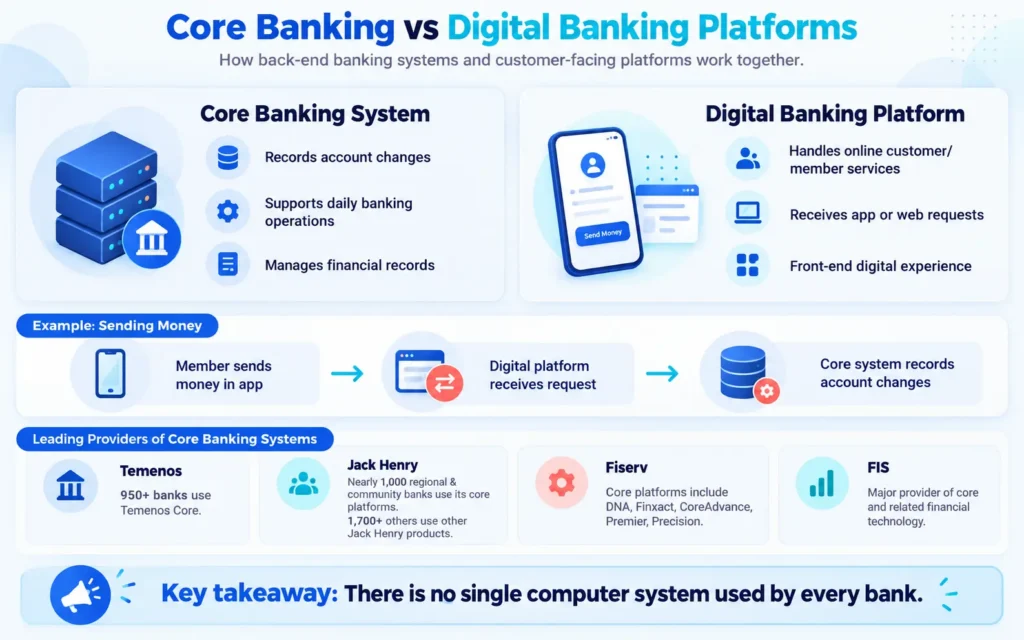
Core Banking vs Digital Banking Platforms
A core banking system manages financial records that support daily banking operations.
A digital banking platform manages many of the services customers or members access online.
For example, when a member sends money through a credit union app, the digital platform may receive the request while the core system records the resulting account changes.
Fiserv, FIS, Jack Henry, and Temenos are major providers of core or related financial technology.
Temenos states that more than 950 banks use Temenos Core.
Jack Henry says nearly 1,000 regional and community banks use its core platforms, while more than 1,700 others use other Jack Henry products.
Fiserv offers several core platforms, including DNA, Finxact, CoreAdvance, Premier, and Precision.
There is no single computer system used by every bank.
What Is Credit Union Technology?
Credit union technology includes systems used to serve members, manage deposits and loans, process payments, control risk, and meet regulatory requirements.
Common systems include:
- Core account processing
- Mobile and online banking
- Loan origination
- Digital account opening
- Card management
- Payment processing
- Fraud monitoring
- Identity verification
- Member support systems
- Financial reporting
Jack Henry reports more than 2,200 credit union clients, including more than 700 using its Symitar platform.
Credit union technology projects may improve digital services without requiring an immediate replacement of the institution’s entire core system.
Banks, Credit Unions, and Fintech Companies
Banks, credit unions, and fintech companies may offer similar digital features, but their structures differ.
| Area | Banks | Credit unions | Fintech companies |
| Ownership | Private or shareholder-based | Member owned | Usually private or public |
| Relationship | Customer | Member | User or customer |
| Deposit services | Yes | Yes | Often through bank partners |
| Lending | Common | Common | Often specialized |
| Core banking | Required | Required | May use bank partners |
| Regulation | Bank regulators | NCUA or state regulators | Depends on activity |
A fintech app may appear similar to a bank app while relying on a regulated financial institution behind the scenes for deposits or payment access.
That distinction matters when comparing Financial Technology Solutions.
Digital Banking Technology for Customers
Digital banking technology lets customers and credit union members complete many financial tasks without visiting a branch.
Common functions include account access, electronic statements, card controls, alerts, remote deposits, transfers, bill payment, digital account opening, and personal finance tools.
Q2 provides digital banking software across consumer, small business, and commercial banking. Its platform can also connect banks and credit unions with outside fintech services.
The useful question is not simply whether a financial institution has an app. Customers should also consider what the app can do, how reliable it is, how well it connects with other systems, and what security controls protect access.
Banking Technology Solutions Used Today
Modern banking technology solutions cover several parts of financial operations.
Digital Account Opening
Customers can provide information, verify identity, sign documents, and fund some accounts remotely.
Banks still need controls for identity fraud, sanctions screening, eligibility, and record-keeping.
Loan Origination
Loan software can collect applications, review documents, calculate terms, manage decisions, and move approved loans into servicing systems.
Machine learning may support risk analysis, but sensitive decisions need suitable controls and oversight.
Data and Analytics
Banks analyze transaction data for reporting, fraud checks, risk management, customer service, and product planning.
Digital Member Support
Secure messaging, online service requests, virtual assistants, and call center software can handle routine requests while staff manage cases that require judgment.
APIs and Open Banking
An API lets one software system request information or an action from another under defined rules.
Banks use APIs to connect digital platforms with core systems, payment providers, identity services, lending tools, and fintech products.
Open banking adds customer permission to the process. A customer may authorize an approved outside service to access certain financial data.
APIs can make it easier to add services, but they also create security, privacy, and vendor oversight responsibilities.
Payments Are Part of Digital Finance
U.S. banks and credit unions may use ACH, card networks, wire transfers, peer payment services, the RTP network, and the Federal Reserve’s FedNow Service.
FedNow allows participating banks and credit unions to send and receive eligible payments within seconds, 24 hours a day and seven days a week. The Federal Reserve maintains an updated list of live participants and service providers.
Payment services also depend on account systems, fraud controls, settlement arrangements, and messaging standards.
Readers researching this field in more detail can also explore Payment Technology, Digital Payments & Processing Solutions, since payment processing is a major technology category of its own.
How Chip Technology Credit Card Security Works
Searches for chip technology credit cards usually refer to EMV chip technology.
An EMV chip generates a unique security code for a transaction. This makes copied payment information harder to reuse for counterfeit card transactions than traditional magnetic stripe data.
EMVCo says chip technology helps prevent counterfeit, lost, and stolen card fraud by validating the card and generating transaction-specific security data.
Chip cards do not stop every type of fraud. Phishing, account takeover, stolen credentials, and some online card fraud can still occur.
Artificial Intelligence in Banking
Banks use several forms of AI.
Machine learning can identify unusual transaction patterns. Language systems can help with customer support. Document tools can extract information from forms. Generative AI can summarize material, assist employees, and support search across internal information.
Google Cloud describes banking uses that include fraud and risk prediction, customer engagement, analytics, document processing, and cybersecurity.
Microsoft provides financial services tools for customer service, employee work, risk, compliance, data, and core modernization.
AI output should not automatically become a final decision in sensitive financial cases. Banks still need appropriate controls, testing, governance, and human review.
Banking Security and Fraud Prevention
Digital banking increases the number of systems and connections that financial institutions need to protect.
Common controls include:
- Multi-factor authentication
- Biometric login
- Device checks
- Encryption
- Transaction monitoring
- Identity verification
- Fraud scoring
- Access controls
- Security logging
- Incident response
The NCUA’s 2026 supervisory priorities specifically address payment system risk, fraud prevention, vendor management, information security, and protection of member data.
This is important because one banking service may depend on several outside providers. Institutions need to understand who handles data, security, uptime, and incident response at each point.
Legacy Systems and Core Modernization
Some banks still operate systems that have been used for many years.
Age alone does not make software unsafe. Problems appear when systems become difficult to maintain, connect, document, secure, or staff.
A bank may replace its core system, add an API layer around it, move selected services to cloud infrastructure, or modernize parts of the system in stages.
The right approach depends on cost, risk, technical resources, and how much disruption the institution can accept.
Are Banks Still Using COBOL?
Yes. Some financial institutions still run applications written in COBOL.
COBOL has a long history in large transaction processing systems. Banks may keep stable older applications while connecting them with newer digital interfaces and services.
The key questions are whether the software is secure, supported, documented, tested, and maintainable.
Build, Buy, or Partner?
Banks and credit unions usually have three broad choices when adding technology.
| Model | Main benefit | Main concern |
| Build | Greater control | Higher cost and staffing needs |
| Buy | Faster implementation | Vendor dependence |
| Partner | Access to specialist tools | Integration and oversight |
Large banks may develop more systems internally. Community banks and credit unions often buy core technology and connect other products through integrations.
The right choice depends on budget, staff skills, existing systems, risk, and implementation needs.
How to Evaluate Banking Technology
A modern interface alone does not make a banking product a good choice.
Financial institutions should review:
Core Compatibility
Can it connect with current account and transaction systems?
Security and Compliance
How does the vendor protect data, identities, administrative access, and regulated records?
Data Access
Who controls the data, and can the institution export it if needed?
Reliability
What are the uptime commitments and recovery procedures?
Integration
Does the platform provide suitable APIs and connections?
Support and Cost
Who handles serious problems, and what are the costs of software, conversion, training, migration, maintenance, and future upgrades?
Common Banking Technology Mistakes
A common mistake is replacing the customer-facing interface while ignoring weak systems behind it.
Another is adding many vendors without clearly assigning security and data responsibilities.
Financial institutions may also underestimate migration work. Account data, transaction history, documents, user permissions, and integrations need careful testing.
AI creates another risk when it is used without clear controls or review.
First Technology Federal Credit Union and DCU
The keyword first technology federal credit union now points to a significant current development.
Digital Federal Credit Union and First Technology Federal Credit Union legally became one credit union on January 1, 2026. The legal name is First Technology Federal Credit Union. DCU and First Tech are operating as two divisions while their operations are being combined.
The merger approval announcement said the combined institution would have about $28.7 billion in assets, nearly two million members, and more than 50 branches across eight states.
The merger also shows why technology integration matters. Two financial institutions may need to bring together digital channels, account systems, security processes, data, and service operations without disrupting members.
Banking Technology Trends to Watch
Several areas are receiving attention in 2026.
Instant payments continue to expand through services such as FedNow.
Core providers are offering more modular systems and cloud deployment options.
Banks and credit unions are testing generative AI for customer support, operations, fraud work, employee tools, and data analysis.
API based connections also let institutions add outside financial services without rebuilding every system.
Fraud controls remain important as payments become faster. NCUA’s 2026 priorities note that more complex payment integrations can create added operational and security risks.
These banking technology news themes should be reviewed regularly because AI tools, payment services, regulations, and vendor products can change quickly.
The Future of Digital Finance
Banking is moving toward systems that connect more easily with other approved services.
Core platforms, digital banking software, payment networks, identity systems, data tools, and fintech products increasingly work as parts of a larger technology structure.
That creates more choices for financial institutions, but it also makes vendor oversight, data management, cybersecurity, and system ownership more important.
The technology will change. The basic responsibilities of banking remain the same: accurate records, secure access, reliable payments, responsible lending, consumer protection, and dependable service.
Frequently Asked Questions
Who is DCU merging with?
DCU merged with First Tech. The legal combination took effect on January 1, 2026, forming one institution with the legal name First Technology Federal Credit Union. DCU and First Tech currently operate as divisions while integration continues.
What banks use Jack Henry software?
Jack Henry serves many U.S. regional and community banks. The company says nearly 1,000 use its core platforms and more than 1,700 additional banks use other Jack Henry products.
Is Temenos an IT company?
Temenos is a banking software company. It provides core banking, digital banking, payments, financial crime, data, and AI-related technology for financial institutions.
What is Q2 software used for?
Q2 provides digital banking software for banks and credit unions. It supports consumer, small business, and commercial banking, along with money movement, digital onboarding, card functions, and fintech integrations.
Which software is mostly used at banks?
There is no single software package used by all banks. Common providers include Fiserv, FIS, Jack Henry, and Temenos. Banks usually combine several systems for core processing, payments, digital banking, security, and reporting.
Is Fiserv the same as Jack Henry?
No. Fiserv and Jack Henry are separate financial technology companies. Their products compete in some areas, including core banking, payments, and digital financial services.
Are banks still using COBOL?
Yes. Some banks still use COBOL applications. The main concern is not the programming language by itself, but whether the system remains secure, supported, documented, and maintainable.
What AI tools do banks use?
Banks use fraud models, document processing, virtual assistants, predictive analytics, employee copilots, and generative AI platforms. Providers include Microsoft, Google Cloud, AWS, IBM, and financial technology companies.
What computer system do banks use?
Banks normally use a core banking system connected to digital banking software, payment systems, fraud tools, identity services, databases, reporting applications, and security systems.
Conclusion
Technology supports almost every part of modern banking, from account records and loan processing to mobile apps, fraud checks, card payments, and instant transfers.
A useful banking system is not simply the newest one. It needs to connect reliably, protect customer data, support staff, meet regulatory duties, and provide services without losing control of risk.
For customers and credit union members, the result should be easier access to financial services. For financial institutions, the challenge is delivering that access while keeping banking accurate, secure, and dependable.


