

Government & National HIT Organizations in the U.S.
The Office of the National Coordinator for Health Information Technology coordinates U.S. efforts to improve how health records are used and shared. Other organizations have different jobs. The Centers for Medicare & Medicaid Services sets data sharing requirements for certain health plans. The HHS Office for Civil Rights enforces HIPAA rules, and HL7 International publishes standards that software developers use to exchange health data. ONC · CMS · HHS OCR · HL7
Health information technology, or HIT, includes electronic health records and the systems that let people access and share them. If you need to check a product’s certification, understand a payer rule, or report a problem getting records, start with the table below.
Who Does What in U.S. Health IT?
| If you need to… | Start with | What to look for |
| Check whether a product or module is certified | Office of the National Coordinator for Health Information Technology (ONC) | Certified Health IT Product List |
| Check data sharing or prior authorization rules for a health plan | Centers for Medicare & Medicaid Services (CMS) | CMS interoperability guidance |
| Find HIPAA enforcement guidance | HHS Office for Civil Rights (OCR) | HIPAA compliance and enforcement |
| Report suspected information blocking | ONC’s reporting portal | Information blocking guidance and reporting |
| Find the technical rules for a FHIR connection | HL7 International | FHIR specification |
| Learn how nationwide health data exchange works under TEFCA | ONC’s TEFCA resources | TEFCA overview |
What Does the Office of the National Coordinator Do?
The Office of the National Coordinator for Health Information Technology, or ONC, is the federal office within the U.S. Department of Health and Human Services (HHS) that coordinates national health IT efforts. The National Coordinator for Health Information Technology is the leadership position. The HITECH Act of 2009 established that position in federal law.
How to Check Health IT Certification
Search the Certified Health IT Product List, or CHPL, by developer or product name. Open the entry and check the version, certification status, and criteria. If a vendor’s proposal names a specific module, match that module to the listing before making a purchase decision.
If your team uses a saved checklist, compare it with ONC’s current regulations. The HTI-5 Final Rule, published October 28, 2026, removed or revised some certification criteria. ONC publishes a summary of the changes alongside the rule.
How USCDI, FHIR and TEFCA Fit Together
Interoperability means different systems can exchange health information and use it. Three terms come up often when planning that exchange.
| Term | What it covers | Example |
| USCDI | The United States Core Data for Interoperability defines categories and specific pieces of health data for exchange. | Check which allergy or lab result fields are included in an applicable version. |
| FHIR | Fast Healthcare Interoperability Resources is an HL7 standard for structuring and exchanging health data. | Use the FHIR specification to see how to represent a lab result in software. |
| TEFCA | The Trusted Exchange Framework and Common Agreement sets common rules for participating health information networks. | Review how an organization can participate in nationwide exchange through a connected network. |
Which Federal Bodies Handle Payer Rules and Privacy?
CMS and Prior Authorization
CMS sets interoperability and prior authorization requirements for certain health plans, including Medicare Advantage organizations and state Medicaid programs. Under its Interoperability and Prior Authorization Final Rule, requirements for electronic connections begin in 2027, with timing that depends on the payer type. These connections, called application programming interfaces or APIs, let software send requests and receive responses electronically.
For example, a clinic preparing to submit prior authorization requests electronically can ask its software vendor which payer connections it supports. The clinic can then check the payer type and applicable dates in the CMS guidance.
HHS OCR and HIPAA Enforcement
The Office for Civil Rights enforces the HIPAA Privacy and Security Rules. Start with OCR if your question concerns how a covered organization handles or protects patient information. For example, OCR provides guidance on a patient’s right to access records held by a covered provider or health plan.
ONC and OIG on Information Blocking
Information blocking generally involves practices that interfere with access to, exchange of, or use of electronic health information under the applicable rule. ONC runs the reporting portal. The HHS Office of Inspector General (OIG) can investigate claims involving actors covered by the rule. ONC can also review certain claims involving developers of certified health IT under its certification program.
Which Organizations Support Health IT Professionals?
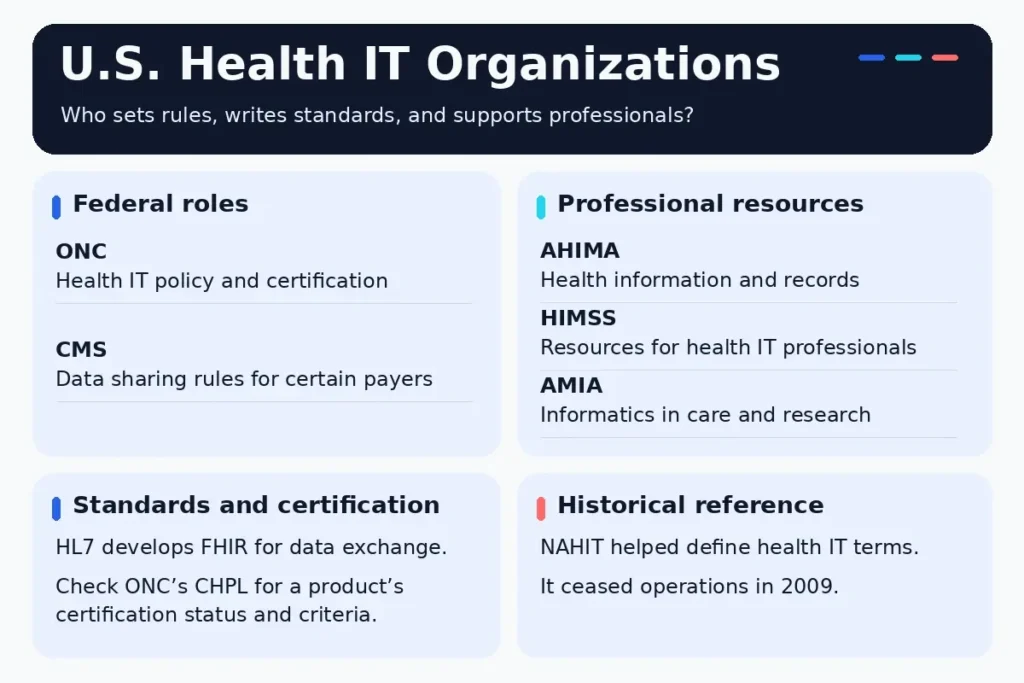
HL7 International develops technical standards such as FHIR. For education and professional resources, the American Health Information Management Association (AHIMA) focuses on health records and information management. The Healthcare Information and Management Systems Society (HIMSS) serves healthcare technology professionals, while the American Medical Informatics Association (AMIA) focuses on how people use data and information in care and research.
If you’re a student comparing formal training options, review what each program teaches. The health information technology curriculum at cambridge health and technology is one place to see how an associate degree program is organized.
What Was the National Alliance for Health Information Technology?
The National Alliance for Health Information Technology, or NAHIT, was an industry group whose 2008 work helped define terms for electronic records and health information exchange. It ceased operations in 2009. You may still see its definitions cited in older publications. For current product certification, use ONC’s CHPL.
Frequently Asked Questions
What Is the Difference Between ONC and CMS?
ONC coordinates federal health IT policy and runs the health IT certification program. CMS administers federal health coverage programs and sets interoperability requirements for certain payers. A hospital buying software can use ONC’s product list, while a health plan checking API requirements should consult CMS.
Is FHIR Support the Same as ONC Certification?
FHIR support describes a software capability. ONC certification applies to a specific product or module and its listed criteria. Check the CHPL entry to see what the certification covers.
Where Can I Find a List of UK Government Agencies?
Use the official GOV.UK directory. Search by agency name or find agencies grouped under the departments they work with.
Where Can I Find a List of All UK Government Departments?
The GOV.UK departments directory lists ministerial and nonministerial departments, along with agencies and other public bodies.
What Are Public Sector Organisations in the UK?
The term covers bodies that carry out public functions, including government departments, agencies, local authorities, and NHS bodies. GOV.UK’s directory shows how central government bodies are classified.
Where Can I Find a List of UK Civil Service Departments?
Start with the ministerial and nonministerial department sections on GOV.UK. The Cabinet Office’s responsibilities list also shows ministerial portfolios and lists executive agencies.
How Many Government Departments Are There in the UK?
As of November 24, 2026, GOV.UK lists 23 ministerial departments. Nonministerial departments are listed separately, so a total depends on which category you count.