

Health Technology Assessment (HTA): Process and Methods
Health Technology Assessment (HTA) is a structured way to examine whether a health technology is safe, effective, worth its cost, and suitable for a health system. It can assess medicines, devices, diagnostic tests, medical procedures, and public health programs. Its findings help decision makers weigh evidence before making choices about use, coverage, or funding.
This guide explains what HTA reviews, how it works, who conducts it in the US, and how UK and EU approaches differ.
What Is Health Technology Assessment?
HTA brings together evidence about a health technology and considers what that evidence means for patients and the health system. It may examine clinical results, possible harms, costs, patient experience, and wider effects on how care is delivered.
The World Health Organization describes HTA as a multidisciplinary review of clinical, economic, ethical, and social effects. Its 2025 medical device guide explains how assessments can inform adoption and reimbursement decisions. WHO’s guide to HTA of medical devices provides more detail.
Here, “technology” can mean a cancer medicine, screening test, insulin pump, procedure, or vaccination program. The assessment question depends on the technology and the decision at hand.
What questions can an HTA answer?
An assessment may ask:
- Does the technology improve health compared with current care?
- What harms or side effects may occur?
- How strong and complete is the evidence?
- What costs or health service resources may be needed?
- How do patients value the outcomes?
- Could the technology affect access or fairness?
An HTA report informs decisions, but the assessor may not make the final recommendation or coverage decision. These steps are often handled by different organizations.
What Does an HTA Evaluate?
The review depends on the technology and the decision. A medicine may need evidence on trials and treatment costs. A diagnostic test may need evidence on accuracy and whether results improve care.
| Assessment area | Questions it may address |
| Clinical effectiveness | Does it work better than existing options? |
| Safety | What harms, side effects, or risks are known? |
| Economic impact | What does it cost, and what health outcomes may it produce? |
| Patient experience | Does it improve quality of life or reduce treatment burden? |
| Health service impact | What staff, equipment, or changes in care may be needed? |
| Ethical and social factors | Are there concerns about fairness, access, or acceptability? |
Clinical benefit and safety
Assessors compare a technology with relevant care, another treatment, or no treatment. They review trial design, patient groups, follow up, and whether results are likely to apply to real patients.
Cost and health outcomes
Economic analysis asks how costs relate to outcomes. One method is cost effectiveness analysis. It compares the extra cost of a technology with the extra health benefit it may provide.
Budget impact estimates what adoption may cost a health system. Cost effectiveness and affordability are related, but answer different questions.
Patient and wider impacts
Patient input can show which outcomes matter and how care affects daily life. Assessments may also consider ethical, social, and organizational effects.
How Does the HTA Process Work?
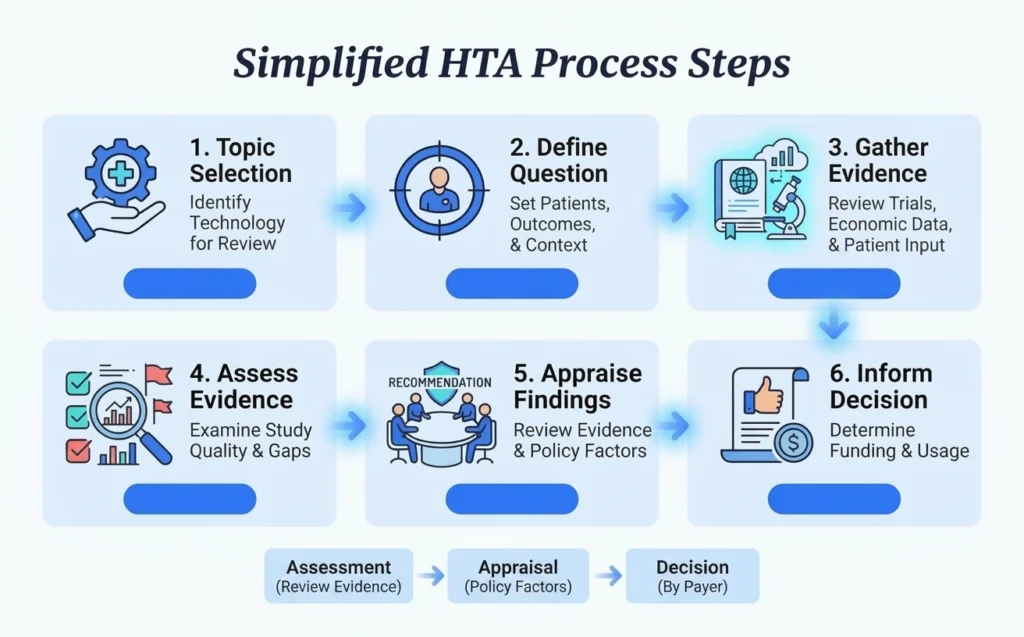
There is no single process used by every HTA body. A simplified process often includes these stages:
- Select the topic. An agency or decision maker identifies a technology that needs review.
- Set the assessment question. The team defines the patient group, alternatives, outcomes, and decision context.
- Gather evidence. Researchers review trials, observational studies, economic data, and patient input.
- Assess the evidence. They examine study quality, relevance, uncertainty, and gaps.
- Appraise the findings. A committee or decision group considers the evidence and other relevant factors.
- Make or inform a decision. The responsible organization decides whether or how the technology should be used, funded, or covered.
- Review impact where appropriate. New evidence or experience may lead to a later review.
EUPATI separates assessment, appraisal, and decision making. Assessment reviews evidence; appraisal considers it alongside policy factors; a payer or health system makes the decision. EUPATI’s HTA process guide explains these steps.
Evidence, uncertainty, and limitations
HTA teams may review trials, observational studies, systematic reviews, and economic models. Evidence can be limited: trials may be too short, while models rely on assumptions about future costs or outcomes.
A sound assessment explains what is known, what remains uncertain, and how that uncertainty may affect the decision.
Who Conducts Health Technology Assessments in the US?
Health technology assessment in the US is conducted primarily by public and private organizations with different roles. The country has no single national HTA agency that makes all coverage decisions.
CMS makes national coverage determinations for Medicare. In some cases, it supplements internal research with outside technology assessments or advice from MEDCAC.AHRQ’s Technology Assessment Program has supported such assessments. The CMS coverage determination process and CMS information about MEDCAC explain these roles.
The nonprofit Institute for Clinical and Economic Review (ICER) reviews clinical and economic evidence. Its reports inform discussion, but ICER is not a federal regulator and does not decide coverage for every payer. ICER’s overview describes its role.
Private insurers and health systems may conduct or use assessments under their own policies.
| Organization | Role in US decisions |
| AHRQ and CMS | AHRQ has supported technology assessments. CMS may use outside assessments when considering national Medicare coverage and makes the coverage decision. |
| MEDCAC | Gives CMS independent advice on clinical evidence. CMS makes the final coverage decision. |
| ICER | Reviews clinical and economic evidence. Its reports inform discussion but do not decide coverage for every payer. |
| Private payers and health systems | Set coverage or use policies for their members and patients. Rules can vary by organization. |
HTA is not the same as FDA approval
The FDA decides whether a product meets U.S. legal requirements for marketing. HTA also examines comparative benefit, evidence, cost, and fit with a health system.
FDA authorization does not guarantee insurance coverage, and an HTA report is not regulatory approval.
What Is HTA in the NHS and UK?
In the UK, HTA informs decisions about technologies in publicly funded care. NICE evaluates medicines and HealthTech such as diagnostics and devices, then publishes guidance for the NHS. NICE published its HealthTech programme manual on July 14, 2025.
The manual generally applies to guidance that started after that date, but the previous manual applies to guidance begun from July 14 through October 22, 2025. Check NICE’s current manual and topic notes for the applicable process. NICE’s HealthTech programme manual describes its process.
In the NHS, HTA helps guide whether and how a technology should be used. NICE is a major evaluator, but health systems and decision arrangements differ across the UK nations, so recommendations may not apply identically everywhere.
How Does the EU HTA Regulation Work?
The EU HTA Regulation supports joint clinical assessments and scientific consultations among member states. It entered into force in 2022 and has applied since January 12, 2025. The European Commission’s implementation page explains the regulation.
Joint work can reduce repeated clinical assessments, but countries still decide pricing, reimbursement, and how care is delivered.
From 2025, the regulation covered new cancer medicines and advanced therapy medicinal products. Developers can also seek scientific consultation on evidence plans. The Commission’s joint clinical assessment information provides current details.
Common HTA Requirements
There is no universal checklist that applies to every technology or country. Requirements depend on the relevant agency, program, and assessment question. Common evidence needs include:
- A clear description of the technology and intended use
- The patient group and condition being assessed
- Relevant comparators, such as standard care
- Clinical evidence on benefits and harms
- Information about study quality and evidence gaps
- Costs, resource use, and economic analysis where required
- Patient or clinician input where the process allows it
- Transparent methods, assumptions, and conflicts of interest
For a submission, follow the receiving agency’s current methods. NICE’s health technology evaluation manual describes evidence review, stakeholder input, and economic evaluation for its NHS guidance.
A Simple Example of a Health Technology
A home blood pressure monitor is a health technology. An HTA could review its accuracy, safety, ease of use, and whether home readings help clinicians manage treatment.
It could also examine device costs, training needs, and effects on clinic visits. Findings would depend on the evidence and health system. This example does not describe a specific agency decision.
Why HTA Matters for Health Policy
HTA helps decision makers weigh evidence before committing public or private health resources. It can clarify likely benefits, costs, risks, and uncertainty.
Recommendations may not transfer across countries because populations, prices, budgets, and services differ. Health Technology Funding & Policy examines how funding rules shape HTA decisions. Health Technology Trends, Research & Future covers new technologies and the evidence they need.
Frequently Asked Questions
What is health technology assessment (HTA)?
Health technology assessment reviews evidence on a technology’s benefits, harms, costs, patient experience, and effects on care.
What is the Health Technology Assessment framework?
An HTA framework sets the questions, methods, evidence domains, and decision steps used to assess a technology. Its details vary by organization and country.
What are the HTA requirements?
Requirements vary, but often cover the patient group, comparators, benefits, harms, costs, outcomes, and uncertainty. Check the receiving agency’s current guidance.
What is HTA in the NHS?
In the NHS, HTA reviews evidence to guide technology use. NICE publishes guidance on medicines and HealthTech.
Can you give me an example of a health technology?
A diagnostic test, medicine, insulin pump, procedure, or vaccination program is a health technology. HTA can assess its benefits, risks, costs, and effects on care.
Conclusion
Health Technology Assessment (HTA) helps decision makers weigh a technology’s benefits, harms, costs, patient outcomes, and effects on care before deciding how it should be used or funded.
Processes vary by organization and country. In the United States, public and private groups assess evidence, while the responsible payer or health system makes coverage decisions.


