

Reducing Health Care Costs with Technology
Technology can lower health care costs when it replaces expensive work, cuts repeat services, or helps a care team act before a problem gets worse. A clinic might automate insurance checks, offer virtual follow ups, or monitor selected patients at home. The financial result depends on who pays, what costs change, and how much the new service costs to run.
The Centers for Medicare & Medicaid Services (CMS) reports that U.S. health care spending reached $5.3 trillion in 2024, or $15,474 per person. For a hospital or clinic manager, the first step is much smaller. Pick one costly process, find out what it costs today, and check whether a digital tool can lower that cost while keeping care safe and accessible.
How Can Technology Reduce Health Care Costs?
Start with the expense you want to change. If a billing team spends hours correcting claims, measure the cost of that rework. If patients travel a long way for short follow ups, measure their travel costs and how often a virtual visit can complete the same care. Each problem calls for a different tool and a different measure of success.
| Technology | Cost it may lower | Who may save | What to track |
| Billing automation | Manual insurance checks and claim corrections | Clinics and insurers | Cost per claim and rework rate |
| Telehealth | Travel and the cost of some office visits | Patients and clinics | Patient travel costs and cost per completed visit |
| Remote patient monitoring | Emergency visits or hospital stays in some programs | Insurers and health systems | Program cost per patient and hospital use |
| Shared electronic health records | Time spent finding records and some repeat tests | Clinics, insurers, and patients | Record retrieval time and repeat test rates |
| Staffing and inventory software | Overtime, rush orders, and expired supplies | Hospitals and clinics | Overtime spending, urgent orders, and wasted stock |
Five Ways Technology Can Lower Health Care Costs
1. Automate Insurance Checks and Claims
A billing team can check insurance eligibility before an appointment and flag missing information before sending a claim. Finding an error early can spare staff a second round of work. Start with a common problem, such as incomplete claims, and track how many need manual review after the change.
The 2025 CAQH Index, released in 2026, estimated that electronic transactions and better data exchange helped the U.S. health care sector avoid $258 billion in administrative costs in 2024. That estimate covers the industry. For a clinic, the more useful measures are cost per claim, staff time spent on corrections, and any change in overtime or outside billing fees.
2. When Telehealth Can Lower Visit Costs
A virtual follow up can spare a patient a drive, parking fees, or time away from work. The clinic still pays for clinician time, software, and support. If the patient also needs to come in, the clinic should count both visits when it compares costs.
Start with one visit type, such as a results discussion that the care team considers suitable for telehealth. Compare the average cost of completing that follow up online and in person. Record how often technical problems or clinical needs lead to a second appointment. Keep an in person option for patients who need an exam or cannot use video.
3. When Remote Patient Monitoring Can Lower Costs
Remote patient monitoring (RPM) lets a care team review readings from a device patients use at home. A program might use a connected blood pressure cuff, for example. Its costs include the device, patient setup, and the staff time needed to review readings and respond.
A 2025 review of seven economic evaluations found six were cost effective in the studies’ main estimates. Four estimated both lower costs and better health outcomes. The researchers also found considerable uncertainty in the estimates. When planning a program, track cost per enrolled patient, staff time spent on alerts, and the outcomes the program aims to change.
4. Share Health Records Across Care Teams
An electronic health record (EHR) stores information such as test results and visit notes. If a specialist can see a recent lab result from another practice, they can decide whether the patient needs a repeat test. The teams need a way to share the result and a clear place to find it during the visit.
HL7 FHIR, short for Fast Healthcare Interoperability Resources, is a standard for sharing health data between systems. Before paying for an integration, ask the vendor to show how a common lab result would reach your EHR and where staff would see it. Then check whether staff spend less time chasing records or ordering tests because earlier results were missing.
5. Use AI and Data to Plan Staff Time and Supplies
Appointment and admission data can help managers plan coverage for busy periods. Inventory software can show which supplies sit unused or expire. Before adding a tool, pick a cost it can help you change, such as overtime, rush shipping, or expired stock.
AI can also draft visit notes for clinicians to review. A 2026 JAMA study across five academic medical centers linked AI scribe adoption to less time spent on documentation. To assess the business case in your clinic, count subscription fees and the time clinicians spend editing notes. Track staff time separately from any drop in paid expenses.
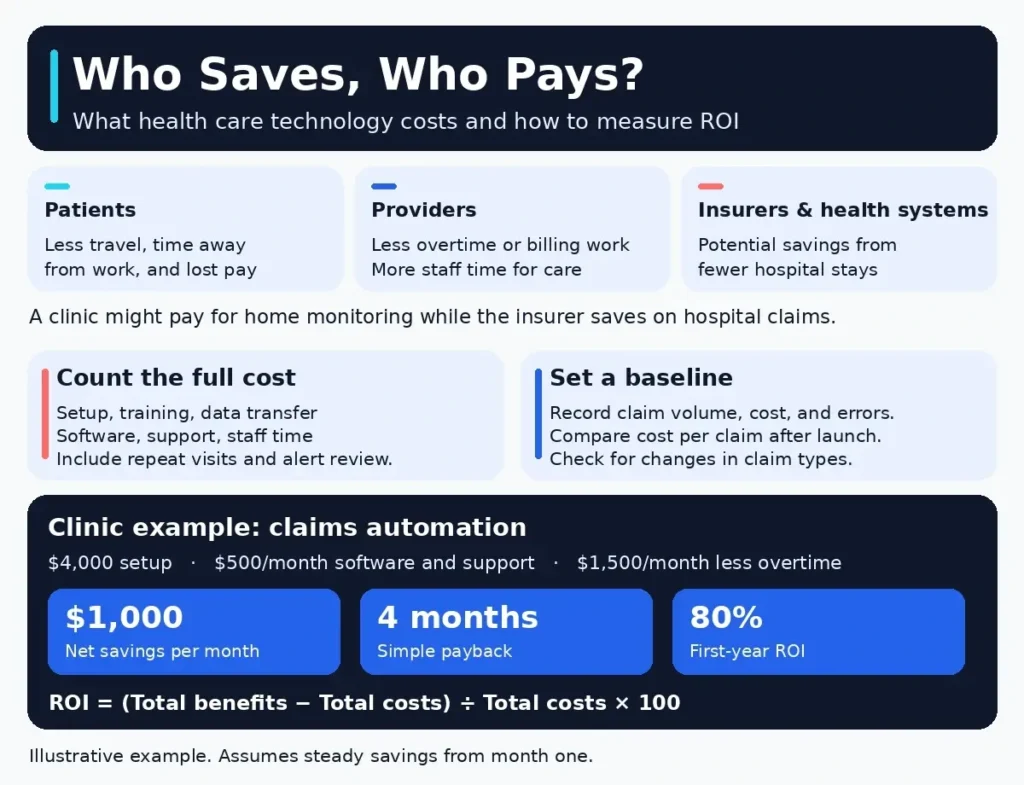
Who Saves, and Who Pays?
Patients may save time, travel costs, or wages they would lose by taking time off. Their bill still depends on the service and their health plan. Providers may spend less on overtime, outside billing services, or supplies. They may also gain staff capacity, which means staff have more time for other work. Insurers and health systems may spend less when a program helps prevent costly hospital care, depending on who pays for that care and how the program is funded.
Ask who pays for the software and who benefits from any savings. A clinic could pay for home monitoring while the insurer saves on hospital claims. That difference matters when the clinic decides whether it can afford to keep the program running.
When Health Care Technology Can Raise Costs
The purchase price covers only part of the budget. Add setup, training, data transfer, support, and ongoing staff time. Include the work people will keep doing by hand. A telehealth program may add appointments if patients still need office visits, and home monitoring may add hours of staff work if teams receive more alerts than they can act on.
Set aside time to check privacy and access before launch. The U.S. Department of Health and Human Services says covered providers must use telehealth vendors that comply with HIPAA and will sign the applicable business associate agreement. During a pilot, track missed appointments and repeat visits alongside cost. Ask patients who could not complete a visit what got in their way.
How to Measure Savings and Return on Investment
Set a Baseline Before You Buy
Choose one workflow and record its volume, total cost, and error rate. Use the same definitions after launch. If claim volume changes, compare cost per claim as well as total spending. Check whether the mix of claims changed, too. Comparing a batch of routine claims with a batch that needed extra review can give a misleading result.
Work Through a Simple Payback Example
ROI = (Total benefits − Total costs) ÷ Total costs × 100
Suppose a clinic pays $4,000 to set up claims automation and $500 per month for software and support. After the trial, payroll records show that overtime costs fell by $1,500 per month because staff spent less time fixing claims.
| Measure | Illustrative result |
| Monthly net savings | $1,000 after software and support |
| Simple payback period | 4 months at that rate |
| First year net savings | $8,000 after setup and 12 months of software and support |
| First year return on investment | 80%, based on $8,000 in net savings and $10,000 in total costs |
These figures are hypothetical and assume savings begin right away and stay steady. If the clinic saves staff time but payroll and other spending stay the same, it has gained capacity. Track how that time is used and count any drop in expenses separately.
Avoid Three Common Measurement Mistakes
- Counting faster payments as lower costs. Quicker claims payment helps cash flow. Count expense savings when collection or processing actually costs less.
- Comparing unlike periods. Account for changes in volume, staffing, and the mix of patients or claims.
- Leaving quality out of the pilot. Pair a cost measure with a quality or access measure. For billing, track claim errors. For telehealth, track whether patients complete care.
Frequently Asked Questions
How can technology reduce health care costs for a small clinic?
Start with a task the clinic already does often. If staff spend hours checking coverage by phone, test electronic eligibility checks. Compare manual review time and cost per check before and after the pilot. Include the software fee in the comparison.
How does AI reduce costs in health care?
AI can sort work for staff review, draft visit notes, and help teams forecast demand. A tool that saves time may lower costs if it cuts an expense such as overtime or transcription. Add license fees, staff review time, and the cost of fixing mistakes when you evaluate it.
Why is the cost of technology in health care so high?
The bill can include software, devices, connections to existing systems, training, privacy controls, and ongoing support. Ask for the total cost over the period you expect to use the tool. Include the work your own staff will need to do after launch.
How has technology improved health care?
Patients can attend some visits from home. Care teams can look up results in shared records or review readings collected between appointments. Beyond costs, how does technology affect health care? Look at whether patients can get care more easily, whether teams have the information they need, and what it costs to deliver that care.
What is the impact of technology on health care cost and quality?
The same tool can affect cost and quality in different ways. A virtual visit may save a patient travel time while adding work for the clinic if a second visit is needed. Measure the full cost of completing care and track a related quality or access outcome.
What are innovative ways to reduce health care costs?
Options include checking coverage before a visit, using barcodes to track equipment, and sharing recent test results across practices. Choose based on the problem you can document. If expired supplies are a recurring expense, improving stock tracking gives you a clear cost to measure.
What do systematic reviews say about digital health costs?
A 2022 systematic review by Andrea Gentili and colleagues examined 35 economic studies across 17 countries. Results varied by tool, patient group, and setting. Cost effective means the health gains may justify the cost. Cost saving means total spending falls compared with the alternative. When reading a study, check whose costs the researchers counted and what care they used for comparison.
Start With One Cost You Can Measure
Choose a workflow with a clear cost, such as overtime for claim corrections or staff time spent tracking down records. Measure it before the pilot, include the full cost of the tool, and check what happens to care quality or access. Use those results to decide whether to expand the program.


