

Health Technology Management: A Practical Guide
Health technology helps clinicians diagnose, monitor, and treat patients. But a hospital needs more than the right equipment. It must also know what it owns, whether each device works safely, who can use it, and when it needs service or replacement.
Health Technology Management (HTM) is the organized work behind these tasks. It covers a medical device’s journey from planning and purchase through installation, maintenance, and retirement. Its purpose is to help keep equipment safe, reliable, and ready for patient care.
What Is Health Technology Management?
HTM is a field that helps healthcare organizations manage medical devices throughout their useful life. It includes planning, purchasing, testing, maintenance, staff training, equipment records, and replacement decisions.
For example, when a hospital buys an infusion pump, the HTM team may help review its safety and service needs. After delivery, the team can inspect it, record it in the equipment inventory, check its performance, and train staff to use it. Later, technicians may test, calibrate, repair, or replace it.
HTM includes health care technology management, though the wording can vary by organization. The central idea stays the same: manage healthcare equipment so it supports safe and dependable care.
HTM, health IT, and health technology assessment
These terms are related, but they describe different work.
| Field | Main focus | Example |
| Health technology management | Managing devices used in care | Inspecting and maintaining a patient monitor |
| Health IT management | Managing information systems and digital services | Supporting an electronic health record system |
| Health technology assessment | Reviewing a technology’s evidence, costs, and effects | Assessing whether a new device offers value for a health system |
| Clinical engineering | Applying engineering knowledge to improve healthcare technology | Reviewing device risks and how equipment works in a clinical setting |
HTM teams often work with the health IT department. A connected device may need network access or may share information with an electronic health record. The teams coordinate, but their responsibilities are not identical.
HTM is also not medical diagnosis. A technician may troubleshoot a device that is giving an error. That work helps restore the equipment. It does not mean the technician diagnoses a patient.
How the Medical Device Lifecycle Works
The lifecycle starts before a device arrives at a hospital. The World Health Organization describes steps that include needs assessment, procurement, incoming inspection, inventory, training, maintenance, and decommissioning.
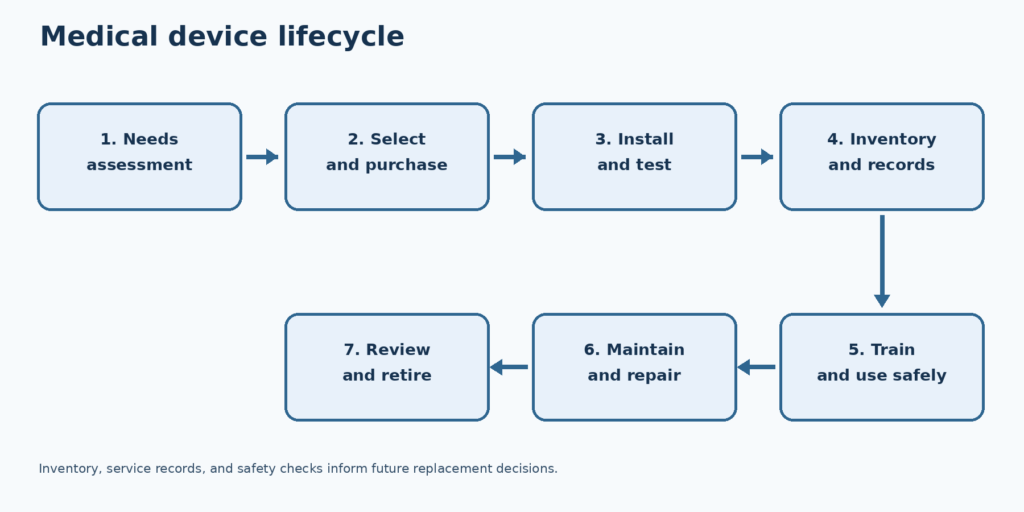
Figure 1. A medical device moves through planning, use, service, and retirement.
| Stage | Typical HTM work | Example |
| Needs assessment | Learn what clinicians need and review current equipment | A clinic checks whether its monitors meet patient care needs |
| Selection and purchase | Review safety, service, compatibility, and expected costs | A team compares two models of infusion pump |
| Installation and testing | Inspect, install, and confirm that the device works as expected | A technician checks a new ventilator before clinical use |
| Inventory and records | Track the device, location, service history, and status | Staff log the pump in a computer maintenance system |
| Training and safe use | Help users understand correct operation and care | Nurses receive device training before using new equipment |
| Maintenance and repair | Perform planned checks and respond to faults | A technician tests a monitor and repairs a failed part |
| Review and retirement | Decide whether to repair, replace, or remove the device | A hospital retires equipment that can no longer be supported |
A good record system helps staff find equipment and see when it needs service. A computerized maintenance management system, often called a CMMS, can hold inventory, service history, maintenance tasks, costs, and performance records. The exact information varies by facility.
What Equipment Does an HTM Team Manage?
The equipment depends on the facility. A hospital may have thousands of devices, while a small clinic may manage a smaller group.
Common examples include:
- Patient monitors, defibrillators, and electrocardiogram machines.
- Infusion pumps, ventilators, and anesthesia equipment.
- MRI, CT, ultrasound, and X ray systems.
- Laboratory analyzers and diagnostic equipment.
- Surgical equipment, beds, and patient lifts.
- Connected devices that send or receive information over a network.
Some technicians work across many device types. Others specialize in an area such as imaging or laboratory equipment. The U.S. Bureau of Labor Statistics describes repairers’ work as installing, testing, calibrating, maintaining, and repairing patient care equipment.
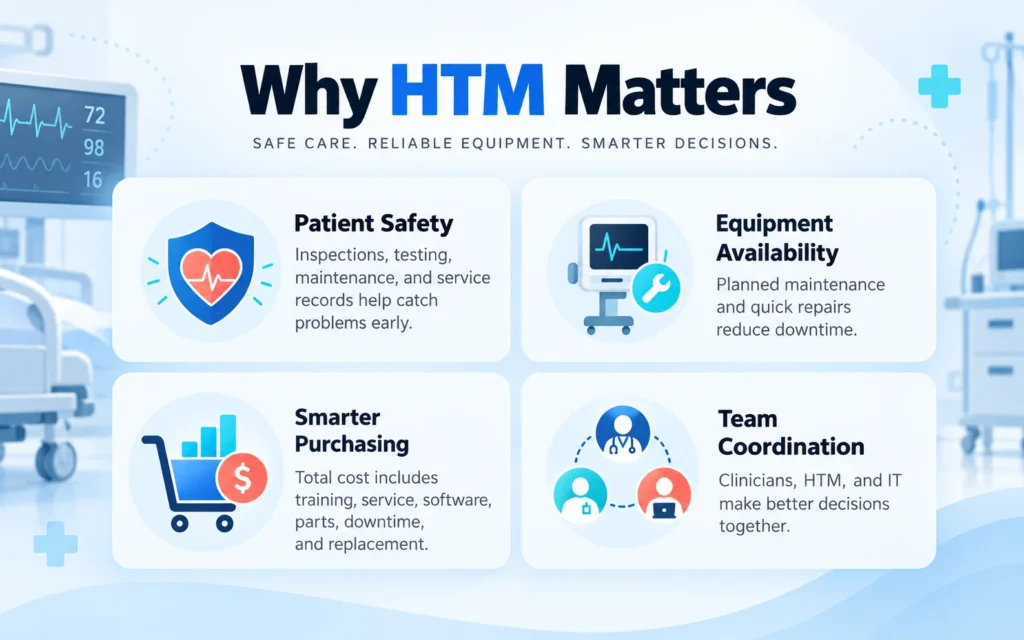
Why HTM Matters to Hospitals and Patients
It supports patient safety
A device must work as intended before a clinician relies on it. Inspections, testing, maintenance, and clear service records help staff identify problems and respond to them.
It helps keep equipment available
A broken device can interrupt a clinical service or require staff to find another unit. Planned maintenance and prompt repairs help reduce avoidable equipment downtime.
It supports better purchasing decisions
The purchase price is only one part of a device’s total cost of ownership. A hospital may also pay for installation, staff training, service contracts, spare parts, software support, network connections, downtime, and eventual replacement or disposal.
HTM staff can share information about repair history and use. That evidence can help leaders compare repair and replacement options.
It connects clinical teams with technical teams
Clinicians know how equipment is used during care. HTM staff understand its service needs and performance. IT teams understand network and software concerns. Good coordination helps each group make decisions with the right information.
Common Challenges in Medical Equipment Management
Aging devices and limited budgets
Hospitals may need to keep older equipment in service while planning for replacement. A device’s age alone does not show whether it should be replaced. Teams also review its condition, repair record, parts support, clinical importance, and risk.
Staffing and training needs
HTM workers must understand electronics, mechanical systems, software, safety, and clinical workflows. New devices may also require product specific training from manufacturers or vendors.
Connected device security
Networked medical devices can create security and service concerns. HTM staff may work with IT and security teams to maintain an accurate device inventory, review updates, track vulnerabilities, and plan safe responses.
In February 2026, the FDA issued updated guidance for industry on cybersecurity in medical devices. It covers device design, labeling, and information recommended in premarket submissions. This is guidance for manufacturers and FDA review, not a substitute for a hospital’s own security policies.
Changing technology
Devices may rely on software, wireless connections, and links to hospital information systems. The BLS notes that repairers can work with IT staff on network connections, software updates, and communication with electronic health record systems.
Maintenance, Recalls, and Compliance
Preventive maintenance and risk based schedules
Preventive maintenance includes planned inspections, testing, calibration, and service before a device fails. HTM teams set schedules based on the device, its risk, manufacturer guidance, applicable rules, and the organization’s maintenance program. A CMMS can flag upcoming work and keep a record of completed checks.
Medical device recall management
When a manufacturer or the FDA announces a recall or safety notice, the organization needs to identify affected devices, check where they are, follow the notice, and document the response. HTM staff may coordinate with clinical departments, supply chain, risk management, and vendors. Check the FDA Medical Device Recalls database and manufacturer notices, then follow the facility’s recall procedure.
CMS and accreditation requirements
For Medicare participating hospitals, CMS requires facilities, supplies, and equipment to be maintained to support an acceptable level of safety and quality. CMS guidance addresses inspection, testing, and maintenance, including risk based approaches for eligible equipment. Joint Commission materials also address equipment inventories, high risk devices, and maintenance strategies. Requirements can depend on facility type, state rules, equipment, and accreditation status, so HTM leaders should check current CMS guidance, state requirements, and the organization’s accreditor. See current CMS hospital equipment maintenance guidance and the Joint Commission equipment management FAQ
HTM Jobs, Degrees, and Training in the United States
HTM roles can be found in hospitals, clinics, medical equipment companies, repair services, and other healthcare settings.
Common roles include:
- Biomedical Equipment Technician, also called a BMET.
- Clinical engineer.
- Imaging equipment specialist.
- HTM supervisor or manager.
- Medical device service technician.
Health technology management degree
There is more than one education route into the field. The BLS says medical equipment repairers typically need an associate degree or certificate in biomedical technology or a related field. Some enter with a high school diploma and relevant training or experience, including an apprenticeship. Employers may have their own requirements.
Relevant programs may be called biomedical equipment technology, biomedical equipment repair, biomedical engineering technology, or clinical engineering. A four year engineering degree may fit some clinical engineering roles, while technician positions may have different education requirements.
Health technology management courses
Courses can teach electronics, anatomy and physiology, device safety, troubleshooting, maintenance, and medical equipment systems. AAMI offers BMET 101, an introductory course for people with limited or no HTM experience, as well as study courses for selected certifications.
When comparing programs, check the course content, hands on training, internship or apprenticeship options, employer links, and whether the curriculum prepares students for the role they want.
Healthcare technology management certification
Certification is separate from a degree. AAMI offers credentials for different career stages. The table summarizes their general focus; check AAMI for current eligibility and exam rules.
| Credential | Who it is for | Career level | Provider |
| CABT | People entering or preparing to enter biomedical equipment technology | Entry level | AAMI |
| CBET | Biomedical equipment technicians with relevant education or experience | Technician | AAMI |
| CHTM | Professionals who lead or manage HTM operations | Management | AAMI |
Eligibility rules can change. Applicants should check the current requirements with the certification provider.
Healthcare technology management salary and jobs
“HTM salary” can mean different jobs, from entry level technicians to managers. The closest broad BLS occupation is medical equipment repairer, so its figures should not be treated as the salary for every HTM role.
The BLS reported a median annual wage of $61,660 in May 2025 for medical equipment repairers. The median for those working in hospitals was $75,390. It projects 13 percent employment growth from 2025 to 2035, with about 8,200 openings each year on average. Actual pay can vary by location, employer, experience, and specialty.
AAMI and TechNation’s 2025 workforce survey included 947 HTM professionals. The report described growing responsibilities in areas such as cybersecurity and software, along with staffing and workload concerns. Survey results describe respondents and should not be read as a complete count of all U.S. HTM workers.
HTM Organizations and Learning Resources
The Association for the Advancement of Medical Instrumentation, known as AAMI, provides HTM resources, education, events, and certification information. The American College of Clinical Engineering, or ACCE, is a professional society focused on clinical engineers. These organizations serve related professional communities, with different programs and membership options.
Readers can use AAMI’s HTM training and WHO medical device guides to learn more. Related articles can also explain health technology examples and compare health technology companies and products. Healthcare technology also differs across hospitals, clinics, and home care.
Frequently Asked Questions
What is a health technology management degree?
It is a degree or program that prepares students to work with medical equipment and related systems. Program names vary. Common options include biomedical equipment technology and biomedical engineering technology. Check each school’s curriculum and entry requirements.
What are health technology management jobs?
Jobs include BMET, clinical engineer, imaging equipment specialist, service technician, and HTM manager. Duties and education requirements depend on the role and employer.
What is the healthcare technology management salary?
The BLS reported a median annual wage of $61,660 in May 2025 for medical equipment repairers, a related occupation. Hospital workers in that occupation had a median of $75,390. These figures are not a salary range for every HTM job.
Where can I take health technology management courses?
Colleges, technical schools, employers, and professional organizations may offer relevant courses. AAMI’s BMET 101 is an introductory option for people who are new to the field. Review course content and current enrollment details with the provider.
Is healthcare technology management certification required?
Requirements depend on the job. Some employers prefer or require a certification, while others focus on education and hands on experience. AAMI offers CABT, CBET, and CHTM credentials with different eligibility rules.
Where can I find a health technology management PDF?
The World Health Organization’s Inventory and maintenance management information systems for medical devices is a specific resource on this topic. Open the WHO publication page to read or download it. AAMI also provides HTM resources and training information.
Does HTM mean medical diagnosis?
No. HTM refers to managing healthcare technology. A BMET may troubleshoot or test a device, but that is different from diagnosing a patient.
What is the Healthcare Technology Management Association?
There is not one association that represents every HTM and clinical engineering professional. In the United States, AAMI provides HTM resources and credentials. ACCE serves clinical engineers. People should compare each organization’s focus, education, and membership options.
Conclusion
HTM helps healthcare organizations plan for, acquire, maintain, secure, and retire medical equipment. Its work depends on accurate records and cooperation among technicians, clinicians, IT staff, and leaders. For patients and care teams, the goal is practical: equipment that is safe and available when it is needed.
References and Further Reading
- World Health Organization, Inventory and maintenance management information systems for medical devices
- AAMI, Healthcare Technology Management
- U.S. Bureau of Labor Statistics, Medical Equipment Repairers
- U.S. Food and Drug Administration, Cybersecurity in Medical Devices guidance
- AAMI, HTM Certifications
- American College of Clinical Engineering
- U.S. Centers for Medicare & Medicaid Services, Hospital Equipment Maintenance Requirements
- The Joint Commission, Medical Equipment Inventory, High Risk Equipment, and Maintenance Strategies
- U.S. Food and Drug Administration, Medical Device Recalls database


One Comment