

Financial Technology Jobs & Career Opportunities
Financial technology has created careers for people with very different backgrounds. A FinTech company may need software engineers to build payment systems, data scientists to detect fraud, compliance specialists to meet financial rules, product managers to plan new services, and sales teams to bring those services to customers.
Financial Technology Jobs & Career Opportunities are not limited to people who studied both finance and computer science. Many people enter the field from banking, accounting, software, cybersecurity, data, law, marketing, operations, and customer service.
The World Economic Forum lists FinTech engineers among the fastest-growing job roles through 2030. Big data specialists and AI and machine learning specialists also appear near the top of its growth list.
For job seekers, the main question is not simply whether FinTech has jobs. It is which role fits your skills, education, interests, and career goals.
Quick Career Match
| If You Enjoy… | FinTech Paths to Explore |
| Coding and building systems | Software engineering, data engineering, AI |
| Working with numbers and finance | Risk, financial analysis, payments |
| Rules and investigations | Compliance, AML, fraud prevention |
| Planning digital products | Product management, product operations |
| Working with clients | Sales, partnerships, customer success |
What Are Financial Technology Jobs?
Financial technology jobs involve building, operating, selling, regulating, or improving financial services that use modern technology.
FinTech covers areas such as digital banking, payments, lending, fraud prevention, investing, insurance technology, regulatory technology, financial data, blockchain, credit scoring, and personal finance software.
A worker does not need to be a programmer to have a FinTech career.
A payments company, for example, may employ:
- Software engineers
- Product managers
- Data scientists
- Fraud analysts
- Compliance specialists
- Risk analysts
- Account executives
- Customer success managers
- Finance professionals
- Legal and regulatory specialists
Current job listings in the Washington, DC area show how broad the field has become. Recent roles include regulatory FinTech attorneys, full-stack engineers, lending specialists, analysts, and payments-related finance positions.
FinTech Jobs vs Traditional Finance Jobs
Traditional finance roles often focus on banking, investments, accounting, lending, insurance, or financial planning.
FinTech roles may work on the same financial problems, but technology is usually a larger part of the product or process.
A bank analyst may review credit risk. A FinTech data scientist may build a model that helps assess that risk across thousands of applications.
A traditional payments employee may manage transaction operations. A FinTech engineer may build the software and APIs that move those transactions.
The two fields also overlap. Large banks now hire software engineers, cybersecurity specialists, data scientists, and product teams. FinTech companies hire accountants, financial analysts, risk professionals, and compliance staff.
Is FinTech a Good Career?
FinTech can be a strong career choice for people interested in finance, technology, data, products, regulation, or a mix of these areas.
The field offers several routes rather than one fixed career track.
Demand also connects with broader growth in technology occupations. The US Bureau of Labor Statistics projects data scientist employment to grow 35 percent from 2025 to 2035. Information security analyst employment is projected to grow 21 percent, while software developer employment is projected to grow 10 percent.
These figures cover whole occupations, not FinTech alone. They still matter because FinTech employers compete for many of the same technical skills.
FinTech may suit you if you enjoy solving financial problems, working with data, building digital products, studying risk, or understanding how money moves.
It may be less suitable if you dislike frequent changes in software, financial rules, security requirements, or customer expectations.
Main Types of FinTech Careers
FinTech employment can be divided into several broad groups.
Software Engineering
Software engineers build customer apps, payment systems, account platforms, internal tools, APIs, and financial infrastructure.
Common roles include:
- Software developer
- Backend engineer
- Full stack engineer
- Mobile developer
- API engineer
- Site reliability engineer
BLS reported a median annual wage of $135,980 for software developers in May 2025. In finance and insurance, the median was $135,460.
Data Science and AI
Data teams work with transaction records, customer behavior, credit information, fraud patterns, pricing, forecasting, and financial models.
Common positions include:
- Data analyst
- Data scientist
- Machine learning engineer
- AI engineer
- Quantitative analyst
- Decision scientist
Data scientists had a US median annual wage of $120,230 in May 2025. BLS also reported a median of $129,490 for data scientists working in credit intermediation and related activities.
Cybersecurity and Fraud
Financial firms handle sensitive personal and payment information, making security a major business need.
Jobs may include:
- Information security analyst
- Security engineer
- Fraud analyst
- Identity specialist
- Security operations analyst
- Financial crime analyst
Information security analysts had a median annual wage of $129,180 in May 2025. The median within finance and insurance was $130,630.
Product Management
Product managers connect customer needs, business goals, technology, and financial requirements.
A payments product manager might work with engineers, compliance staff, designers, finance teams, and card network partners to improve a checkout or money transfer service.
Related roles include product analyst, product owner, product operations specialist, and product manager.
Risk and Compliance
Financial products operate under federal and state laws, industry rules, and company risk controls.
FinTech employers therefore hire people in:
- Compliance
- Anti-money laundering
- Know your customer processes
- Credit risk
- Operational risk
- Model risk
- Regulatory affairs
- Financial crime prevention
Financial risk specialists had a US median annual wage of $117,330 in May 2025, according to BLS.
Payments and Digital Banking
Payments is one of the largest areas of financial technology.
Jobs can involve card processing, merchant services, digital wallets, payment operations, bank transfers, fraud controls, payment APIs, and cross-border transactions.
Professionals who understand digital payments and processing solutions can work in engineering, product, banking partnerships, risk, operations, or sales.
Sales and Business Development
FinTech products still need customers.
Business roles can include:
- Account executive
- Partnership manager
- Sales engineer
- Business development manager
- Customer success manager
- Implementation specialist
These roles may suit people who understand financial products but prefer customer work over programming.
Technical vs Nontechnical FinTech Careers
FinTech is often described as a technology career field, but many jobs do not require coding.
| Career | Coding Need | Finance Knowledge | Entry Route |
| Software Engineer | High | Helpful | Computer science or software skills |
| Data Scientist | High | Helpful | Data, math, statistics |
| Cybersecurity Analyst | Medium | Helpful | Security or IT |
| Product Manager | Low | Helpful | Product, business, technology |
| Compliance Analyst | Low | High | Finance, law, compliance |
| Risk Analyst | Low to Medium | High | Finance, economics, analytics |
| FinTech Sales | Low | Helpful | Sales or financial services |
| Customer Success | Low | Helpful | Service, operations, finance |
Coding can open more technical roles, but it is not a requirement for every FinTech career.
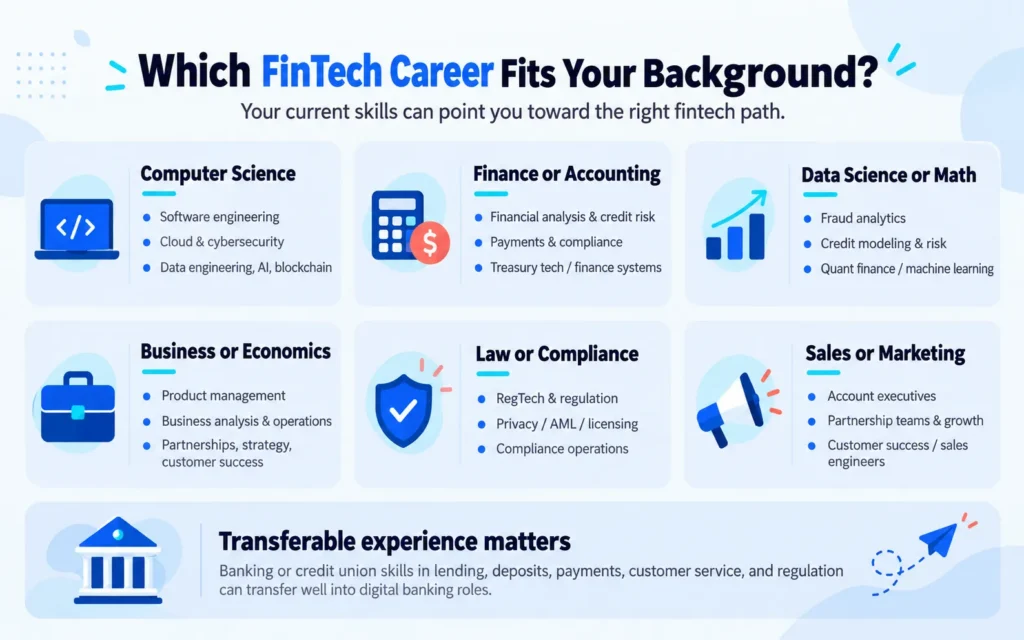
Which FinTech Career Fits Your Background?
Your current skills can help narrow the options.
Computer Science
Consider software engineering, cloud engineering, cybersecurity, data engineering, AI, payment infrastructure, or blockchain development.
Finance or Accounting
Consider financial analysis, credit risk, payments, finance systems, compliance, treasury technology, product operations, or financial planning software.
Data Science or Mathematics
Good matches include data science, fraud analytics, credit modeling, risk analytics, quantitative finance, and machine learning.
Business or Economics
Possible routes include product management, business analysis, operations, partnerships, strategy, customer success, and risk.
Law or Compliance
RegTech, financial regulation, privacy, bank partnerships, anti-money laundering, licensing, and compliance operations can be strong options.
Sales or Marketing
FinTech companies hire account executives, partnership teams, growth marketers, customer success managers, and sales engineers.
People coming from banks or credit unions may also find that their knowledge of lending, deposits, payments, customer service, and regulation transfers well into digital banking and credit union technology roles.
Skills Employers Look For
The exact skill set depends on the role.
Technical Skills
Common skills include:
- Python
- SQL
- JavaScript
- Java
- Cloud platforms
- APIs
- Data analysis
- Machine learning
- Cybersecurity
- Database systems
A compliance analyst does not need the same technical depth as an engineer. Still, basic data skills can help in many business and risk positions.
Finance Knowledge
Useful subjects include:
- Banking
- Payments
- Lending
- Credit
- Investment products
- Accounting
- Financial modeling
- Risk management
- Financial regulation
A technical worker does not need to master every area of finance before applying. Learning the financial purpose of the product they work on can make them more effective.
Human Skills
FinTech teams also need clear communication, judgment, problem-solving, teamwork, curiosity, and the ability to explain technical or financial issues in plain language.
A strong candidate can often explain both what a system does and why it matters to the customer or business.
What Degree Is Best for FinTech?
There is no single degree required for the whole industry.
Common choices include:
- Computer science
- Finance
- Data science
- Statistics
- Economics
- Accounting
- Information systems
- Cybersecurity
- Mathematics
- Business
Some universities now combine these subjects in dedicated FinTech programs.
Virginia Tech, for example, offers a FinTech and Big Data Analytics major that includes finance, computer science, statistics, mathematics, Python, SQL, investments, and financial modeling.
A dedicated FinTech degree can be useful, but it is not the only route. A finance graduate can add technical skills. A computer science graduate can learn payments, banking, and risk.
Employers usually care about whether your knowledge matches the job.
Can You Enter FinTech Without Experience?
Yes, but you need proof that you can do useful work.
- Entry-level routes include internships, graduate programs, analyst positions, junior engineering roles, customer operations, support, compliance, and business analysis.
- A student interested in fraud analytics could create a sample transaction analysis project using public data.
- A software student could build a simple budgeting or payment demo.
- A finance graduate could create a credit analysis project and learn SQL.
- A compliance candidate could study common KYC and anti-money laundering workflows.
- The goal is to turn education into evidence of skill.
How Much Do FinTech Jobs Pay?
There is no single reliable salary for all FinTech workers. Pay varies by occupation, city, company, experience, bonus structure, and equity.
For a useful comparison, official BLS occupation data provides a stronger reference than combining unrelated FinTech job listings.
| Occupation | US Median Annual Wage | Official Source |
| Software developers | $135,980 | BLS, May 2025 |
| Information security analysts | $129,180 | BLS, May 2025 |
| Data scientists | $120,230 | BLS, May 2025 |
| Financial risk specialists | $117,330 | BLS, May 2025 |
| Financial and investment analysts | $102,740 | BLS, May 2025 |
| Operations research analysts | $88,940 | BLS, May 2025 |
These are national occupation figures. They should not be treated as guaranteed FinTech salaries.
Senior management can earn far more. BLS reported a median annual wage of $166,570 for financial managers in May 2025, but that occupation usually requires prior professional experience.
What Are the Highest Paying FinTech Jobs?
Many of the highest-paid roles sit in senior engineering, AI, quantitative finance, cybersecurity leadership, product leadership, and financial management.
Pay can also rise through bonuses and equity, especially at some private technology firms.
A high salary should not be the only reason to choose a role.
Someone who dislikes software development is unlikely to enjoy engineering simply because software salaries are high. A better choice is a field where your strengths can grow over time.
How to Get a Job in FinTech
A practical job plan can be broken into seven steps.
1. Choose a Career Track
Decide whether you are most interested in engineering, data, finance, product, risk, compliance, operations, or sales.
2. Study Real Job Descriptions
Look at current roles on company career pages, LinkedIn, Indeed, Glassdoor, and specialist job sites.
Write down the skills that appear several times.
3. Fill the Main Skill Gaps
Do not try to learn everything.
If most roles require SQL and you do not know SQL, start there. If you are moving into compliance, study the regulations and processes used in that area.
4. Build Proof of Work
Projects, internships, freelance assignments, case studies, open source work, and relevant work experience can show what you can do.
5. Tailor Your Resume
A general resume often hides relevant experience.
A banking employee applying for a FinTech operations job should highlight payment systems, customer processes, financial controls, risk, and technology use.
6. Learn the Product
Before an interview, understand how the company makes money, who its customers are, what financial problem it solves, and which risks it faces.
A candidate applying to a payments company should understand the basic flow of digital payments rather than discussing technology in isolation.
7. Prepare for Role-Specific Interviews
Engineering interviews may test coding and system design.
Data roles may test SQL, statistics, or analytical reasoning.
Product roles may use case questions.
Compliance and risk interviews may focus on judgment, financial rules, controls, or past cases.
Where Can You Find FinTech Jobs?
Large job sites are useful, but company career pages can uncover roles that broad searches miss.
Useful places to check include:
- FinTech company career pages
- Bank and credit union career pages
- LinkedIn Jobs
- Indeed
- Glassdoor
- The Muse
- Specialist finance and technology job boards
Search by job function as well as the word FinTech.
A company may advertise a payment operations analyst, fraud data scientist, or banking product manager without putting “FinTech” in the title.
That is one reason broad searches for financial technology jobs can miss relevant opportunities.
US Cities With FinTech Career Opportunities
New York and the San Francisco Bay Area remain major finance and technology centers, but FinTech work is spread across many US markets.
Washington, DC and nearby Northern Virginia have a mix of finance, regulation, government, technology, cybersecurity, banking, and consulting employers.
Current listings in the Washington, DC, and Baltimore region include finance roles at Capital One as well as lending, payments, engineering, and regulatory positions across the area.
Other markets worth researching include Boston, Chicago, Charlotte, Atlanta, Austin, and cities with large banking or technology employers.
Remote work can expand the search, although work location rules may depend on the company, state, tax requirements, security policy, and role.
How AI Is Changing FinTech Careers
AI is changing tasks inside financial services, but the evidence does not support the idea that every FinTech career will disappear.
BLS expects AI use to support demand in several computer and mathematical occupations. Its 2024 to 2034 analysis projected strong growth for data scientists, information security analysts, operations research analysts, and software developers.
Some repetitive work may shrink or become automated.
At the same time, financial companies still need people to build systems, test outputs, manage security, interpret regulations, investigate fraud, make risk decisions, and take responsibility for products.
The safer career strategy is not to compete with AI at repetitive tasks. Learn how your field uses AI and build skills that require financial knowledge, judgment, technical ability, or responsibility.
Common Mistakes When Starting a FinTech Career
Assuming Every FinTech Job Requires Coding
Many roles in compliance, operations, sales, risk, product, finance, and customer success require little or no programming.
Applying Only to Companies Called FinTechs
Banks, insurers, investment firms, credit unions, payment companies, consulting firms, and large technology companies also hire people for financial technology work.
Learning Tools Without Learning Finance
Technical skill helps, but understanding the financial problem makes that skill more useful.
Chasing Salary Without Checking Career Fit
High-paying roles often require years of skill building. Choose work you can become good at rather than selecting a title only because its salary looks attractive.
Using One Resume for Every Job
A resume for a data role should not look the same as one for a compliance or product role.
Is FinTech a High Risk Industry?
FinTech can carry significant business risk because firms handle money, personal information, credit decisions, financial transactions, and regulated services.
- The type of risk depends on the company.
- A lender faces credit risk.
- A payment processor faces fraud and transaction risk.
- A digital bank must manage security, compliance, operational controls, and customer protection.
- An AI-driven financial product may also face model and data quality risk.
This does not mean every FinTech company is unsafe to work for. Job seekers should study the employer’s business model, funding, regulatory position, security record, leadership, and financial health before accepting an offer.
Frequently Asked Questions
What jobs can you get with a financial technology degree?
A FinTech degree can lead to roles in financial data analysis, software development, risk, quantitative analysis, payments, product management, financial systems, consulting, fraud prevention, and compliance. The best fit depends on how much finance, programming, statistics, and business training your program includes.
What are the careers in FinTech?
FinTech careers include software engineering, data science, AI, cybersecurity, product management, payments, banking technology, financial analysis, risk, compliance, fraud prevention, operations, sales, partnerships, customer success, and regulatory work.
Is FinTech a high-paying career?
Many FinTech-related occupations pay above the US median wage, especially software, data, security, risk, quantitative, and management roles. Pay still varies widely. BLS reported 2025 median wages of $135,980 for software developers and $120,230 for data scientists.
What degree is best for FinTech?
Computer science, finance, data science, statistics, mathematics, economics, information systems, and dedicated FinTech degrees can all work. Choose the degree that matches the career you want. Technical roles usually need stronger computing skills, while risk and finance roles need deeper financial knowledge.
Is FinTech still in demand?
Yes, several skills used heavily in FinTech remain in strong demand. The World Economic Forum lists FinTech engineers among its fastest-growing roles through 2030. US projections also show growth in data science, cybersecurity, and software development.
Can FinTech be replaced by AI?
AI can automate parts of FinTech work, but replacing an entire industry is unlikely based on current labor projections. Financial firms still need people for engineering, security, risk, regulation, product decisions, investigations, and oversight. Workers should learn how AI affects their own role.
Is FinTech a high-risk industry?
FinTech firms can face regulatory, cybersecurity, fraud, credit, operational, funding, and technology risks. Risk levels differ greatly between a mature bank technology provider and an early-stage startup. Research the specific employer rather than judging every FinTech company the same way.
Conclusion
Financial technology gives job seekers more choices than the word “FinTech” may first suggest.
A programmer can work on payment infrastructure. A finance graduate can move into risk or financial systems. A lawyer can focus on regulation. A data specialist can work on fraud or credit models. A salesperson can build partnerships with banks and businesses.
The best route starts with a specific role, not a vague goal of “working in FinTech.”
Choose the type of work you want to do. Study real job descriptions. Build the missing skills. Learn how the financial product works. Then create evidence that you can solve the problems employers are hiring for.
That approach gives students, career changers, and experienced professionals a clearer path from interest to a real FinTech career.


