

Mental Health Technology Tools, Innovations & Companies
A mood tracker can help you keep a record between appointments. An online therapy platform can connect you with a licensed therapist. A prescription app can add exercises to a treatment plan. All three use technology, but they offer different kinds of support.
Start with what you need the tool to do. If you want to talk to a therapist, check who provides care, whether they can see you in your state, and what a visit costs. If you want to track sleep or mood, check who can see the information you enter. If a product claims to treat a condition, look for research on that product and that specific use.
What Is Mental Health Technology?
Mental health technology includes apps, devices, and online services that support mental wellbeing or help people receive and manage care. Some tools are for daily use, such as a journal or a guided meditation app. Others deliver care, such as video therapy. A digital therapeutic is software designed to deliver a specific treatment. Some digital therapeutics require a prescription.
Mental health tools at a glance
| Tool type | What it can help you do | What to check first |
| Wellness app | Practice meditation, record your mood, or build a routine | Whether you can delete entries and what a subscription includes |
| Online therapy | Meet with a licensed therapist by video or another supported format | State eligibility, insurance, and the cost per visit |
| Text or peer support | Talk with a trained person or connect with peers | Who responds, what training they have, and when support is available |
| AI chatbot | Use guided exercises, reflection prompts, or mood check ins | Whether a person reviews chats and how to reach human support |
| Digital treatment | Complete a structured program for a specific condition | Which condition it addresses and whether you need a clinician or prescription |
| Wearable | Record signals such as activity or sleep patterns | What the device measures and what its scores mean |
A practical example is keeping a simple sleep and mood log before a therapy visit. It gives you something specific to discuss. If you want help understanding what the pattern might mean, ask your clinician to review it with you.
Assistive Technology for Mental Health
Assistive technology can make everyday tasks or services easier to use. For someone who gets overwhelmed by long instructions, a visual schedule or a checklist with one task at a time may be useful. A calendar reminder can help someone prepare for an appointment. Captions, larger text, or access by phone can make an online service easier to use.
Consider where and how you will use the tool. If you share a phone, see whether reminders display private details on the lock screen. If your internet connection drops often, ask whether the provider offers phone visits or whether the app works offline. Try the features you need before paying for a plan.
Mental Health Technology Innovations and Their Evidence
AI chatbots for guided support
Some chatbots ask about mood or guide users through exercises based on cognitive behavioral therapy, or CBT. CBT helps people examine patterns in how they think and act. Dartmouth researchers evaluated Therabot, a generative AI chatbot, in a randomized trial. The study offers evidence about that specific chatbot and study population. For any other chatbot, check whether researchers have evaluated the product itself and how the service handles situations that need human help.
Prescription apps used alongside care
The U.S. Food and Drug Administration cleared Rejoyn, a prescription digital therapeutic from Otsuka. Its intended use is to address symptoms of major depressive disorder alongside outpatient care for adults age 22 and older who take antidepressant medication. This example shows why the exact wording of an FDA record matters. It identifies the product, the patients it was designed for, and its role in their care.
Virtual reality and care between appointments
Virtual reality can give people a controlled setting to practice situations they find difficult. In England, the game Change trial tested automated virtual reality therapy for avoidance and distress in people with psychosis. SloMo offers a different model. It pairs therapy sessions with an app that people can use between visits. When reading about either approach, check who took part in the study, what researchers measured, and whether the service is available where you live.
Mental Health Technology Companies and What They Offer
The names below illustrate different kinds of products and services. Start with the type of support you need, then check the specific product and access route. A company may offer more than one service under the same brand.
| Company | Example offering | What to verify |
| Headspace | Mindfulness content and mental health coaching | Whether your plan includes coaching and how to enroll |
| Lyra Health | Mental health benefits offered through employers | Whether your employer offers it and which services your plan covers |
| Wysa | AI guided mood management exercises | The features available in your version and its limits for urgent support |
| Otsuka | Rejoyn prescription software | Whether the FDA listed use applies to you and how to get a prescription |
Product and access information comes from company documentation and, for Rejoyn, the FDA device record. Clinical claims need evidence specific to the product and use. Company funding and user counts can tell you about the business or its reach. Look for clinical outcome data when you want to know whether an intervention helped.
Technology and Mental Health Statistics in Context
In the 2025 National Survey on Drug Use and Health, the Substance Abuse and Mental Health Services Administration reported that 21.6% of U.S. adults, or about 57.3 million people, received mental health treatment in the prior year. That figure measures treatment overall. To learn how many people use a particular app or get care online, look for a source that measures that activity directly.
When reading about how technology affects mental health, check what the study measured. Research on teens using social media asks a different question from a trial of an app prescribed for depression. Also look at what researchers can conclude from their design. A study that observes a link between social media use and mood cannot, on its own, show which caused the other.
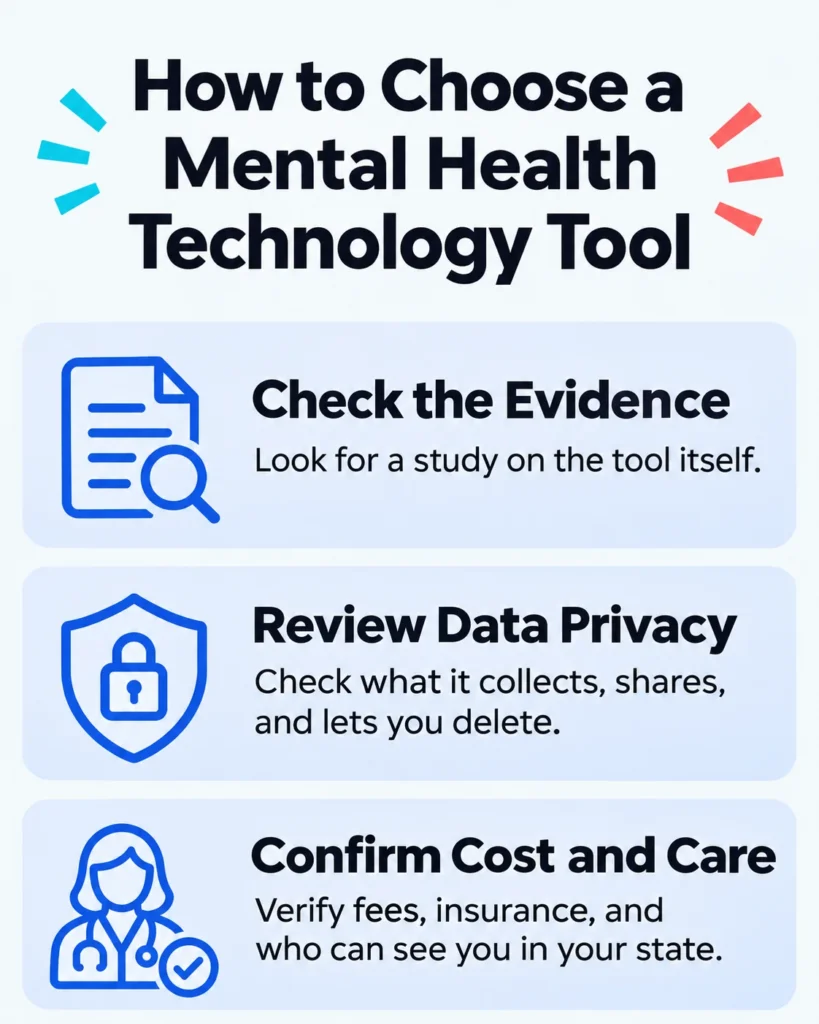
How to Choose a Mental Health Technology Tool
Check the evidence for the exact product
Look for a published study that names the tool. Check who took part, what the researchers measured, and how long they followed people. If an app says it uses CBT, ask whether a study evaluated that app for your intended use. Research on CBT as a therapy and research on a specific CBT app answer different questions.
Read the privacy policy before sharing personal details
Find out what the tool collects, who can see it, and how to delete it. Look for plain answers about chat logs, mood entries, advertising, and sharing with other companies. In the U.S., whether federal HIPAA protections apply depends in part on who provides the app and their role. A consumer app you download yourself may fall outside HIPAA. The Federal Trade Commission’s Better Help case shows why it is worth checking how a service handles sensitive information.
Confirm the cost and who provides care
Before booking online therapy, ask whether the clinician can see you while you are physically in your state. Check whether the service accepts your exact insurance plan, what you will pay per visit, and how cancellations work. If the service offers messaging, ask who responds, how quickly they reply, and what happens when you need more support.
The Future of Mental Health Technology
One model to watch is blended care, where a therapist or other care provider uses a digital tool as part of regular treatment. A patient might practice an exercise at home and discuss what happened at the next visit. Research needs to show when this approach helps, who it serves, and how it fits into the work of a clinic.
Access will shape which tools people can use. Wellcome describes research adapting a chatbot for adolescent girls in rural India, including design for shared devices and weak internet connections. Those questions apply in the U.S. too. Can someone use the tool privately on a shared device? Does it work with limited data? Did people with those needs help design or test it?
Frequently Asked Questions
What are the top mental health tech companies in the UK?
Examples include Unmind for workplace mental health, Together all for online peer support, and ieso for digital CBT services. Sweden based Mindler acquired ieso Digital Health UK in 2025. If you are comparing providers, define what matters to you first, such as clinical evidence, availability, or employer coverage. Beauhurst’s UK list uses funding as its ranking measure.
What are mental health technologies?
They are digital tools and services that support wellbeing, deliver care, or help people track and manage mental health concerns. Examples include mood journals, video therapy, wearable devices, and prescription treatment software.
What are some tech companies that focus on mental health?
Headspace offers mindfulness and coaching services, Lyra Health provides mental health benefits through employers, and wysa offers AI guided wellbeing exercises. Which one is relevant depends on the kind of support you want and how you can access it.
What are some mental health tools?
Examples include mood journals, guided breathing exercises, sleep logs, online therapy, and structured CBT programs. A sleep log can help you record bedtime and wake times. A therapist can help you decide whether that information matters for your care.
What new technologies are being used in mental health treatment?
Examples include prescription software, virtual reality therapy, and apps used between sessions. Researchers are also studying generative AI chatbots. Availability depends on the specific tool, where you live, and whether you need a prescription or a clinician referral.
What are some health technologies?
Health technologies include patient portals, telehealth platforms, wearable sensors, and software that delivers treatment. Mental health technology is one part of this field. A patient portal can let you send a message to your care team, while telehealth can let you attend an appointment from home.
Before You Download or Pay
Write down the one thing you want the tool to help you do. Then check who it was built for, whether the evidence supports that use, what happens to your data, and how you can reach a person if you need help. Those answers give you a practical way to compare products before you share sensitive information or commit to a plan.


