

Best Technology ETFs & Technology Funds Guide
Technology funds let investors own groups of companies tied to software, semiconductors, hardware, cybersecurity, artificial intelligence, cloud services, and other parts of the technology market.
For U.S. investors, the harder question is choosing a fund that provides the right exposure without adding more cost or concentration than expected.
Our 2026 review looks at fund cost, benchmark rules, assets, liquidity, holdings, concentration, risk, and investor fit. Recent returns are useful context, but they do not decide our selections by themselves.
Fund data can change. Figures below use the latest issuer or SEC data available when this guide was updated.
Best Technology ETFs at a Glance
| Fund | Ticker | Best For | Fund Type | Expense Ratio |
| Vanguard Information Technology ETF | VGT | Broad U.S. technology | Broad sector | 0.09% |
| Technology Select Sector SPDR ETF | XLK | Large U.S. technology stocks | Sector | 0.08% |
| Fidelity MSCI Information Technology ETF | FTEC | Low cost broad exposure | Broad sector | 0.084% |
| VanEck Semiconductor ETF | SMH | Semiconductor exposure | Industry | 0.35% |
| iShares Semiconductor ETF | SOXX | Semiconductor diversification | Industry | 0.33% |
| Global X Artificial Intelligence & Technology ETF | AIQ | Artificial intelligence | Thematic | 0.68% |
| First Trust Nasdaq Cybersecurity ETF | CIBR | Cybersecurity | Thematic | 0.58% |
| iShares Expanded Tech Software Sector ETF | IGV | Software | Industry | 0.38% |
| iShares Global Tech ETF | IXN | Global technology | Global sector | 0.37% |
Vanguard reported a 0.09% expense ratio, 319 holdings as of July 31, 2026, and $170.2 billion in total net assets as of August 31, 2026, for the portfolio associated with VGT. Nvidia, Apple, and Microsoft were its three largest holdings.
State Street lists XLK with a 0.08% gross expense ratio. The fund tracks the Technology Select Sector Index, which represents the technology portion of the S&P 500.
FTEC’s SEC prospectus lists annual operating expenses of 0.084% and states that the fund seeks to track the MSCI USA IMI Information Technology 25/50 Index.
There is no single best technology ETF for every investor. A broad sector fund and an artificial intelligence fund may both own technology companies, but they serve different purposes.
What Is a Technology ETF?
A technology ETF is an exchange-traded fund that owns shares of technology related companies according to a stated index or investment strategy.
Instead of choosing individual stocks such as Nvidia, Apple, Microsoft, or Broadcom, an investor can buy one fund that holds many companies.
Broad funds may invest across:
- Semiconductors
- Software
- Computer hardware
- Information technology services
- Communications equipment
- Electronic components
Narrow funds may focus on only one area, such as chips, cybersecurity, or software.
What Is an Information Technology ETF?
An information technology ETF normally follows an index that uses a formal sector classification.
VGT is one example. Vanguard says its benchmark covers U.S. information technology companies across software and services, hardware and equipment, and semiconductors.
What Is a Technology Sector ETF?
A technology sector ETF invests mainly in businesses classified within the technology sector.
XLK is a clear example. Its benchmark includes technology hardware, software, communications equipment, semiconductors, IT services, and electronic equipment companies from the S&P 500.
ETF Technology Exposure Can Vary by Index
ETF technology exposure is not identical across funds.
A company that consumers think of as a technology business may belong to another formal stock market sector. Nasdaq 100 funds also include companies outside the information technology sector.
This is why checking the benchmark and holdings matters more than relying on a fund’s name.
What Counts as Technology?
Index providers use classification rules to decide which companies qualify.
A pure information technology index may hold Apple and Microsoft while leaving out some companies commonly described as technology stocks.
Before investing, check:
- The benchmark
- The largest holdings
- Industry weights
- Geographic exposure
- Portfolio concentration
These details explain what you are actually buying.
How We Selected the Best Technology ETFs
Our selections focus on practical factors that can affect long-term ownership.
Cost
Expense ratios reduce an investor’s return.
A 0.08% expense ratio equals about $8 a year for each $10,000 invested before other costs. A 0.68% ratio equals about $68.
Cost matters, but the lowest fee does not automatically make a fund the better choice.
Liquidity and Fund Size
Assets under management, trading activity, and the bid-ask spread can affect how easy and costly a fund is to trade.
Large, actively traded ETFs often have narrow spreads, although investors should check current market conditions before placing an order.
Diversification and Concentration
A high number of holdings does not always mean an evenly spread portfolio.
VGT had 319 holdings as of July 31, 2026, yet Nvidia, Apple, and Microsoft together represented about 44% of the portfolio.
That makes top holding concentration an important metric.
Benchmark Rules
Two broad technology ETFs can deliver different results because their indexes include different companies or assign different weights.
We favor strategies whose rules and holdings match the exposure investors are likely to expect.
Risk and Investor Fit
Sector and thematic funds can move more sharply than broad market funds.
A fund focused on semiconductors may be suitable for someone deliberately seeking chip exposure, but it is not a substitute for a broad stock portfolio.
Technology ETF List by Investment Focus
This technology ETF list groups funds by the job they may perform.
| Investment Focus | Funds Worth Comparing |
| Broad U.S. technology | VGT, XLK, FTEC, IYW |
| Semiconductors | SMH, SOXX |
| Artificial intelligence | AIQ |
| Cybersecurity | CIBR |
| Software | IGV |
| Global technology | IXN |
| Nasdaq 100 exposure | QQQ, QQQM |
The categories matter because a semiconductor ETF and a broad technology ETF should not be judged by the same standard.
Best Technology ETF for Broad Exposure
Vanguard Information Technology ETF
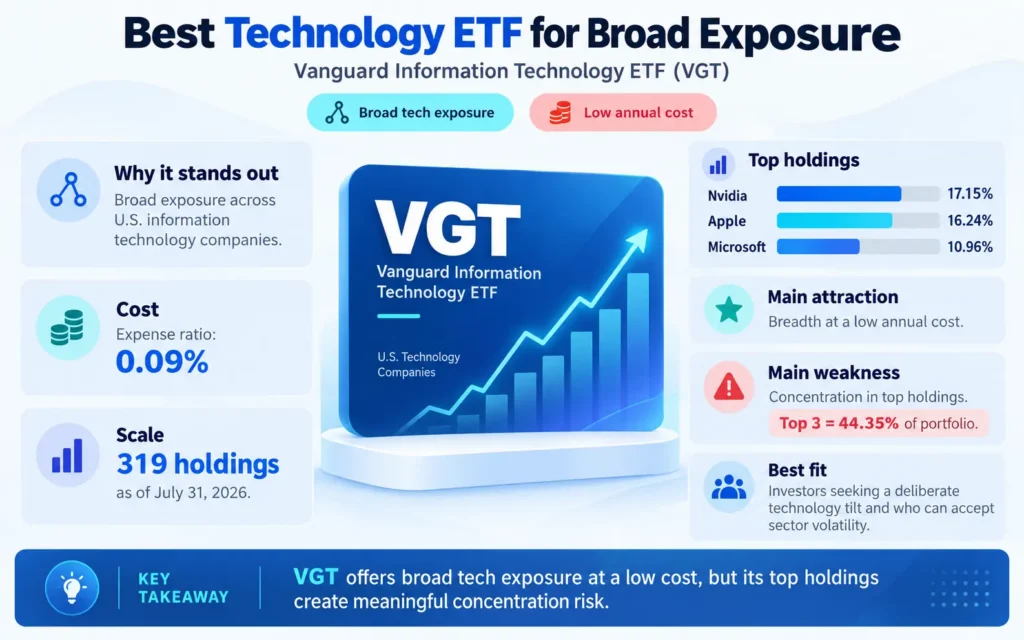
VGT is our leading broad technology choice for investors who want exposure across large, midsize, and smaller U.S. information technology companies.
The fund’s expense ratio was 0.09%, and Vanguard reported 319 holdings as of July 31, 2026. Its largest positions were Nvidia at 17.15%, Apple at 16.24%, and Microsoft at 10.96%.
The main attraction is breadth at a low annual cost.
The main weakness is concentration. More than four out of every ten portfolio dollars were tied to those three companies at the cited date.
VGT may fit an investor who wants a deliberate information technology tilt and can accept sector volatility.
Best Low Cost Technology ETF
Technology Select Sector SPDR ETF
XLK is a strong choice for investors seeking large U.S. technology companies at a very low expense ratio.
State Street reported a 0.08% gross expense ratio and about $127.8 billion in assets as of September 25, 2026.
Its benchmark only draws from technology companies in the S&P 500. This makes XLK more focused on established large companies than funds that include smaller technology stocks.
An investor who already owns an S&P 500 fund should remember that adding XLK increases exposure to companies already present in the broader index.
FTEC: Another Low-Cost Technology ETF
Fidelity MSCI Information Technology Index ETF is another low-cost option for broad U.S. technology exposure.
Its SEC prospectus lists a 0.084% annual operating expense ratio. FTEC seeks to follow the MSCI USA IMI Information Technology 25/50 Index.
The fee difference among FTEC, VGT, and XLK is small. Benchmark construction, holdings, and concentration may matter more when choosing among them.
Best Semiconductor ETFs
Semiconductor funds focus on chip designers, manufacturers, and related equipment companies.
They can benefit from spending on artificial intelligence infrastructure, data centers, electronics, vehicles, and industrial computing. They can also move sharply when the chip cycle turns.
VanEck Semiconductor ETF
SMH tracks companies involved in semiconductor production and equipment.
VanEck reported a 0.35% expense ratio and $77.81 billion in total net assets as of October 2, 2026.
SMH is a focused industry investment rather than a broad technology portfolio.
iShares Semiconductor ETF
SOXX is another major semiconductor fund.
iShares lists a 0.33% expense ratio. The fund tracks U.S. listed semiconductor companies across the chip value chain.
Investors comparing SMH and SOXX should review current holdings and company weights because their index rules differ.
Best AI Technology ETF
Global X Artificial Intelligence and Technology ETF
AIQ targets companies connected to artificial intelligence and supporting technologies.
Global X reported a 0.68% expense ratio and roughly $10.0 billion in net assets as of September 10, 2026. Information technology accounted for about 72.1% of the portfolio at the end of August, with communication services, consumer discretionary, industrial, and other companies also represented.
That mix shows why an AI fund is not necessarily a pure technology sector ETF.
AIQ may appeal to an investor seeking an AI theme, but it charges more than broad index options and carries theme-specific risk.
Best Cybersecurity ETF
First Trust Nasdaq Cybersecurity ETF
CIBR invests in companies involved in cybersecurity.
First Trust reported a 0.58% total expense ratio, about $16.39 billion in net assets, and 45 holdings on September 18, 2026. Its largest positions included CrowdStrike, Fortinet, Cisco, Broadcom, and Palo Alto Networks.
Cybersecurity has its own demand drivers, but CIBR is still a focused portfolio rather than a complete technology allocation.
Best Software ETF
iShares Expanded Tech Software Sector ETF
IGV focuses on North American software companies along with selected interactive media and services firms.
iShares lists a 0.38% expense ratio. The fund had 106 holdings as of September 24, 2026.
IGV gives investors a more direct software allocation without the same semiconductor exposure found in many broad technology funds.
Best Global Technology ETF
iShares Global Tech ETF
IXN adds technology businesses outside the United States.
The fund tracks a global technology index and charges 0.37%. iShares reported about $9.79 billion in net assets as of September 25, 2026.
Global exposure can reduce dependence on U.S. companies, but it also introduces country and currency risks.
Technology Funds Beyond ETFs
A technology fund does not have to be an ETF. Mutual funds remain another option.
Vanguard Information Technology Index Fund
VITAX provides index-based technology exposure through a mutual fund structure.
Vanguard reported 319 stocks in the portfolio as of July 31, 2026. Its largest positions mirrored the portfolio behind VGT, including Nvidia, Apple, and Microsoft.
Investors comparing Vanguard technology ETFs and index funds should look at trading structure, account preferences, investment minimums, and availability before choosing between ETF and mutual fund shares.
Fidelity Select Technology Portfolio
FSPTX is an actively managed technology mutual fund.
Fidelity listed a 0.61% gross and net expense ratio as of April 29, 2026. The fund held 113 securities as of July 31, and its top ten positions represented 66.39% of the portfolio.
The fund seeks capital appreciation and normally invests at least 80% of its assets in businesses tied to technological advances.
Investors comparing broader technology investment funds may also want to understand how mutual funds differ from private equity and venture capital, which use very different structures and risk profiles.
VGT vs XLK vs FTEC
All three provide U.S. information technology exposure, but they are not identical.
VGT offers broad coverage across market sizes and charges 0.09%.
XLK charges 0.08% and limits its universe to technology companies inside the S&P 500.
FTEC charges 0.084% and tracks an MSCI information technology benchmark.
For most investors comparing these funds, a tiny fee difference should not be the only deciding factor.
Look at which companies each index can own, how much weight sits in the largest holdings, and how much overlap exists with investments you already hold.
Is QQQ a Technology ETF?
Not in the strict sector sense.
QQQ and QQQM track the Nasdaq 100 Index, which is not an information technology sector index. It includes large Nasdaq-listed nonfinancial companies from several sectors.
Invesco currently lists QQQ with a 0.18% total expense ratio and QQQM with a 0.15% ratio. Both track the Nasdaq 100.
Investors who want pure information technology exposure may find VGT, XLK, or FTEC closer to that goal. Investors who specifically want the Nasdaq 100 may prefer QQQ or QQQM.
Technology ETF Overlap Matters
Buying several ETFs does not always increase diversification.
An investor who owns an S&P 500 fund, QQQM, and VGT may have repeated exposure to major companies such as Nvidia, Apple, Microsoft, and Broadcom.
That may be intentional if the goal is to overweight technology.
The problem comes when an investor assumes that owning more fund tickers automatically means owning a more balanced portfolio.
Compare the largest holdings and their weights before adding another fund.
Benefits and Risks of Technology ETFs
A technology ETF lets investors own many companies through one security. Broad funds can spread exposure across software, semiconductors, hardware, and other technology industries.
ETFs also make benchmarks and holdings relatively easy to inspect.
The risks are just as important.
Technology companies can be volatile. High valuations may fall when earnings expectations change. Semiconductor businesses move through industry cycles. Software companies face product changes and competition. Thematic AI or cybersecurity portfolios can be more concentrated than broad sector funds.
Even a broad fund may depend heavily on a small number of mega cap stocks.
Common Mistakes When Buying Tech ETFs
Chasing Recent Returns
The strongest fund over the last year may not lead over the next five.
Review longer periods, drawdowns, holdings, fees, and risk rather than choosing solely from a performance table.
Ignoring Portfolio Overlap
Check how much technology exposure already exists in your S&P 500, total market, or Nasdaq funds.
Choosing by Fund Name
Read the benchmark and holdings. A fund with AI in its name may hold companies from several sectors.
Treating a Sector Fund as a Full Portfolio
Technology funds can be useful portfolio components, but a single sector is not a complete diversification plan for every investor.
How to Choose a Technology ETF
Use this checklist before comparing recent returns:
- Decide whether you want broad or thematic exposure.
- Check the index the fund follows.
- Compare expense ratios.
- Review its largest holdings.
- Check top ten concentration.
- Review assets and trading liquidity.
- Compare long-term returns and drawdowns.
- Check overlap with your current portfolio.
- Decide whether the fund fits your risk tolerance.
- Confirm current figures on the issuer’s website.
A fund should solve a clear portfolio need rather than simply add another ticker.
Do You Need a Tech ETF With an S&P 500 Fund?
Maybe not.
Major S&P 500 funds already hold many of America’s largest technology companies. Adding a technology ETF increases the weight of those businesses rather than creating completely new exposure.
That may suit investors who deliberately want a stronger technology allocation.
Someone seeking broader diversification may instead consider other sectors, international stocks, smaller companies, bonds, or alternative technology investments and market trends before adding another technology sector position.
Are Technology ETFs Worth It in 2026?
Technology ETFs can make sense for investors who want extra exposure to the sector and understand the risk.
Broad funds such as VGT, XLK, and FTEC offer low-cost access to established technology companies.
SMH and SOXX provide focused semiconductor exposure. AIQ targets artificial intelligence. CIBR focuses on cybersecurity, while IGV targets software.
The narrower the fund, the more important its holdings, fee, and concentration become.
The reason to own a technology ETF should be that it fits a planned investment strategy, not simply that technology recently performed well.
Frequently Asked Questions
What are the top 5 technology ETFs?
VGT, XLK, FTEC, IYW, and IGM are established technology ETFs worth comparing for broad or expanded sector exposure. Their fees, index rules, holdings, and concentration differ, so they should not be treated as interchangeable.
What are 3 ETFs I can buy and hold forever?
No ETF is guaranteed to be suitable forever. Long-term investors often use broad, low-cost market index funds as core holdings because they cover many companies and sectors. A technology ETF is more concentrated and is usually better evaluated as a sector allocation rather than an entire portfolio.
What is the best performing technology fund?
The answer depends on the period measured. For example, Fidelity reported a one-year return of 50.08% for FSPTX through August 31, 2026. Its five-year annualized return was 19.25%.
Past performance does not tell investors which fund will lead next.
What are the best ETFs to invest in U.S. tech stocks?
VGT, XLK, and FTEC are useful starting points for broad U.S. technology exposure. Investors should compare their benchmarks, fees, holdings, and overlap with existing funds before choosing.
What are the best tech ETFs to buy in 2026?
VGT, XLK, and FTEC stand out for broad exposure. SMH and SOXX focus on semiconductors. AIQ targets artificial intelligence, CIBR targets cybersecurity, and IGV focuses on software. The best choice depends on the exposure an investor wants.
Is there a better tech ETF than QQQ?
There can be, depending on the goal. QQQ tracks the Nasdaq 100 rather than a pure information technology index. VGT, XLK, or FTEC may fit an investor seeking direct sector exposure. QQQ or QQQM may fit someone who specifically wants Nasdaq 100 exposure.
Which ETF is best for science and technology?
There is no single standard science and technology ETF category. Information technology funds cover areas such as semiconductors and software, while biotechnology and life sciences often fall under health care. Investors should first define which industries they want.
What is Warren Buffett’s favorite ETF?
Warren Buffett is widely associated with recommending a low-cost S&P 500 index fund for many long-term investors rather than a particular technology ETF. That is different from endorsing a specific technology sector fund.
What is a good tech fund to invest in?
A good technology fund should match the investor’s goal and existing portfolio. VGT, XLK, and FTEC are worth comparing for broad exposure. SMH, SOXX, AIQ, CIBR, and IGV are narrower choices for specific industries or themes.
Which Technology ETF Is Best for You?
VGT is a strong option for broad information technology exposure because it combines low costs with hundreds of holdings.
XLK may appeal to investors who prefer large S&P 500 technology companies and an especially low expense ratio.
FTEC is another low-cost broad sector choice.
Investors who deliberately want narrower exposure can look at funds such as SMH, SOXX, AIQ, CIBR, or IGV, but those portfolios carry more focused risks.
Before choosing any fund, check what you already own. Many broad U.S. stock funds already have large technology positions.
Compare cost, benchmark rules, holdings, concentration, risk, and portfolio fit before recent performance.
Past performance does not guarantee future results. This guide provides general educational information and is not personal investment, tax, or financial advice.
Sources and Data Method
Fund data in this guide was checked against issuer pages and SEC materials available in 2026.
Primary sources include Vanguard for VGT and VITAX, State Street for XLK, the SEC for FTEC, VanEck for SMH, BlackRock iShares for SOXX, IGV, and IXN, Global X for AIQ, First Trust for CIBR, Fidelity for FSPTX, and Invesco for QQQ and QQQM.
Expense ratios, holdings, assets, and performance figures can change. Readers should check the latest prospectus and issuer data before making an investment decision.


